Caracas dispatch: Brits sceptical of US efforts to capture Nicolás Maduro
Most Britons who have an opinion disapprove of Washington’s actions; party lines diverge sharply.

I f the “Special Relationship” were a marriage, the current mood in Britain suggests the partners are sleeping in separate rooms.
Following the United States’ pre-dawn extraction of Venezuelan President Nicolás Maduro, an operation the White House brands a judicial triumph and critics label a “gangster” abduction, the British public has delivered a resounding verdict: we are not amused.
A YouGov survey of 4,667 adults, conducted on 5 January 2026, reveals a nation deeply uneasy with the muscular unilateralism radiating from Washington. While Downing Street walks a diplomatic tightrope, muttering about “international law” without raising its voice, the electorate has few such reservations.
The Verdict: A Sceptical Majority
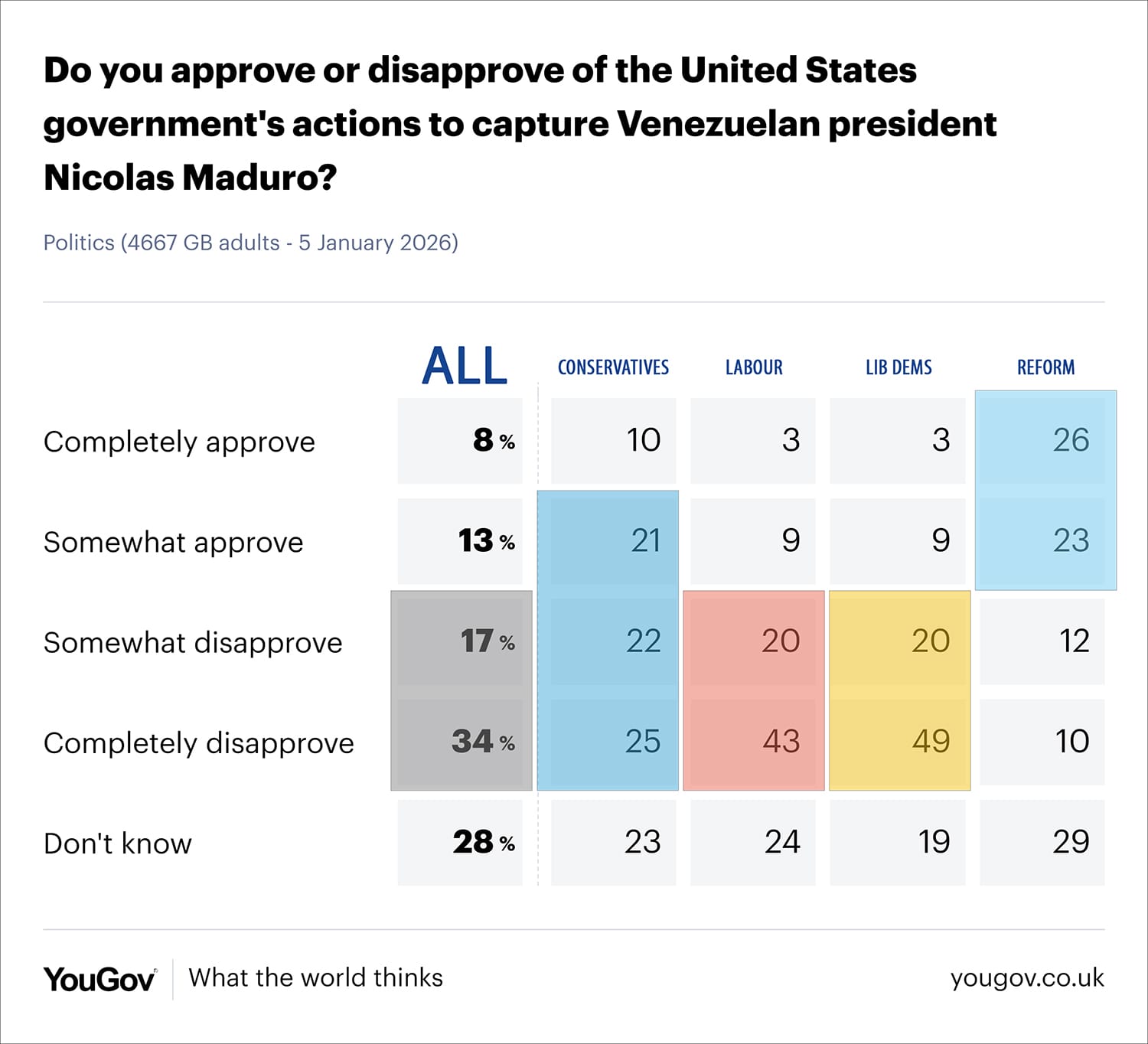
The headline figures are stark. A clear majority of Britons (51%) disapprove of the US operation, with a third (34%) registering “complete” disapproval. By contrast, support for the action is a minority pursuit, mustering just 21% approval.
Perhaps most telling is the 28% of the populace who answered “Don’t know.” In an era of hyper-partisan hot takes, nearly three in ten Britons remain baffled by the geopolitics of the Caribbean, or perhaps simply indifferent to another episode of regime change.
Data Insight: For every Briton who “completely approves” of the capture (8%), more than four “completely disapprove” (34%).
Tribal Warfare: The Partisan Split
Beneath the national scepticism lies a fractured political landscape. The survey exposes a chasm between the populist right and the rest of the spectrum, turning foreign policy into yet another front in the culture wars.
- Reform UK (49%) – Cheerleaders. The only group where a plurality backs the US raid, viewing it as decisive action against a socialist pariah.
- Conservatives (31%) – Conflicted. A significant minority backs the US, but nearly half are uncomfortable with the methodology.
- Labour (12%) – Hostile. The government’s base is overwhelmingly opposed, creating a headache for Sir Keir Starmer.
- Liberal Democrats (12%) – Critical. The most fervently opposed bloc views the extraction as a violation of international norms.
The Reform Anomaly – Reform UK voters stand alone on this issue. With 26% offering “complete approval” (more than triple the national average), this demographic aligns far closer to the “MAGA” doctrine than to traditional British foreign policy conservatism. For them, the projection of power trumps the niceties of sovereignty.
The Centre-Left Consensus – For Labour and the Liberal Democrats, the disapproval is not just technical; it is visceral. With 43% of Labour voters and 49% of Lib Dems “completely disapproving,” the base is signalling that they view the US administration not as a global policeman, but as a rogue actor.
Starmer’s Silence and the Diplomatic Bind
These numbers present a tactical nightmare for Prime Minister Keir Starmer. Elected in 2024 on a platform of stability and “reconnecting” Britain, he now finds himself squeezed between a belligerent US President and a domestic audience that recoils from American interventionism.
While 32% of the public believe the UK government should have explicitly condemned the US action, Starmer has opted for a cautious “neither praise nor condemn” strategy, a stance supported by 34% of voters. It is a classic hedge: trying to preserve the Atlantic alliance without alienating a European continent that views the raid as a dangerous precedent.
However, the silence carries a cost. With child poverty and youth unemployment dominating the domestic agenda, the Labour government can ill afford to look weak on the world stage. The risk is that by saying nothing, Downing Street looks less like a partner and more like a vassal.
The Bottom Line
The Maduro extraction has stripped away the veneer of alignment between the British public and American foreign policy. We are no longer in the era of Blair and Bush, standing shoulder-to-shoulder. In 2026, Britain watches the US not with admiration, but with a mixture of confusion and alarm.

GOING FURTHER
America kidnapped a president. Keir Starmer said nothing | THE NEW STATESMAN
We just witnessed power kidnapping the law | AL JAZEERA
Delcy Rodriguez sworn in as Venezuela’s president after Maduro abduction | AL JAZEERA
Trump's seizure of Maduro raises thorny legal questions, in US and abroad | BBC NEWS
BBC 'bans' journalists from saying US 'kidnapped' Venezuela's Maduro | THE NATIONAL
Sources:
▪ This piece was first published in Europeans TODAY on 5 January 2026.
▪ Cover: Flickr/The White House. (Licensed under a Creative Commons Attribution-ShareAlike 4.0 International License.)