Hantavirus on the MV Hondius: What the cruise outbreak reveals about rare-virus risk at sea
WHO says the public risk is low, but three deaths linked to the MV Hondius have triggered a multinational investigation into whether passengers were exposed to infected rodents, or whether rare close-contact transmission occurred.

What you need to know
🔹 Seven cases identified among 147 people aboard MV Hondius
🔹 Three deaths reported; one patient critically ill
🔹 Exposure source and virus species remain unresolved
🔹 WHO assesses wider public risk as low
A rare and deadly cluster aboard a Dutch expedition ship has triggered an international health response.
World Health Organization (WHO) says the wider public risk is low, but key questions about exposure and possible close-contact transmission remain unresolved. The deaths linked to the MV Hondius are not a reason for public panic. They are a reason to take rare infections, remote travel, and cross-border public health coordination seriously.
The Dutch-flagged expedition cruise ship became the focus of an international health response after a cluster of severe respiratory illness was reported to WHO on 2 May. By 4 May, WHO said seven cases had been identified among the 147 people on board: two laboratory-confirmed hantavirus infections, five suspected cases, three deaths, one critically ill patient and three people with mild symptoms. The vessel had left Ushuaia, Argentina, on 1 April and travelled through remote South Atlantic locations before mooring off Cabo Verde.
The central uncertainty is how the infections began. Hantavirus is usually acquired from infected rodents, especially through contact with urine, faeces or saliva, or by touching contaminated surfaces. WHO says the extent of passengers’ contact with wildlife during the voyage, or before boarding in Ushuaia, remains undetermined. That matters because the ship’s route included remote and ecologically varied stops, including mainland Antarctica, South Georgia, Nightingale Island, Tristan da Cunha, Saint Helena and Ascension Island.
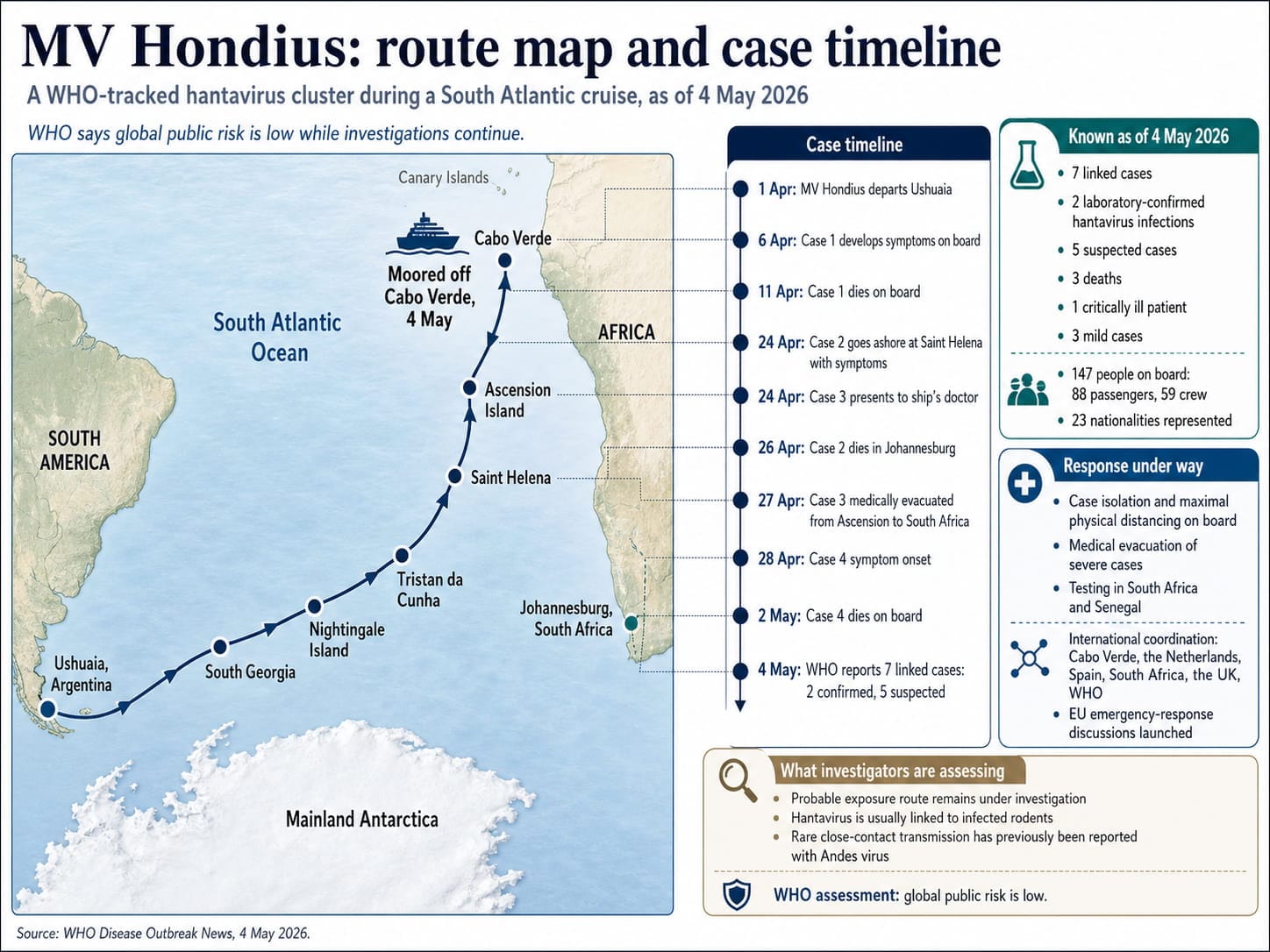
The most sensitive question is whether there was human-to-human transmission on board. WHO has not said that this is proven. It has said that limited human-to-human transmission has previously been reported in outbreaks of Andes virus, a South American hantavirus, usually involving close and prolonged contact. That distinction is essential. “Possible” is not the same as “confirmed”, and close-contact transmission is not the same as an easily spreading respiratory virus.
The evidence so far points to a serious but contained event. WHO currently assesses the risk to the global population as low. That assessment sits beside a severe clinical reality for those affected: illness onset was reported between 6 and 28 April, with symptoms including fever, gastrointestinal problems, rapid progression to pneumonia, acute respiratory distress syndrome and shock.
The timeline shows why investigators are cautious. According to WHO, the first case developed fever, headache and mild diarrhoea on 6 April and died on board on 11 April. A close contact later went ashore at Saint Helena with gastrointestinal symptoms, deteriorated during travel to Johannesburg and died on 26 April. PCR later confirmed that case as hantavirus infection. Another adult male became ill on 24 April, worsened two days later and was medically evacuated from Ascension to South Africa, where PCR testing confirmed hantavirus infection on 2 May. Serology, sequencing and metagenomic work are still ongoing.
This is why the MV Hondius outbreak is not just a cruise story. It is a test of international public health coordination when a medical emergency unfolds on a moving vessel with people from many countries, far from large medical centres. WHO says Cabo Verde, the Netherlands, Spain, South Africa, and the United Kingdom have been involved in coordinated response measures through International Health Regulations channels. Argentina has shared passenger and crew lists by nationality, while WHO has supported laboratory testing, sample collection, and information exchange.
Two crew members, one British and one Dutch, were being prepared for medical evacuation to the Netherlands after developing respiratory symptoms. Spanish authorities have said the MV Hondius is expected to arrive in the Canary Islands within days, where medical teams will examine and treat passengers and crew before any onward arrangements are made. WHO official Dr Maria Van Kerkhove said there were no additional symptomatic people on board at that stage, but passengers had been asked to remain in their cabins while disinfection and other public health measures continued.
The operator, Oceanwide Expeditions, has described the situation as serious. In its public updates, the company said it was working with WHO, Dutch authorities, Cabo Verdean authorities, RIVM, embassies, and the Dutch Ministry of Foreign Affairs. That coordination matters because expedition cruising is built around access to remote places. When serious disease appears, the same remoteness that makes such voyages attractive can make diagnosis, evacuation and public reassurance far harder.
For passengers and crew, the response is necessarily strict. WHO says measures include case isolation and care, medical evacuation, laboratory investigations, physical distancing, cabin confinement where possible, ship sanitation and active symptom monitoring for 45 days. It also advises frequent hand hygiene, ventilation, avoidance of dry sweeping and prompt reporting of symptoms.
For the wider public, the message is different: vigilance, not fear. Hantavirus infections are uncommon globally. WHO says symptoms of hantavirus pulmonary syndrome typically occur two to four weeks after exposure, but may appear as early as one week and as late as eight weeks. There is no approved specific antiviral treatment for hantavirus cardiopulmonary syndrome, so early recognition, ICU-level supportive care, respiratory support and careful clinical management are critical.
The public health value of this case lies in refusing two easy mistakes. One is to minimise it because most people are not at risk. Three people have died, others have been seriously ill, and those still aboard need careful medical assessment. The other mistake is to inflate it into a general threat to travellers or Europe. WHO’s current assessment does not support that.
The facts still missing are the most important ones: the exact virus species, the source of exposure, whether any transmission occurred between people, and whether additional cases emerge during monitoring. Until those answers are available, responsible reporting should hold the line between seriousness and speculation.
The MV Hondius outbreak shows that rare diseases do not need to become widespread to demand competent public action. They require fast laboratories, honest communication, humane evacuation decisions, and international coordination that works before panic fills the gaps.

GOING FURTHER
Hantavirus outbreak toolbox | World Health Organization
Operational Update: Medical Situation Aboard m/v Hondius | Oceanwide Expeditions
MV Hondius: the ice-breaking expedition cruise hit with hantavirus cases | The Guardian
Cruise ship virus latest: medics on board after deadly outbreak | Sky News
Clinician Brief: Hantavirus Pulmonary Syndrome | CDC
Hantavirus infection | ECDC
Hantavirus in the Americas: guidelines for prevention, diagnosis, treatment, and control | PAHO
Sources:
▪ This piece was first published in Europeans TODAY on 6 May 2026.
▪ Cover: Dreamstime/Zhukovsky.