Starmer under pressure after Labour’s election losses expose a fragmented Britain
Labour’s setbacks in England, Wales and Scotland have triggered a crisis of confidence around Keir Starmer’s leadership, while revealing a deeper political fragmentation that no major party yet appears able to contain.

Keir Starmer entered the weekend trying to contain Labour’s election losses. He ends it facing a possible succession crisis, with Monday 11 May emerging as a potential next test of whether pressure inside the party stays noisy or starts to turn into action.
What has changed is not simply that Labour performed badly, but that the political meaning of those losses has shifted. By Saturday, doubts about Starmer were no longer confined to grumbling in private. The Guardian reported that backbench Labour MPs were urging him to set out a timetable for his departure. At the same time, former minister Catherine West said that if no cabinet minister moved by Monday, she would act herself to try to break the impasse.
That does not yet amount to a formal challenge. But it does amount to something more dangerous than a bad set of headlines. Starmer is now dealing with live succession pressure, and with the prospect that the start of the new week could turn internal agitation into something more organised.
The damage from Thursday’s elections was broad enough to make that risk real. The Labour Party lost heavily in England, shedding support to Reform UK and the Greens, lost power in Wales for the first time since devolution, and failed to make the breakthrough it wanted in Scotland.
Labour did not lose in one direction only. It lost voters to the right, to the centre, to the left, and to nationalist opponents, thus exposing a strain across the coalition that the PM needs to hold together.
Starmer’s answer has been to resist the idea that one ideological pivot can solve the problem. In an article for the Guardian on 8 May, he wrote that the results did not mean “tacking right or left”. Instead, he argued that Labour had to listen to voters’ frustrations and respond with a programme broad enough to speak across political divides.
That is a defensible position, but it is not the same thing as a secure one. Once colleagues begin talking openly about succession, the issue is no longer only what strategic correction is needed. It becomes whether the leader still has enough authority to impose any correction at all.
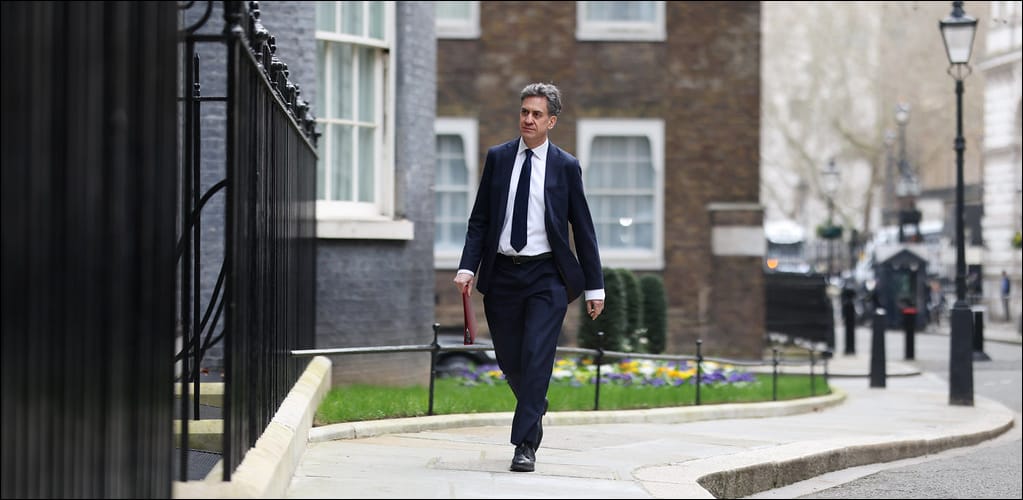
The names now surfacing are significant mainly for that reason. MPs are discussing Ed Miliband (Secretary of State for Energy Security and Net Zero) on Labour’s left, while Andy Burnham continues to attract support elsewhere in the party. The deeper point is not that either man is on the brink of moving. It is that succession talk has moved into public view.
Monday may be more than another difficult news cycle for the PM. It might be the next measure of whether Keir Starmer can still steady Labour after a heavy electoral defeat, or whether the losses have already become something more corrosive: a test of whether he still commands his own party.

GOING FURTHER
These election results don’t mean tacking left or right, but delivering for the whole country | THE GUARDIAN
MPs from Labour’s left to urge Ed Miliband to consider leadership bid | THE GUARDIAN
2026 elections mapped: how Labour lost ground in different directions | THE GUARDIAN
What to know about British elections that hammered Starmer's Labour Party | AP
Starmer says he won't quit after local elections deliver losses for Labour and wins for Reform UK | AP
Sources:
▪ This piece was first published in Europeans TODAY on 10 May 2026.
▪ Cover: Flickr/Number 10. (Licensed under a Creative Commons Attribution-ShareAlike 4.0 International License.)