📊 Westminster Voting Intention
Our latest charts displaying the voting intention percentages for the next general election in the UK. This week, the Reform Party leads, Labour stagnates, and the Greens fall; coalition uncertainty and debates over electoral reform reshape UK politics.

The following charts display the voting intention percentages for the next general election in the UK (expected to take place in 2029). The charts are updated regularly.
Analysis
Reform UK holds firm
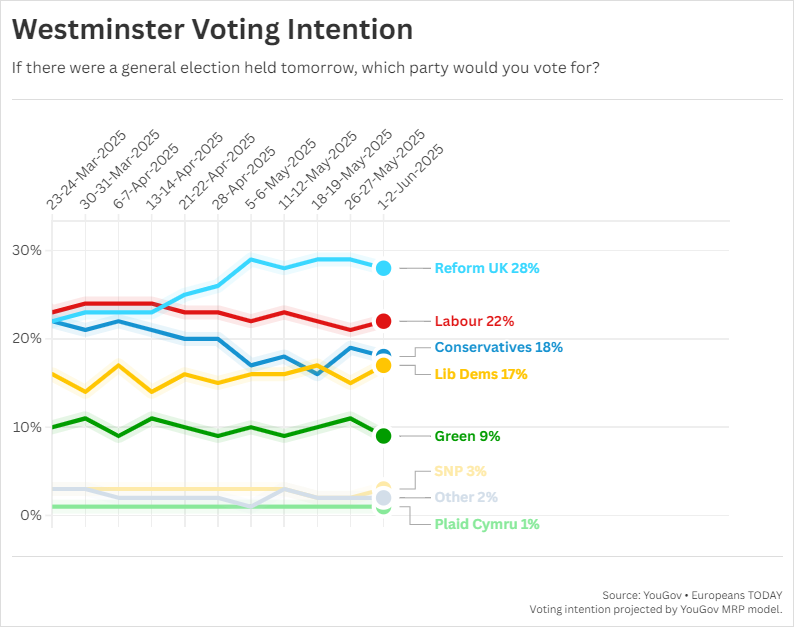
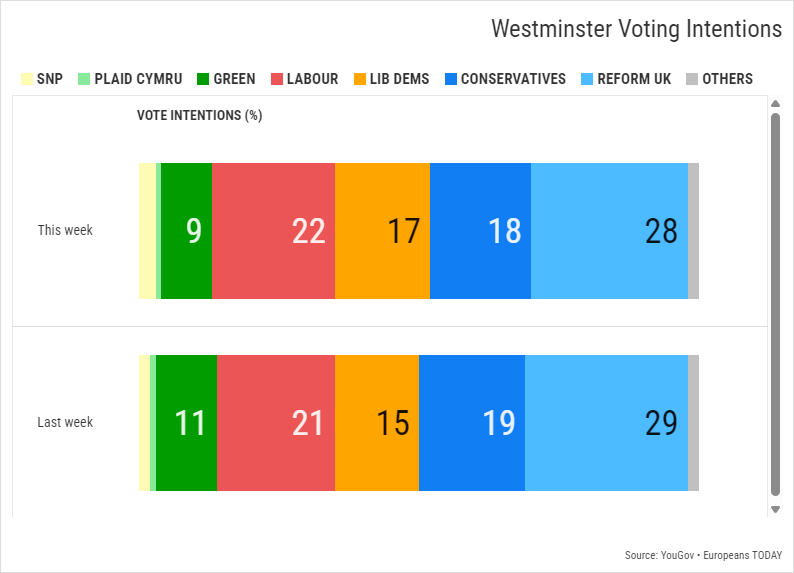
Reform UK remains consistently strong at 28%, sustaining its position as the UK’s leading political force. While marginally down by 1 point, this performance underscores ongoing public dissatisfaction with the political status quo and persistent momentum for populist alternatives.
Labour stabilises
Labour holds steady at 22%, maintaining its core base without gaining additional ground. Despite government fatigue, the party continues to underperform in converting voter frustration into support.
Conservatives steady
The Conservative Party remains unchanged at 18%, suggesting a stabilisation after recent recovery. However, their position remains historically weak, and they continue to trail both Reform UK and Labour.
Lib Dems edge up, Greens lose ground
The Liberal Democrats gain 2 points to reach 17%, strengthening their position among centre-ground voters. The Green Party, on the other hand, drops by 2 points to 9%, halting its recent upward trend, likely due to progressive vote consolidation.
Seat projection comparisons
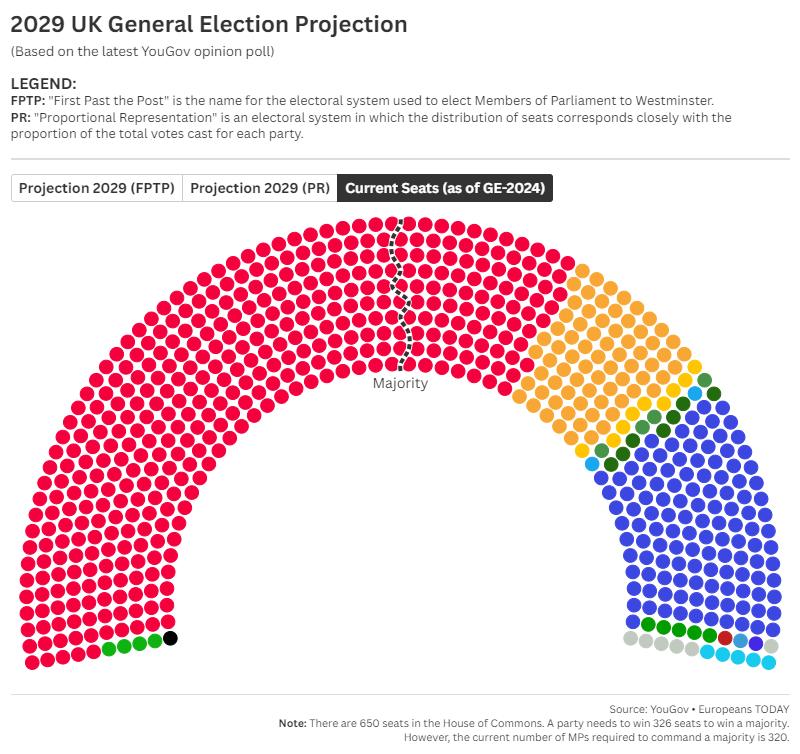
Currently: Labour holds a commanding majority. The Conservatives and Lib Dems are significantly behind, highlighting a stark contrast to current polling dynamics.
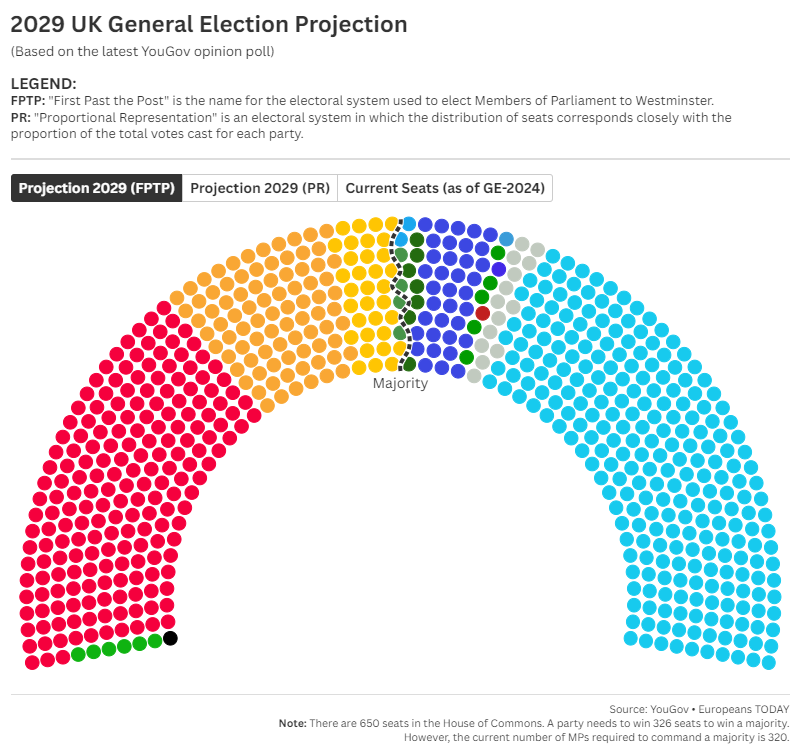
First Past the Post (FPTP): Reform’s surge dramatically alters seat distributions, creating a hung parliament scenario. Neither Reform nor Labour can achieve a stable majority independently, underscoring the profound realignment underway.
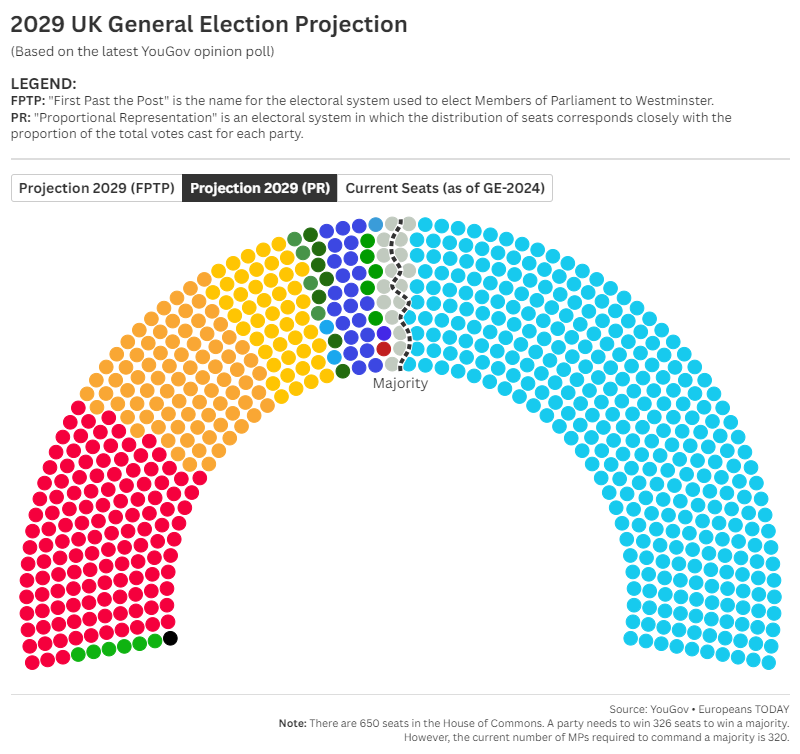
Proportional Representation (PR): Under PR, Reform dominates, vastly outperforming Labour and the Conservatives. Smaller parties, notably the Greens and Lib Dems, see more proportionate representation, amplifying their political influence.
Implications for UK politics
These projections reveal a deepening fracture within traditional UK politics. Reform’s stability suggests lasting voter sentiment for significant change, potentially reshaping party structures long-term. The Conservative Party’s mild resurgence might temporarily stabilise some internal concerns, but it remains insufficient to restore its traditional dominance. Labour’s stagnation highlights deeper challenges requiring strategic shifts.
The stark differences between electoral systems (FPTP vs. PR) underscore calls for electoral reform, which may gain momentum if voter dissatisfaction with outcomes under FPTP grows.
Coalition prospects
Right-wing coalition: Likely dominated by Reform with Conservative backing; could reshape governance fundamentally.
Left-wing coalition: Possible but challenging; Labour would need substantial cooperation from Greens, Lib Dems, and possibly SNP to form a viable administration.
Prime ministerial prospects
Based on the latest seat projections, Keir Starmer has roughly a 35% chance of becoming the next Prime Minister under the FPTP system, largely reliant on a viable centre-left coalition. Under PR, his chances rise slightly to 40% due to more proportionate representation, which bolsters potential allies like the Lib Dems and Greens.
Nigel Farage has around a 30% chance under FPTP due to strong Reform polling but limited coalition avenues. Under PR, his prospects significantly improve to approximately 45%, as Reform would hold the most seats and potentially lead a right-leaning bloc.
Kemi Badenoch faces a difficult path: under FPTP, she has about a 15% chance, with slightly better odds of 20% under PR, mostly as a junior partner in a coalition.
Ed Davey has slim direct chances, 5% under FPTP and 10% under PR, though he could be pivotal in coalition talks.

Conclusion
As the 2029 election is still some time off, the UK’s political scene remains fragmented and dynamic. Reform UK’s sustained strength challenges the traditional order, while Labour holds steady but uninspiring ground. PR continues to expose the distortion of FPTP and may gain traction as debates intensify around fair representation.