Robert Jenrick sacked by Tories and embraced by Reform – what his Newark constituency tells us about the future
Robert Jenrick’s defection to Reform has turned Newark into a test case for the British right, highlighting Conservatives’ fragility, Reform’s local breakthrough, and the risks of vote-splitting that could aid Labour.

What you need to know
🔹 Tory Robert Jenrick defected to Reform, attacking his Conservative colleagues and endorsing Nigel Farage as saviour.
🔹 Newark is now shifting from a safe Conservative seat into a competitive testing ground for Reform.
🔹 Election and by-election results show that Reform is consolidating support beyond mere protest voting.
🔹 Jenrick’s profile could legitimise Reform, but also risks splitting right-wing votes.
W ithin just a few hours of being publicly sacked from the shadow cabinet by Conservative leader Kemi Badenoch, Robert Jenrick held a press conference to announce he was joining Reform. Badenoch cited “clear, irrefutable evidence” that Jenrick had been plotting to defect to Reform in a maximally damaging way.
In his press conference, Jenrick attacked his former party, painted a bleak view of the state of Britain and declared that Nigel Farage was the only person who could save it.

Jenrick has said that he doesn’t intend to trigger a by-election, which means the people of Newark, his constituency in the English East Midlands, have lost a Conservative MP and gained a Reform one. Newark will then, come a general election, become a test of Reform’s penetration into traditional Tory shire heartlands. Here, the 2024 election results already looked like a warning light: the Conservatives held on against Labour but Reform emerged as a meaningful third force. Newark is an affluent market-town and rural seat, where traditional Tory loyalty has long dominated.
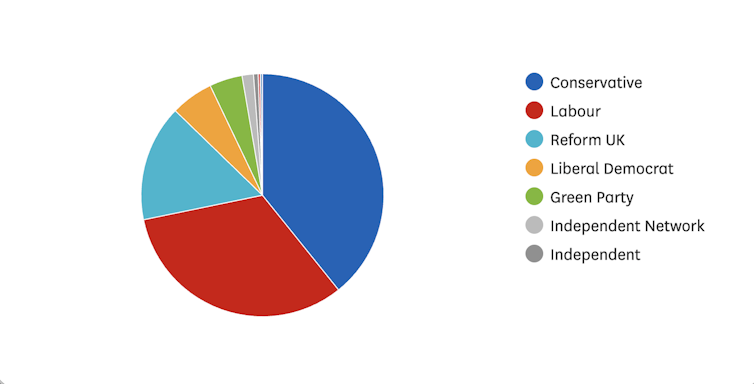
Jenrick held Newark (contested under new boundaries) quite comfortably in 2024. He won 20,968 votes, taking 38.2% of the vote share, and ending up with a majority of 3,572 over Labour, which came second with 17,396 or 32.5% of the vote. Reform had 15.5% of the vote – 8,280 votes.
Newark’s vote in 2024
In the 2025 Nottinghamshire County Council elections, Reform gained control regionally (taking 40 of 66 seats), but the Conservatives held or narrowly beat Reform in Newark-area divisions, indicating shire Tory loyalty persists against the insurgent wave.
Those 2024 general election numbers in the constituency really do matter, though. They show Newark is no longer a seat where the Conservatives can rely on a big cushion. The party held on, but it did so in a fragmented contest with nine candidates and amid a clear anti-Conservative mood nationally.
It’s also clear that Reform’s 15% is not an incidental protest vote. It is large enough to be decisive if the right splits further – or to become the base for a serious challenge if it consolidates, such as via an electoral pact, as unlikely as that currently looks.
Yet the most useful indicator of whether Reform can consolidate is what happens between general elections – in contests where party organisation and motivated voters matter.
In the Newark & Sherwood District Council by-elections in November 2025, Reform won two seats, and the details are striking. In the Castle ward, Reform’s Michelle Home won with 204 votes, narrowly ahead of the Local Conservatives on 193.
In Balderton North & Coddington, Reform’s Kay Smith won with 545 votes, beating the local Conservatives on 480.
By-elections can be weird: turnout is low, issues can be hyper-local, and parties sometimes don’t throw full resources at them. But taken together, these results suggest Reform has crossed an important threshold: it can win actual contests in areas such as these, not just rack up national vote share.
Wider local election data points the same way. In Newark & Sherwood’s 2025 results (reported at the district level), Reform’s vote share sits virtually level with the Conservatives (33.7% vs 33.6%), while Reform wins multiple seats.
The constituency profile: fertile territory
Newark has characteristics often associated with Reform’s strongest performances, including a mixed economy of market town, suburban edges and rural hinterland.
A government local data profile for Newark-on-Trent reports roughly 95.3% identifying as white. There are pockets of deprivation and education and skills gaps in the constituency, which can prove receptive to narratives about being overlooked by distant decision-makers.
It’s important to stress that none of this mechanically produces a Reform MP. It does, however, help to explain why messages about immigration, institutions and “broken politics” might resonate; and why a candidate pitching themselves as an insurgent against the status quo might find an audience.
But the crucial variable is Jenrick himself. He is not a blank slate. He has high name recognition, ministerial experience and a public profile built around “tough” issues (especially immigration and crime) that overlap with Reform’s core terrain. He has, lately, been shifting further to the right, posting provocative social media videos about immigration, ticket fare dodgers and crime.
This matters because of what might be called a permission slip effect: when a familiar, high-status politician validates a challenger party, it can give cautious voters “permission” to treat that party as credible rather than purely protest. This is why Reform has been pleased to welcome other defectors from the Conservative Party who had previously served in ministerial roles, such as former chancellor Nadhim Zahawi.
For a “Jenrick-as-Reform” candidacy to top Labour in Newark, Reform needs to add at least 17 points from elsewhere. These would almost certainly come from former Conservative voters and non-voters. Jenrick would need to pull about half of his 2024 Conservative coalition across with him. That is possible, but far from guaranteed. Some may, of course, wish to punish him.
The right vote could split in a way that hands Labour the seat even if Reform rises with Jenrick as its candidate. Newark’s 2024 margin was already tight enough for that scenario to be plausible.
Wanting “a Reform MP” is also different from wanting “Reform-ish politics”. That is the final complication: Reform has built its appeal partly on being an anti-Tory option. It remains to be seen whether voters like the convenience of a known figure as Reform candidate or reject it as recycled politics.
Either way, Newark is no longer just Jenrick’s seat. It is now a live laboratory test for the future of the British right – and for the fragmentation and reinvention of British politics.

GOING FURTHER
'I have lost a friend': Tories in Jenrick's constituency shocked by defection to Reform | THE GUARDIAN
How Robert Jenrick's Defection Unfolded | POLITICS HOME
I asked Robert Jenrick's constituents about defection - and there was 1 resounding answer | EXPRESS
IHT critic Robert Jenrick dismissed from Tories after plotting to defect to Reform | FARMERS GUARDIAN
Jenrick: Conservative Party is 'over' and Reform defection 'uniting the right' | ITV NEWS
From Remainer to Reform: Can Jenrick and Farage really get along? | SKY NEWS
Robert Jenrick: My defection to Reform 'united the right' | BORDER TELEGRAPH
Sources:
▪ This piece was originally published in The Conversation and re-published in Europeans TODAY on 18 January 2026. | The author writes in a personal capacity.
▪ Cover: Flickr/Number 10. (Licensed under a Creative Commons Attribution-ShareAlike 4.0 International License.)