The pump paradox: Why Trump blinked at Tehran while bullying Caracas
Donald Trump wants cheap petrol more than he wants a war in Iran. With Venezuela’s oil taps opening, a conflict in the Gulf would send prices soaring, killing his economic agenda. For now, the calculator beats the cruise missile. But how long will he resist the urge?

What you need to know
🔹 American strikes on Iran stalled because war economics undermine domestic fuel prices.
🔹 Venezuela’s acquisition aims to flood oil markets and suppress inflation.
🔹 However, Gulf allies denied Trump basing access, raising costs, and deterring an Iranian strike.
🔹 Domestic war weariness and electoral risk make restraint a temporary transaction.
I n the theatre of modern geopolitics, silence is often louder than the explosion. For two weeks, the world has braced for the thunder of American Tomahawks raining down on Tehran.
The casus belli was scripted perfectly: a brutal regime cracking down on heroic protesters, a US President promising that “help is on its way,” and an American public historically prone to rallying round the flag. Yet, the order to fire never came. The aircraft carriers idled. The “help” remained rhetorical.
Why? Because Donald Trump, despite his mercurial reputation, is ultimately a creature of the balance sheet. And the mathematics of war in 2026 do not add up.
As they say, you cannot fight a war in the Persian Gulf and fill your gas tank for two dollars in Ohio. Physics does not allow it.
The Venezuelan Anchor
To understand the quiet in the Persian Gulf, one must look to the Caribbean. The Trump administration has just expended massive political capital on the audacious “acquisition” of Venezuela, explicitly to flood the market with cheap crude and drive global oil prices down to a target of $50 (£41) per barrel. This is the cornerstone of “MAGAnomics” — crushing inflation by drowning it in oil.
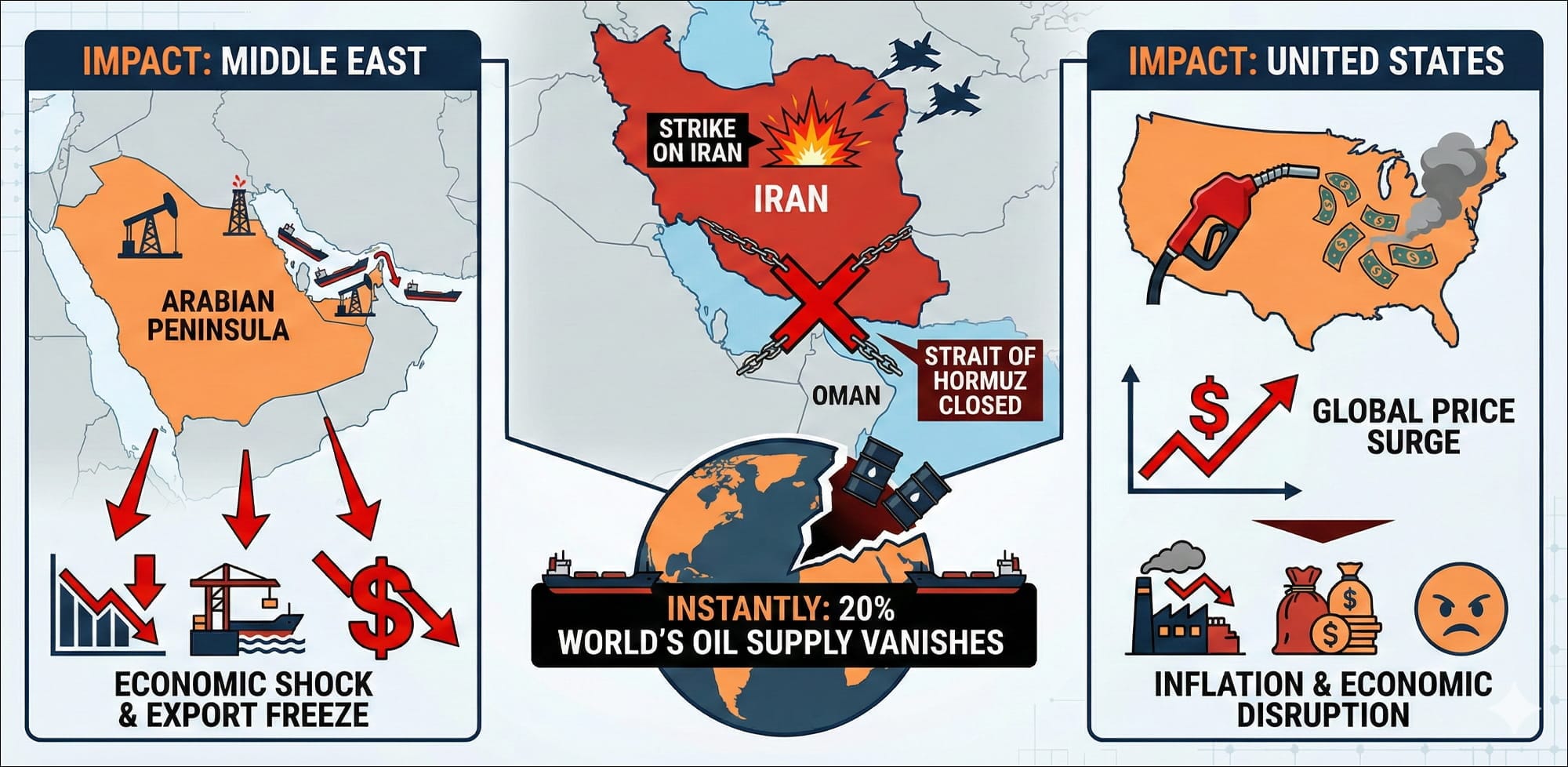
A strike on Iran would close the Strait of Hormuz. In an instant, 20% of the world’s oil supply would vanish from the market. Prices would not just rise; they would verticalise, likely breaching $150 (£123) per barrel. The economic boon of the Venezuelan operation would be vaporised in a single afternoon of trading, replaced by a recession-inducing oil shock that would doom the Republicans in the midterms. Trump is many things, but he is not politically suicidal. He cannot have his low-inflation cake and eat his regime-change, too.
The Gulf Firewall
The second factor is the surprisingly stiff spine of America’s traditional allies. In a frantic 72-hour diplomatic blitz, officials from Saudi Arabia, Qatar, and Oman reportedly delivered a unified message to the White House: Not from our backyard.
Riyadh and Doha, acutely aware that Iranian missiles can reach their glass skylines far more easily than they can reach Washington, refused to allow their airspace or bases to be used for offensive strikes. By restricting the US’s logistical ease of local basing, the Gulf states raised the “transaction cost” of the war beyond what Trump was willing to pay.
The Domestic Calculation
Finally, there is the ghost of wars past. The American electorate is weary. While they cheer the spectacle of seizing a “rogue” state like Venezuela (which was sold as a quick police action in the “neighbourhood”), a protracted conflict with a near-peer military power like Iran is a harder sell. The US military is already stretched, and the “Donroe Doctrine” prioritises the Western Hemisphere. Expanding the theatre to the Middle East now would look less like strength and more like imperial overstretch.
The Outlook
This pause is likely transactional, not moral. Trump is effectively selling his “restraint” to the highest bidder — extracting concessions from the Gulf states and perhaps waiting for Venezuelan production to stabilise before he reconsiders his options.
We are watching a high-stakes game of poker in which the chips are barrels of crude. The guns remain loaded, but for now, the price of firing them is too high. For how long?

GOING FURTHER
'Help is on its way,' Trump tells Iranians as he urges them to keep protesting | BBC NEWS
Trump says Venezuela will be 'turning over' up to 50 million barrels of oil to US | BBC NEWS
It’s ‘Maganomics’: Trump’s brash economic strategy is likely to end in crash or crisis | THE GUARDIAN
Trump’s $50 Oil Price Goal Is Doable, but Painful | THE WALL STREET JOURNAL
Strait of Hormuz: What happens if Iran shuts global oil corridor? | BBC NEWS
Saudi, Qatar, Oman convinced Trump to ‘give Iran a chance’, says senior Saudi official | THE STRAITS TIMES
On the verge of strikes in Iran, the US held off. What happens next is up to Trump | CNN
‘Naked imperialism’: how Trump intervention in Venezuela is a return to form for the US | THE GUARDIAN
Sources:
▪ This piece was first published in Europeans TODAY on 18 January 2026.
▪ Cover: Flickr/The White House. (Licensed under a Creative Commons Attribution-ShareAlike 4.0 International License.)