America can project power. Can it supply its own troops?
Stalled care packages and complaints about food on deployed ships have turned a private family worry into a public test of military logistics and accountability. Trump’s superpower image versus basic supply failure.

The most alarming reports from the Iran war are not only about strikes, blockades or ship movements. For some American families, they are coming in messages from sons and daughters at sea saying they are hungry.
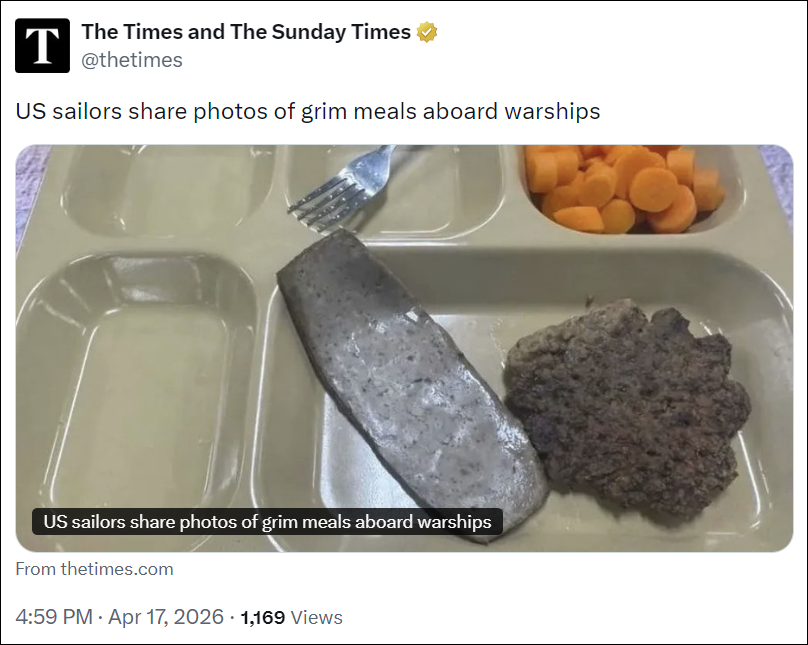
Relatives of service members deployed to the Middle East say their children have described meagre meals, dwindling supplies and too few essentials on board U.S. warships. Photos shared with families from the USS Tripoli and USS Abraham Lincoln appear to show sparse food portions, deepening fears that some crews are being asked to endure prolonged deployment with too little food variety and too little support.
That anxiety has triggered a rush of care packages. Families, churches and community groups have filled boxes with socks, toothpaste, deodorant, tampons, vitamin packets, cookies, candy, games and homemade treats, trying to send some relief to service members caught up in the conflict. But many of those parcels are now stuck.
The U.S. Postal Service has suspended delivery to a range of military ZIP codes in the region due to airspace closures and broader logistical disruption tied to the war. Mail already in transit is being held for future delivery, with no clear timetable for when normal service will resume.
That leaves families in a painful limbo. Some have spent hundreds of dollars, others much more, only to watch tracking information stop short of its destination. Boxes packed with small necessities now sit in depots, post offices or living rooms while loved ones remain at sea.
Mail disruption during war is not unusual. What makes this episode striking is what it suggests about the gap between military image and military reality. The Trump Administration presents itself as able to project overwhelming force across the region. Yet families are being left to worry about whether their children have enough food and basic supplies.
That, by itself, does not prove a system-wide crisis across the fleet. It does expose something serious all the same: when war stretches supply lines, the first people to feel it are often those sent to fight it, and the families trying to care for them from home.

GOING FURTHER
Families fear US sailors are hungry on Iran war ships, packages in limbo | USA TODAY
Families Fume Over Pathetic Meals for American Forces in Trump’s War | DAILY BEAST
US sailors share photos of grim meals aboard warships | THE TIMES
Sources:
▪ This piece was first published in Europeans TODAY on 17 April 2026.
▪ Cover: Flickr/The White House. (Licensed under a Creative Commons Attribution-ShareAlike 4.0 International License.)