Ivermectin misinformation returns as Hantavirus outbreak revives a COVID-era myth
A fatal hantavirus cluster has prompted renewed online claims about ivermectin. But the same drug was falsely promoted during the COVID-19 pandemic, despite warnings from public health agencies that evidence did not support its use as a COVID treatment outside clinical trials.

What you need to know
🔹 Hantavirus cases have been linked to MV Hondius.
🔹 Three deaths were reported in the cluster.
🔹 Agencies say European public risk remains very low.
🔹 Misinformation is spreading online, but Ivermectin is not a proven hantavirus treatment.
A deadly hantavirus cluster linked to the cruise ship MV Hondius has produced the conditions in which bad medical claims spread fastest: fear, uncertainty, deaths, international travel, and a disease most people know little about.
That is why claims about ivermectin matter now. The drug is real. The problem is the false leap from a legitimate antiparasitic medicine to an all-purpose cure for viral outbreaks.
The World Health Organization said on 4 May that seven confirmed or suspected hantavirus cases had been identified in the MV Hondius cluster, including three deaths. Illnesses began between 6 and 28 April and involved fever, gastrointestinal symptoms, rapid progression to pneumonia, acute respiratory distress syndrome and shock. Further investigations were continuing.
By 7 May, news agencies were reporting ongoing international efforts to trace passengers and monitor potential additional cases, underscoring how quickly outbreak figures can change. AP reported at least three deaths and several illnesses linked to the ship, with health authorities in multiple countries involved in contact-tracing and isolation measures.
The public health risk should not be exaggerated. The European Centre for Disease Prevention and Control has assessed the risk to the general European population as very low while investigations and control measures continue. That is the factual baseline: serious enough to require public health action, but not a reason to invent treatments.
Hantaviruses are usually associated with exposure to infected rodents, including through urine, droppings or saliva. Some strains can cause severe respiratory disease. The Andes virus, linked to South America, is unusual because limited person-to-person transmission has been documented after close contact. That makes careful tracing important. It does not create evidence that ivermectin treats hantavirus.
The CDC says there is no specific treatment for hantavirus infection. Patients should receive supportive care, including rest, hydration and treatment of symptoms. In severe hantavirus pulmonary syndrome, patients may need breathing support, including intubation. A clinical explainer in JAMA gives the same basic message: there is no specific medication for hantavirus infection, and severe cases may require oxygen, mechanical ventilation or ECMO.
This is where the COVID-19 memory matters.
During the pandemic, ivermectin became one of the most prominent examples of a drug being promoted beyond the evidence. It was pushed online as a COVID-19 cure or preventive treatment, often alongside claims that authorities were suppressing cheap medicines. Public health agencies repeatedly rejected that framing.
In March 2021, the European Medicines Agency advised against using ivermectin to prevent or treat COVID-19 outside randomised clinical trials, concluding that available data did not support such use. EMA’s public health advice still records that position, saying published data from laboratory studies, observational studies, clinical trials and meta-analyses did not support ivermectin’s use for COVID-19.
The pattern is familiar. A frightening disease appears. Scientific uncertainty leaves space for speculation. A known drug is recast as a hidden answer. Supporters present caution as censorship. Opponents of public health institutions use the claim to argue that experts cannot be trusted. The result is not a harmless debate. It can delay care, confuse patients, and drain attention from what doctors actually know how to do.
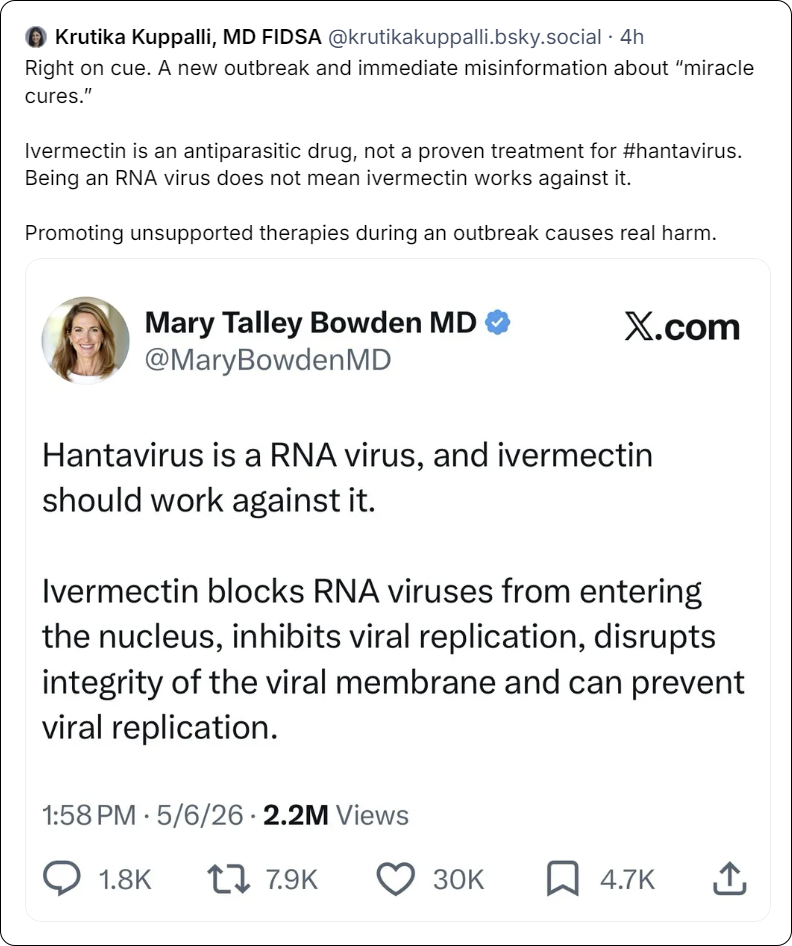
That does not mean every person asking about ivermectin is acting in bad faith. In an outbreak, people search for hope. But responsible public communication has to distinguish hope from evidence.
For hantavirus, the responsible message is narrow but important: seek medical care early if symptoms and exposure history suggest risk; follow public health instructions on isolation, testing and monitoring; do not self-medicate with drugs promoted online; and do not assume that a medicine useful for one condition works against another.
Europe has already lived through the cost of pandemic misinformation. The MV Hondius cluster is not COVID-19, and public health agencies are not describing a general European emergency. But the misinformation machinery does not need a pandemic to restart. It only needs fear, uncertainty and a familiar false cure.

GOING FURTHER
Hantavirus cluster linked to cruise ship travel, Multi-country | WHO
Dozens of passengers left hantavirus-stricken cruise ship after first fatality | AP
Suspected hantavirus outbreak on cruise ship under investigation | ECDC
About hantavirus | CDC
What is hantavirus? | JAMA
EMA advises against ivermectin for COVID-19 outside clinical trials | EMA
Hantavirus in humans: clinical aspects and management | The Lancet Infectious Diseases
Sources:
▪ This piece was first published in Europeans TODAY on 7 May 2026.
▪ Cover: Dreamstime/KORWEN.