Burnham general election speculation faces a 5 November reality check
Speculation that Andy Burnham could call a general election for 10 December faces a decisive test this week, as the statutory deadline for such a vote approaches.

🔍 WHY THIS STORY MATTERS
A December election would abruptly reshape British politics. The important distinction for voters is between evidence of favourable electoral conditions and evidence that Downing Street has actually decided to call an election.
KEY TAKEAWAYS...
● Labour has strengthened its position in recent opinion polls.
● Political experts argue that the political conditions favour an immediate election.
● A 10 December election would require Parliament to be dissolved on 5 November under the normal statutory timetable.
S peculation that Andy Burnham could call a general election for 10 December faces a decisive test this week, as the statutory deadline for such a vote approaches.
Broadcaster and political commentator Iain Dale argued on LBC on 26 October that the PM had strong political reasons to consider an immediate election. His case included Labour’s improved polling position, weaker support for Reform UK, Conservative preparations, and the attraction of securing a personal mandate.
There is evidence for the central electoral premise.
An Ipsos poll conducted between 15 and 22 October put Labour on 32%, eight points ahead of the Conservatives on 24%, with Reform UK on 20%. More recent polling has continued to show Labour ahead. Opinium’s polling from 28 to 30 October put Labour on 30%, Reform on 22% and the Conservatives on 20%.
But an electoral opportunity is not evidence that an election is being prepared.

Some elements of Dale’s argument are also less certain than the headline polling suggests. An eight-point national lead does not automatically translate into a Commons majority under Britain’s constituency-based electoral system. Recent constituency projections have produced markedly different outcomes.
Other arguments are inherently speculative, including what Burnham might have learnt from Gordon Brown’s decision not to call an election in 2007.
Burnham has also spoken again since Iain Dale published his prediction. In an ITV News interview published on 30 October, Burnham said: “No election in 2027.”
He said his priority was to establish a ten-year programme for government and begin putting it into effect before asking voters for a mandate.
That statement does not rule out an election in December 2026. A prime minister can also change course after publicly rejecting an election. But Burnham’s statement is relevant evidence when assessing claims about his intentions beyond this year.
The specific prediction of a 10 December election is much easier to test.
UK Parliament guidance says polling day takes place 25 working days after Parliament is dissolved. For an election on Thursday 10 December, dissolution would therefore have to take place on Thursday 5 November.
That leaves only days for the speculation to acquire concrete supporting evidence.
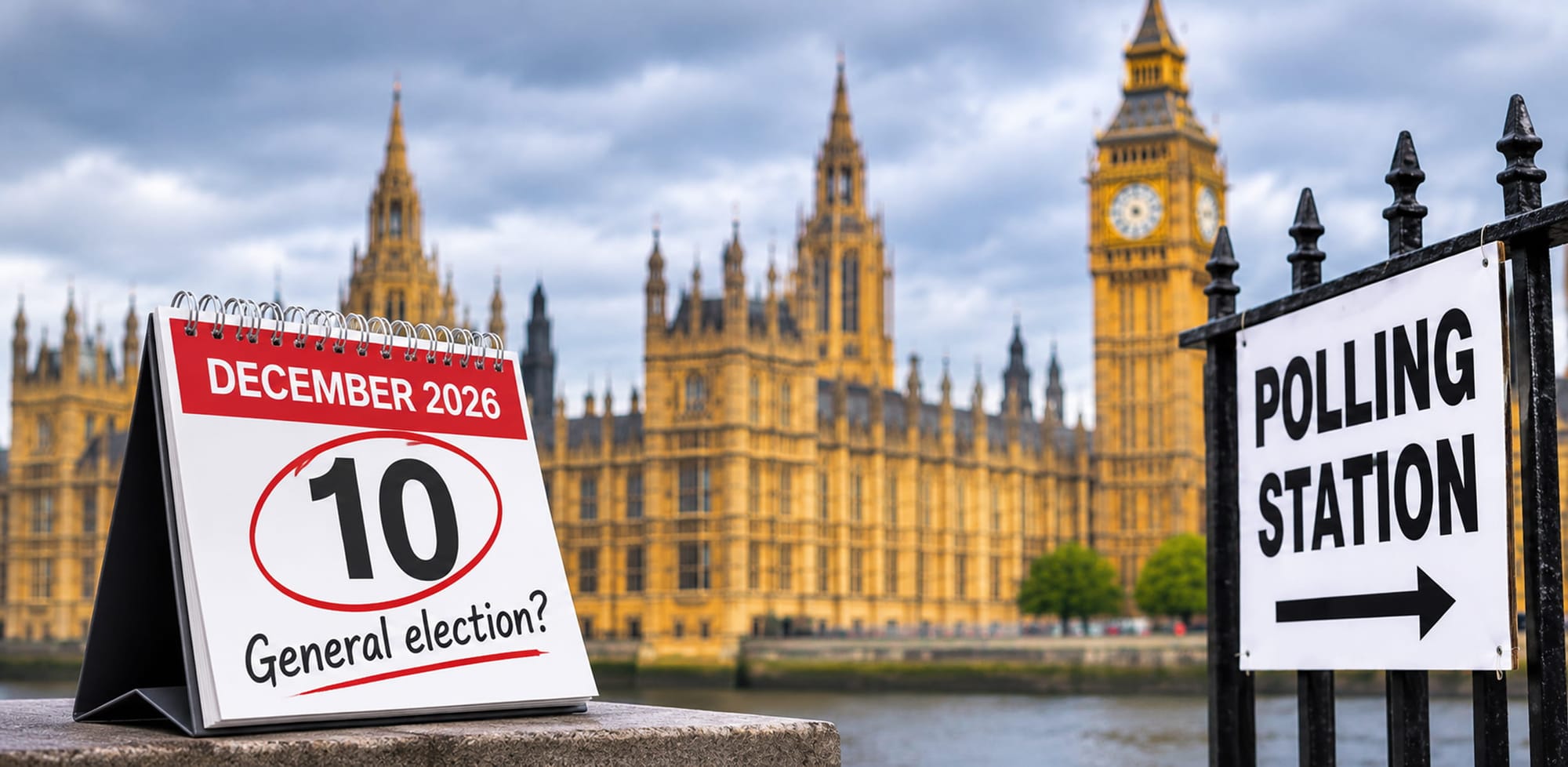
Labour’s improved polling helps explain why an immediate election might appeal politically. What it does not establish is that Burnham has decided to call one.
If 5 November passes without dissolution, a 10 December election will no longer be possible under the normal statutory timetable.
🔮 WHAT MATTERS NEXT...
🎯 WHAT TO WATCH NEXT:
● Any announcement from Downing Street concerning a request to dissolve Parliament.
● Whether Parliament is dissolved by 5 November, the decisive event required for Dale’s proposed 10 December polling date.
● Any further statement from Burnham clarifying whether his rejection of a 2027 election also extends explicitly to the remainder of 2026.
● Whether Labour’s improved polling position persists beyond the immediate post-Budget period.
🎯 MOST LIKELY OUTCOME:
● On the evidence currently available, there is insufficient support for concluding that a 10 December election will be called. Burnham’s public statements point away from an imminent electoral cycle, although they do not categorically exclude December 2026.
🎯 WHAT COULD CHANGE THE PICTURE:
● Concrete evidence that Burnham has requested, or intends to request, a dissolution before the statutory deadline would immediately transform the speculation into an election timetable.
🎯 WHY THIS MATTERS:
● The episode illustrates the difference between a persuasive argument about what a prime minister could gain politically and verified evidence about what a government has actually decided to do.

GOING FURTHER
10 reasons why Andy Burnham may call a 10 December election, writes Iain Dale | LBC
Andy Burnham admits first Budget as prime minister was ‘not ideal’ | ITV News
Labour now lead by 8 points with the Conservatives in second place in latest voting intention polling | IPSOS
Voting intention: 28th October 2026 | OPINIUM
End of a Parliament and dissolution | UK PARLIAMENT
Election timetables | HOUSE OF COMMONS LIBRARY
MRP Poll October 2026 | ELECTORAL CALCULUS
Sources:
▪ This piece was first published in Europeans TODAY on 2 November 2026.
▪ Cover: Flickr/Number 10. (Licensed under a Creative Commons Attribution-ShareAlike 4.0 International License.)