UK newspapers publish more ads for polluting products than climate coverage
Space devoted to promoting flights, cruises, SUVs, and the oil industry dwarfed the column inches given to last year’s U.N. climate summit, study finds.

by ELLEN ORMESHER —
What you need to know
🔹 Study finds ads for polluting industries outweighed COP29 coverage over threefold.
🔹 Researchers measured 5,086 advertising inches versus 1,745 inches on coverage.
🔹 Travel promotions were dominated by cruises and packages during the conference period.
🔹 Experts urged tobacco style ad controls as COP30 begins in Belém.
B ritish national newspapers devoted more than triple the space to advertising polluting industries such as oil, airlines, and sports utility vehicles than they did to covering last year’s United Nations climate talks, according to a new study.
Total high-carbon advertising — including for fossil fuel companies, cruises, and banks financing oil and gas – amounted to 5,086 column inches on two key dates during 2024’s COP29 climate conference in Baku, Azerbaijan, relative to 1,745 column inches for the negotiations themselves.
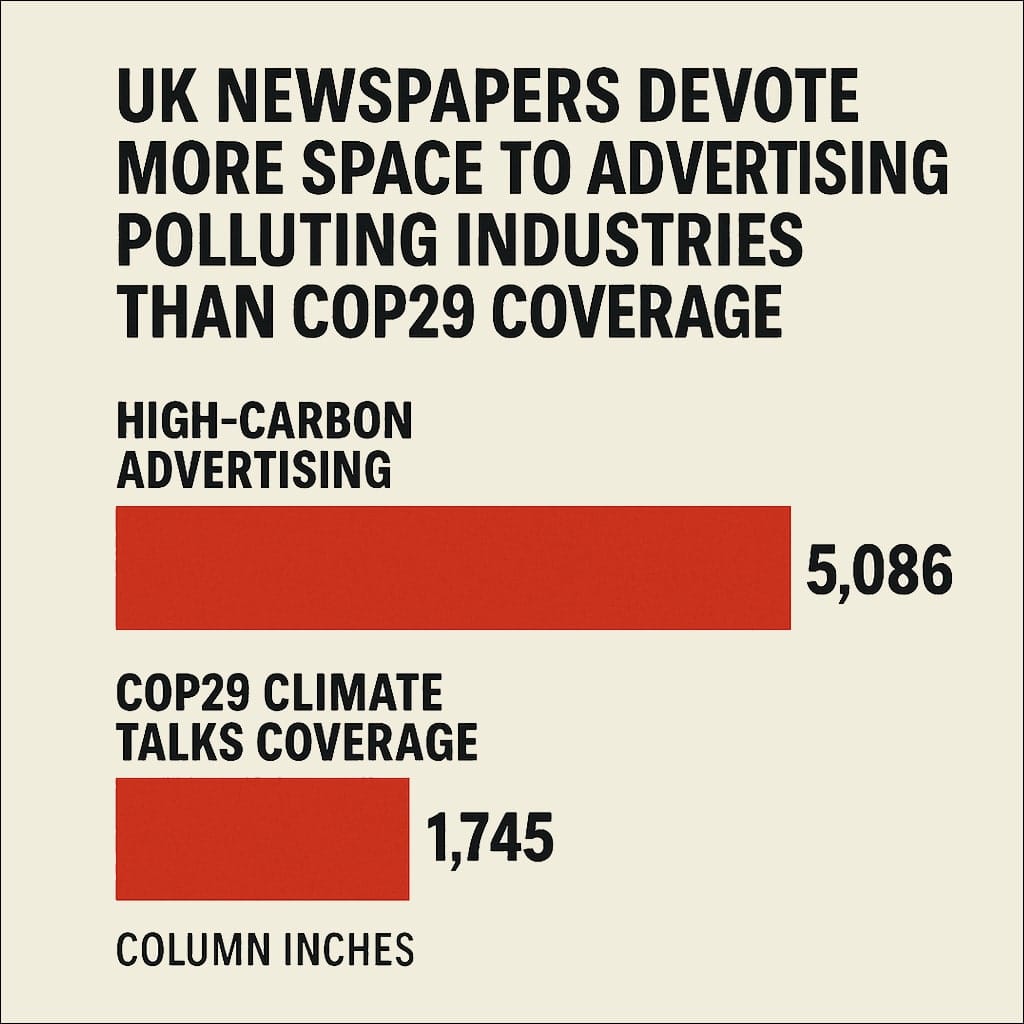
With the next round of talks, known as COP30, getting underway in Belém, Brazil, newspapers will likely repeat the pattern, warned Andrew Simms, co-director of the New Weather Institute think tank, which conducted the research.
“What will people in the UK see when they open their newspapers? A handful of stories warning them that there is an urgent challenge that must be addressed, but that will likely be drowned out by at least three times the amount of advertising normalising pollution,” Simms said. “We need tobacco-style controls on ads that promote polluting products.”
The research examined coverage in ten British national newspapers, including the Times, the Sun and the Daily Mail, on November 11, the opening day of the Baku talks, and November 25, the morning after the conference ended and when coverage peaked. The ten papers dedicated an average of 2.1 percent of their editorial space to the conference.
Some of the newspapers carried almost no mention of major climate impacts at the time, such as the floods in Valencia, Spain or Storm Bert in the UK.
Cruises and package holidays dominated travel advertising during the same period, accounting for 50 percent of travel promotions.
The Financial Times was the only paper that carried no travel ads during the period, publishing 55.7 percent of the COP29 coverage across all papers. The Guardian, which has not accepted advertising from fossil fuel companies since 2020, published a full-page advertisement for Turkish Airlines on one of the key conference dates, the study found.
U.N. Secretary-General António Guterres has called on countries to ban fossil fuel advertising and urged news media and tech companies to stop running the ads.
“The public are being told by reporters that climate scientists are warning that we must stop burning fossil fuels, but those who still buy print newspapers are bombarded with adverts suggesting everyone else is enjoying long-haul flights and luxury cruises,” said Brendan Montague, the study’s author and editor of The Ecologist.
The Times, the Sun, the Daily Mail, and The Guardian did not respond to requests for comment.

GOING FURTHER
Promoting pollution before reporting the climate (PDF) | NEW WEATHER INSTITUTE
Sources:
▪ This piece was first published in DeSmog and re-published in Europeans TODAY on 11 November 2025 under a Creative Commons Attribution-NonCommercial 4.0 International licence. | The author writes in a personal capacity.
▪ Cover: Dreamstime/Mathieu Compin.