COVID Inquiry says Boris Johnson and Tories oversaw late and chaotic COVID response with leadership failures and toxic culture
The official COVID Inquiry has found the UK’s COVID response was hindered by late decisions, confused leadership, and a corrosive culture within Boris Johnson’s No 10, with thousands of deaths judged preventable.

What you need to know
🔹 The UK COVID-19 Inquiry finds delayed decisions and weak leadership significantly worsened the UK’s pandemic outcomes.
🔹 The report shows toxic governance and confused messaging repeatedly obstructed timely national action.
🔹 The findings reveal that structural inequalities and fragmented institutions increased harm for vulnerable groups.
🔹 The conclusions urge urgent reforms so future crises receive faster, clearer responses.
T he second report from the UK’s public inquiry into the COVID-19 pandemic opens without ceremony yet lands with considerable force. It is a dossier shaped by two years of hearings, tens of thousands of documents and emotional testimony from officials and families who lived through the crisis.
Across more than 700 pages, the inquiry concludes that the UK’s response to the pandemic suffered from repeated delays, institutional drift, and a corrosive working culture at the heart of government. Its central message is stark. Decisions that were taken late contributed to the high death toll, which now stands at roughly 240,000 people. The authors argue that more rapid action, particularly in March 2020, could have saved approximately 23,000 lives in England alone.
The report’s central finding is expressed with clarity: “The response of the four governments repeatedly amounted to a case of too little, too late.” The inquiry’s chair, Baroness Heather Hallett, writes that the UK’s leadership underestimated the threat, failed to prepare for the virus’s arrival and was slow to alter course even as evidence of its spread became unambiguous.
Her conclusion is rooted in the simple progression of dates. While cases mounted in China and Italy, February 2020 passed in the UK with few senior-level discussions and almost no escalation of emergency measures. This lack of urgency, described by the inquiry as “a lost month”, shaped everything that followed.
From the outset, the inquiry proceeds through the five essential questions: what happened, where it unfolded, when crucial decisions were taken, who shaped the response and why those choices produced such significant consequences. It also asks how institutions functioned under pressure and why patterns of delay repeated through successive waves.
The Hallett team stresses that the pandemic arrived at extraordinary speed and placed every government in a difficult position. Yet the evidence collected suggests that the UK’s response was hindered by structural weaknesses that were already visible before the virus took hold.
The political centre faltered
The inquiry’s most critical passages focus on Downing Street. It portrays a government struggling to find clarity, order and cohesion. Boris Johnson’s approach to the emerging crisis is described as inconsistent, reactive and heavily influenced by a chaotic workplace culture.
The authors repeatedly note his failure to attend Cobra meetings in February 2020. They write that “Mr Johnson should have appreciated sooner that this was an emergency that required prime ministerial leadership to inject urgency into the response.” Instead, the prime minister spent the school half-term week at Chevening, receiving no regular updates on the virus’s spread.
Former officials provided deeply uncomfortable testimonies. Simon Case, who served as the cabinet secretary, said, “Good people were just being smashed to pieces”. Other senior figures described meetings dominated by the loudest voices, often men, with junior women either talked over or ignored. The inquiry quotes witnesses who referenced misogynistic language and a belief that confrontation was encouraged at the highest levels.
Dominic Cummings, Johnson’s chief adviser, plays a central role in this narrative. The report states that he “materially contributed to the toxic and sexist workplace culture” and that his behaviour “poisoned the atmosphere in 10 Downing Street”. According to the inquiry, Cummings used “offensive, sexualised and misogynistic language” in internal messages, and the prime minister did not constrain this. Instead, Johnson is described as having “intentionally sought to foster conflict and a chaotic working environment”. One senior official described the environment as one where “the loudest voice prevailed rather than the clearest analysis”.
The inquiry does not dismiss Cummings’s professional abilities. It notes that he had many traits valuable to a prime minister, including relentless energy and a willingness to challenge assumptions. Yet the report concludes that his influence became destabilising. “His behaviour contributed significantly to a culture of fear, mutual suspicion and distrust that undermined the authority of the prime minister.”
Johnson is portrayed as someone who struggled to make decisions and often reversed his position within hours, prompting one witness to describe his leadership style as akin to “watching a shopping trolley veering from side to side”. This, the report says, had a measurable impact on the speed and clarity of the UK’s response.
Cummings has released a lengthy statement on X, rejecting the report. He wrote that the inquiry reflected “a mix of coverups and rewriting history” and argued that experts gave flawed advice at the start of 2020. He said: “If the inquiry says I got anything right, bear in mind it’s probably got this wrong too.” His comments do not change the inquiry’s broader assessment that his presence contributed to an atmosphere that made coherent decision-making difficult.
The cost of delay
Central to the inquiry’s critique is the timeline of early 2020. The virus reached the UK earlier than many understood at the time. Community transmission was present in February and gathering pace. Yet the response remained focused on containment, despite mounting evidence from Italy that this approach was no longer viable.
The report emphasises that scientific advisers and ministers were cautious about recommending a lockdown. Chris Whitty, England’s chief medical officer, preferred not to be the first to abandon containment. The inquiry states: “Professor Whitty did not wish the UK to be the first country to abandon containment and felt it was best to wait until the World Health Organization had accepted there was a pandemic. This was the wrong approach, given the extent of the spread of the virus within the UK.” Whitty has since acknowledged that he regrets elements of his early assessment.
Patrick Vallance, the government’s chief scientific adviser, wrote in his contemporaneous notes that Johnson was often “bamboozled” by scientific concepts and struggled to grasp statistical modelling. According to Vallance, watching him “get his head around the stats was awful”. This matters because ministers frequently misinterpreted scenario modelling as predictions, leading some to dismiss warnings as overly pessimistic.
By 12 March, the situation had become, in the inquiry’s words, “little short of calamitous”. The country lacked an effective testing system and did not have an accurate understanding of the virus’s spread. Yet a mandatory lockdown was still not discussed until the days that followed. A further delay pushed the national lockdown to 23 March. Modelling suggests that if it had been imposed one week earlier, around 16 March, approximately 23,000 lives could have been saved during the first wave.
This conclusion has shaped much of the reaction to the report. COVID-19 Bereaved Families for Justice UK said: “We now know that many of our family members would still be alive today if it weren’t for the leadership of Boris Johnson and his colleagues.” The group argues that Johnson “put his political reputation ahead of public safety” and delayed critical steps despite clear scientific warnings.
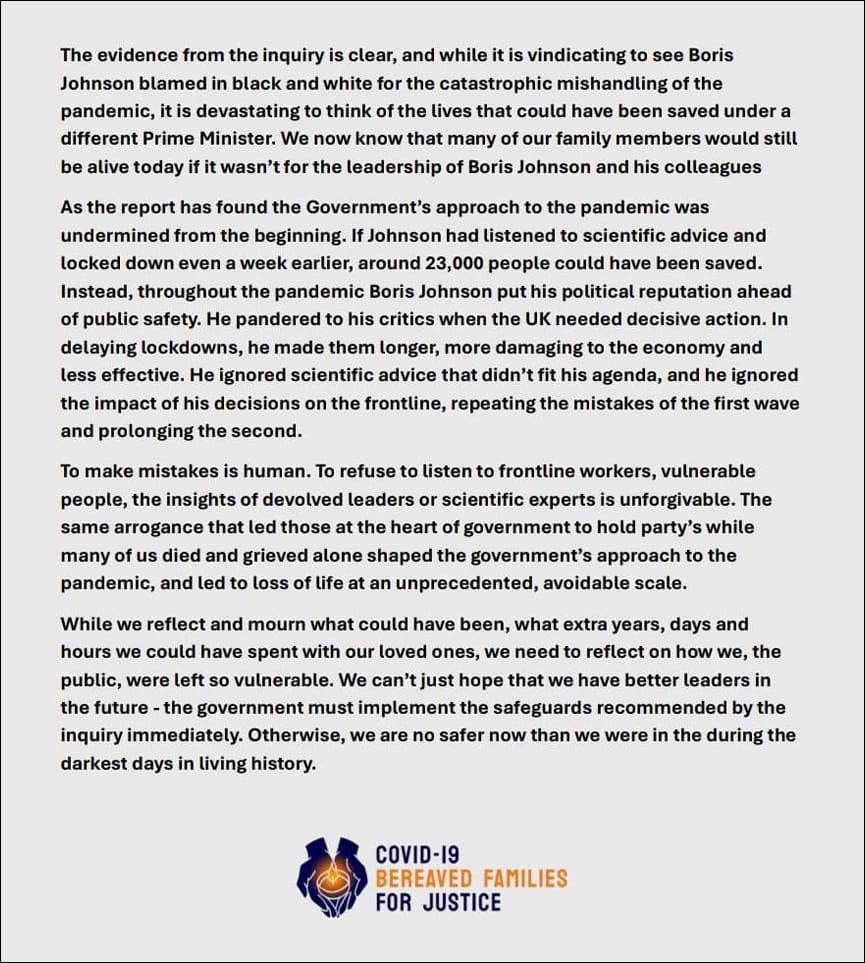
On BlueSky, COVID-19 Bereaved Families For Justice UK are now actively calling for action on Boris Johnson, saying that “Boris Johnson’s silence is deafening, and his contempt for the bereaved is clear. His actions during the pandemic amount to one of the gravest betrayals of the British public in history. His decisions cost tens of thousands of lives that could and should have been saved.
“He must be held accountable. We are not asking for an apology; we are asking for consequences. Boris Johnson should have no role in public life and no further entitlement to public funds.
“We are calling for every privilege to be removed, including the £115k-a-year he can claim as a former PM. It is intolerable that bereaved families are expected to subsidise the lifestyle of the man whose decisions led to the deaths of our loved ones.
“Now that the Inquiry has spoken, there must be accountability. While our focus will always be on learning lessons to save lives in the future, individual accountability must be part of delivering justice.”
Political leaders have responded with varying degrees of contrition. Prime Minister Keir Starmer, in a written statement to Parliament, said the UK had not been adequately prepared and acknowledged that “public services, including the NHS, are under immense pressure and in many cases have not fully recovered from the pandemic”. He added that improvements have since been made, though he noted that local authorities continue to struggle with the long-term impact.
The Liberal Democrats called on the current Conservative leader, Kemi Badenoch, to apologise for the party’s handling of the crisis. Ed Davey said: “The British people will rightly never forgive the Conservatives for leaving the country rudderless and vulnerable, and for partying while our communities were isolated and grieving.” He also warned that “Reform politicians seem intent on trashing medical science and spreading disinformation about vaccines.”
Unions echoed the sentiments of bereaved families. Gary Smith, general secretary of the GMB, said that “workers bore the brunt of the Tories’ inept response to the pandemic.” He added: “Care homes were turned into morgues while those in No 10 partied the night away.” His remarks touch on one of the inquiry’s core concerns: that delays not only increased mortality but prolonged the economic and social damage.
Inadequate protection for vulnerable groups
The inquiry dedicates significant attention to the experience of groups disproportionately affected by the pandemic. Among them are disabled people, individuals with learning disabilities, ethnic minority communities and people with conditions such as Down’s syndrome. The report notes that people with Down syndrome were not added to the shielded patient list until September 2020, months after evidence emerged showing they faced a higher risk.
It also criticises the redeployment of staff from the Race Disparity Unit and the Government Equalities Office to assist with general pandemic response duties. This occurred at a time when emerging data indicated that people from Black, Asian and minority ethnic backgrounds were experiencing higher infection and mortality rates. The redeployment of those teams meant a loss of specialised focus on inequalities.
The inquiry writes that ministers “failed to act sufficiently speedily to mitigate some risks to disabled people” and that this resulted in avoidable harm. Structural inequalities, including housing conditions and employment in public-facing roles, also shaped outcomes for many groups. The report says there was insufficient urgency in gathering data that could have informed targeted interventions.
The science-policy gap
The inquiry portrays a breakdown in how ministers interpreted and used scientific advice. Many witnesses described ministers who lacked confidence in understanding technical information. Johnson is singled out, but the issue appears broader. The report writes that ministers often confused scenario analysis with forecasts. They mistakenly believed worst-case projections were predictions, leading some to view advisers as pessimistic. This contributed to a damaging belief that experts were “overly gloomy”.
The inquiry recommends that ministers receive training in core scientific concepts at the outset of any future emergency. This would include basic statistical literacy, an understanding of modelling techniques, and the interpretation of risk assessments.
The report also warns that placing too heavy a burden on a small number of scientific advisers, many of whom are unpaid for their role, created unsustainable workloads. Some advisers received threats, abuse and, in extreme cases, physical harassment. Chris Whitty was assaulted in a London park in June 2021. Jonathan Van-Tam, the deputy chief medical officer, told the inquiry he did not expect his family to face threats of violence.
The inquiry expresses concern that harassment may discourage scientists from offering public advice in future emergencies. It warns that without institutional protection, the pool of willing experts will diminish.
Confusing messaging and public trust
Communicating risk is a central component of pandemic control, yet the inquiry finds that UK government messaging was often confusing, optimistic, or contradictory. Johnson is criticised for remarks that departed from official advice. One example cited is the moment he said he had “shaken hands with everybody” in a hospital, just days before a public information campaign urging regular handwashing.
The inquiry also examines the “Eat Out to Help Out” scheme, introduced by the Treasury in the summer of 2020 to boost the hospitality sector. It writes that the programme “might have contributed to a belief that the pandemic was effectively over, even though the government was aware of the significant risk that there would be further waves of the virus”. The scheme had public appeal and economic rationale, but the inquiry notes it sent mixed signals at a critical stage.
The mantra of “following the science” is also scrutinised. The report argues that this phrase implied decisions were directed solely by scientific advice, when in reality, ministers were weighing multiple factors. The inquiry writes that the words “downplayed their responsibility for their own decision-making” and that, occasionally, ministers shielded themselves behind advisers.
Rule-breaking by senior government officials further weakened public confidence. The most prominent example remains Cummings’s trip to Barnard Castle during the first national lockdown. The inquiry states that such incidents “undermined public confidence in decision-making and significantly increased the risk of the public failing to adhere to measures designed to protect the population”. The report stresses that leaders must observe the rules they impose to maintain public trust.
Devolved governments: shared delays, divergent decisions
The inquiry offers a detailed account of how the devolved governments engaged with the pandemic. Although the devolved administrations for Scotland, Wales, and Northern Ireland made their own decisions on public health measures, they were heavily influenced by UK-wide data, scientific advice and coordination.
The report concludes that all four governments reacted slowly in the early months. Scotland, Wales, and Northern Ireland were “overly reliant” on the UK government to lead early decision-making. As evidence of widespread transmission grew, this reliance created gaps in local adaptation. The inquiry notes that the devolved administrations lacked full access to modelling resources available in London.
The inquiry also highlights tensions between the devolved governments and Westminster. Baroness Hallett writes that “there was a lack of trust between Boris Johnson and some of the leaders of the devolved nations”. The report describes how these tensions influenced decisions and complicated coordination.
In Scotland, Nicola Sturgeon is described as a “serious and diligent leader”, yet the inquiry criticises her tendency to take decisions within a small circle of advisers. It concludes that Scotland was “significantly under-prepared” for the pandemic and that early actions mirrored UK government delays. However, the inquiry also notes that Scotland adopted notably cautious measures when lifting the first national lockdown. While this did not eliminate subsequent waves, it reflects a divergence in political judgment.
Sturgeon responded to the report by acknowledging mistakes. She said: “Given the unprecedented and highly uncertain nature of the situation we faced, it was inevitable that mistakes would be made, and I know that I made my share.” She added that she acted “in absolute good faith” with the information available at the time.
Wales’s response is described as “inadequate” in early 2020. The inquiry writes that Welsh ministers were too dependent on decisions taken in London and did not adjust quickly as the situation evolved. Wales also experienced the highest age-standardised mortality rate of the four nations between August and December 2020. The report argues that decisions during this period “likely contributed” to the high mortality rate.
Eluned Morgan, the first minister, said the Welsh government would “take time to read the report and work with the other UK governments to consider and act on its recommendations”. She emphasised that the government was committed to learning lessons.
Northern Ireland’s response was shaped by the collapse of power-sharing during part of the pandemic and by deeply rooted political divisions. The inquiry describes decision-making at Stormont as “deeply divided along political lines and beset by leaks”. It argues that the devolved structures offered an opportunity for collective governance, but that “on multiple occasions” decisions were “marred by political disputes between Democratic Unionist Party and Sinn Féin ministers”.
Michelle O’Neill, now first minister, said the report marked a “welcome milestone in the long journey of recovery after the pain and trauma” of the pandemic. She acknowledged that the pandemic was an unprecedented emergency and said the report would help shape future responses.
Children and the long-term social impact
While the second report’s primary focus is government decision-making, it echoes findings from the inquiry’s dedicated work on children and young people. The inquiry writes that children “were not always prioritised” and that school closures “brought ordinary childhood to a halt”. The decision to close schools was not taken lightly, but the report suggests ministers did not fully weigh the long-term consequences for education, mental health and social development.
The report highlights uneven access to digital learning, particularly among low-income families. It notes that some teachers and schools were left “in limbo” as decisions changed with little notice. This inconsistency contributed to confusion for families and pressure on the teaching workforce.
Economic planning and the difficulty of exit strategies
The inquiry also considers the economic dimension. Exit strategies from lockdowns were often rushed or poorly coordinated. The lifting of restrictions in summer 2020 is described as “unwise” because it created a false sense of security. Rishi Sunak, then chancellor, is noted as a key advocate for reopening. The inquiry does not dispute the necessity of supporting the economy, particularly sectors such as hospitality, but it argues that the pace and tone of reopening contributed to the severity of the autumn and winter waves.
Ministers across the UK were urged to impose interventions early and “harder than might be considered ideal”. The inquiry suggests that waiting for perfect information costs time that cannot be recovered.
Structural issues and future preparedness
The inquiry stresses that the UK entered the pandemic without the infrastructure needed for a rapid response. Stockpiles of personal protective equipment were incomplete, surveillance systems were outdated and public health agencies struggled to scale operations. Years of austerity and uneven investment across local public health teams created gaps that proved difficult to bridge.
A fundamental lesson emerges: future crises require clear decision-making structures. The inquiry recommends that each nation establish a central task force capable of rapid mobilisation, with the authority to coordinate across sectors.
It also calls for better integration of scientific advice into political systems. This includes training for ministers, a greater diversity of expertise within advisory groups and improved communication channels between local and national public health bodies.
Why the UK struggled to act quickly
The inquiry’s attempt to explain the UK’s repeated hesitation returns to several core themes. First, it notes a belief among some officials in the idea of behavioural fatigue. This suggested that people would comply with restrictions only for a short period. The inquiry concludes that this concept had no grounding in behavioural science and contributed to delays in imposing lockdowns.
Second, ministers hoped that the UK could rely on voluntary measures for longer than other countries. This approach failed to curb transmission. Third, the prime minister’s absence from early decision-making left the system without direction when it was most needed.
The inquiry suggests that these issues combined to create moments of drift, where decisions were postponed despite evidence demanding immediate action.
Political reactions and the reshaping of accountability
The publication of the report has prompted a wave of political responses. Ministers who served during the pandemic have defended their decisions by pointing to the extraordinary uncertainty of the time. Some argue that the decisions made were based on the best available information and that hindsight creates unrealistic expectations. Yet the inquiry counters that many warnings were clear at the time.
Kemi Badenoch, the Conservative leader, has yet to issue a full response. Her absence from the government for the latter stages of Johnson’s tenure does not exempt her party from scrutiny, according to critics.
Beyond blame: the more profound questions
The inquiry does not aim to apportion personal blame. Instead, it seeks to understand how systemic weaknesses led to decisions that shaped the pandemic’s trajectory. It highlights that even when ministers and advisers worked long hours under immense pressure, structural issues prevented the clarity needed for decisive action.
The report underscores that the UK’s government machinery struggled to respond to emergencies that required swift, coordinated action. This includes data systems, intergovernmental relations and communication strategies. The inquiry concludes that meaningful reform is essential to avoid repeating the same mistakes.
A reckoning with loss
At the heart of this investigation is the human cost. Every statistic reflects a family dealing with absence, grief, and unresolved questions. Bereaved families have campaigned for accountability since the earliest days of the pandemic. Their testimonies remind readers that lessons are not abstract. They represent a chance to prevent similar suffering in future emergencies.
The bereaved family group said, “It is devastating to think of the lives that could have been saved under a different prime minister.” They argue that delaying lockdowns made restrictions longer, more damaging and less effective. Their statement stresses that decisions “ignored the impact on the front line”.
The long road ahead
The inquiry is far from over. Further reports will examine health and social care, education and broader social impacts. The work is expected to continue until at least 2027. Yet this second report stands as a critical milestone. It offers a detailed, sometimes painful account of how the UK navigated one of its greatest postwar crises.
Its findings carry implications beyond individual governments or leaders. They question how the UK prepares for emergencies, how decisions are made under pressure and how politics interacts with science. They highlight that leadership style matters, organisational culture shapes outcomes and timing can save or cost thousands of lives.
The inquiry ends with a warning. Crises will return, whether in the form of pandemics, climate emergencies, or economic shocks. The question is whether the UK will learn from the failures of 2020 and 2021. The Hallett report urges the country to act on its recommendations with seriousness and speed.
If there is a single lesson running through its pages, it is that the price of delay can be counted not only in lost time but in lost lives.
For context, a 2024 peer-reviewed study published in BMC Palliative Care by Erin Raquel Fantoni and colleagues, using official mortality data from all four UK nations, notes that by May 2023, “almost 227,000 people in the UK had died with COVID-19 listed as one of the causes on their death certificate”.
--
Bereaved families should not be expected to subsidise the lifestyle of the man whose decisions led to the deaths of our loved ones. Sign their petition!

GOING FURTHER
UK COVID-19 Inquiry
Government ‘chaos’ and failure to tackle Covid cost 23,000 lives, inquiry finds | THE NATIONAL
‘Too little, too late’: damning report condemns UK’s Covid response | THE GUARDIAN
Boris Johnson will not hold coronavirus crisis meeting until Monday | THE GUARDIAN
Coronavirus: Boris Johnson criticised after ‘missing five Cobra meetings’ at start of pandemic | THE INDEPENDENT
Boris Johnson's work style during COVID 'very frustrating' and 'dysfunctional' - head of civil service | SKY NEWS
‘Eat out to help out’ launched without telling official in charge, Covid inquiry hears | THE GUARDIAN
Women’s voices barely heard in Boris Johnson’s No 10, Covid inquiry told | THE GUARDIAN
'Toxic' No 10 culture harmed Covid response, inquiry finds | BBC NEWS
Five things we learned from the Covid Inquiry reportFive things we learned from the Covid Inquiry report | THE WEEK
Government response to COVID-19 was ‘too little too late’, inquiry | BRITISH MEDICAL ASSOCIATION
COVID-19 BEREAVED FAMILIES FOR JUSTICE UK
UK did 'too little, too late', says Covid Inquiry | HEALTHCARE MANAGEMENT
Covid Inquiry: Ministers failed to appreciate scale of threat | CIVIL SERVICE WORLD
Covid: The inside story of the government's battle against the virus | BBC NEWS
Dominic Cummings' Covid trip to Barnard Castle 'caused huge distress', inquiry report says | CHRONICLE LIVE
Dominic Cummings joked about trip to countryside before Barnard Castle visit | THE GUARDIAN
Sturgeon excluded ministers from Covid decisions, inquiry says | BBC NEWS
Covid inquiry: UK action was “too little, too late” and led to avoidable deaths, report finds | THE BMJ
9 Shocking Things We Learnt From The Official Report Into The UK's Covid Response | THE HUFFPOST
Inquiry publishes second report and 19 recommendations, examining ‘Core UK decision-making and political governance’ | UK COVID-19 INQUIRY
Sources:
▪ This piece was first published in Europeans TODAY on 21 November 2025.
▪ Cover: Dreamstime/NSBeer.