The crude reality: Why Trump is betting the house on Venezuela
Donald Trump’s rush into Venezuela signalled a raw, transactional doctrine, driven by inflation fears and midterm politics, coercing oil majors and alarming Europe over US unpredictability and escalating geopolitical risk.

What you need to know
🔹 Donald Trump rapidly reshapes geopolitics through Venezuelan intervention driven by transactional boardroom logic.
🔹 Domestic inflation fears and looming midterms fuel haste to force oil relief.
🔹 Trump reframes war as profit while coercing oil majors into risky investments.
🔹 Europe warns this energy gamble imperils international law and destabilises regions.
I f one were to script the opening act of 2026 to confirm Europe’s darkest anxieties about American unpredictability, it would look remarkably like this. In a single, frenetic week, President Donald Trump has upended the geopolitical chessboard, not with the nuanced statecraft of a superpower, but with the brazen speed of a leveraged buyout.
By decapitating the Venezuelan state and demanding US oil majors immediately underwrite the reconstruction, the White House has signalled a terrifying new doctrine: the era of the “Donroe Doctrine” is here, and the raw, transactional logic of the boardroom governs it.
The question echoing from the corridors of Brussels to the trading floors of the City in London is simple: Why the rush? Why risk regional conflagration and international pariah status for a gamble that oil executives, such as Exxon CEO Darren Woods, deem “uninvestable” under current conditions?
The answer lies not in Caracas, but in the terrified calculus of Washington politics.
The Inflationary Gun to the Head
To understand Trump’s haste, one must look past the “Make America Great Again” rhetoric to the mundane nightmare of the American voter: the cost of living.
Republicans are petrified of the upcoming November midterm elections. Inflation remains the administration’s Achilles’ heel, a persistent political vulnerability that no amount of cultural warfare can entirely obscure.
Trump needs a win, and he needs it yesterday. His promise to cut oil prices to $50 a barrel is not merely an economic policy; it is an act of electoral survival. He cannot wait for the invisible hand of the market; he needs the heavy hand of intervention. By flooding the market with Venezuelan crude — even if that crude is, as experts note, “dense, sticky and heavy” and years away from viable extraction — he is attempting to manufacture an economic miracle before the polls open. The rush is an attempt to book the revenue before the costs come due.
The MAGA Paradox
There is a deeper, more ideological friction at play. Trump swept back into power promising to end “endless wars,” yet he has just launched a fresh one. This creates a dangerous cognitive dissonance for his base. How does the “peace president” sell an invasion?
He does so by reframing the conflict. This is not “nation-building” — a phrase that is poison to the isolationist right. It is, in his own words, a reimbursement. By seizing the oil “for the good” of the American people and declaring that Venezuela will buy “ONLY American-made products,” he transforms a foreign entanglement into a domestic dividend.
The haste is essential to this narrative: Trump must secure the “profit” (the oil contracts) before the “loss” (the insurgency, the body bags) becomes a reality on Fox News.
Coercing the Boardroom
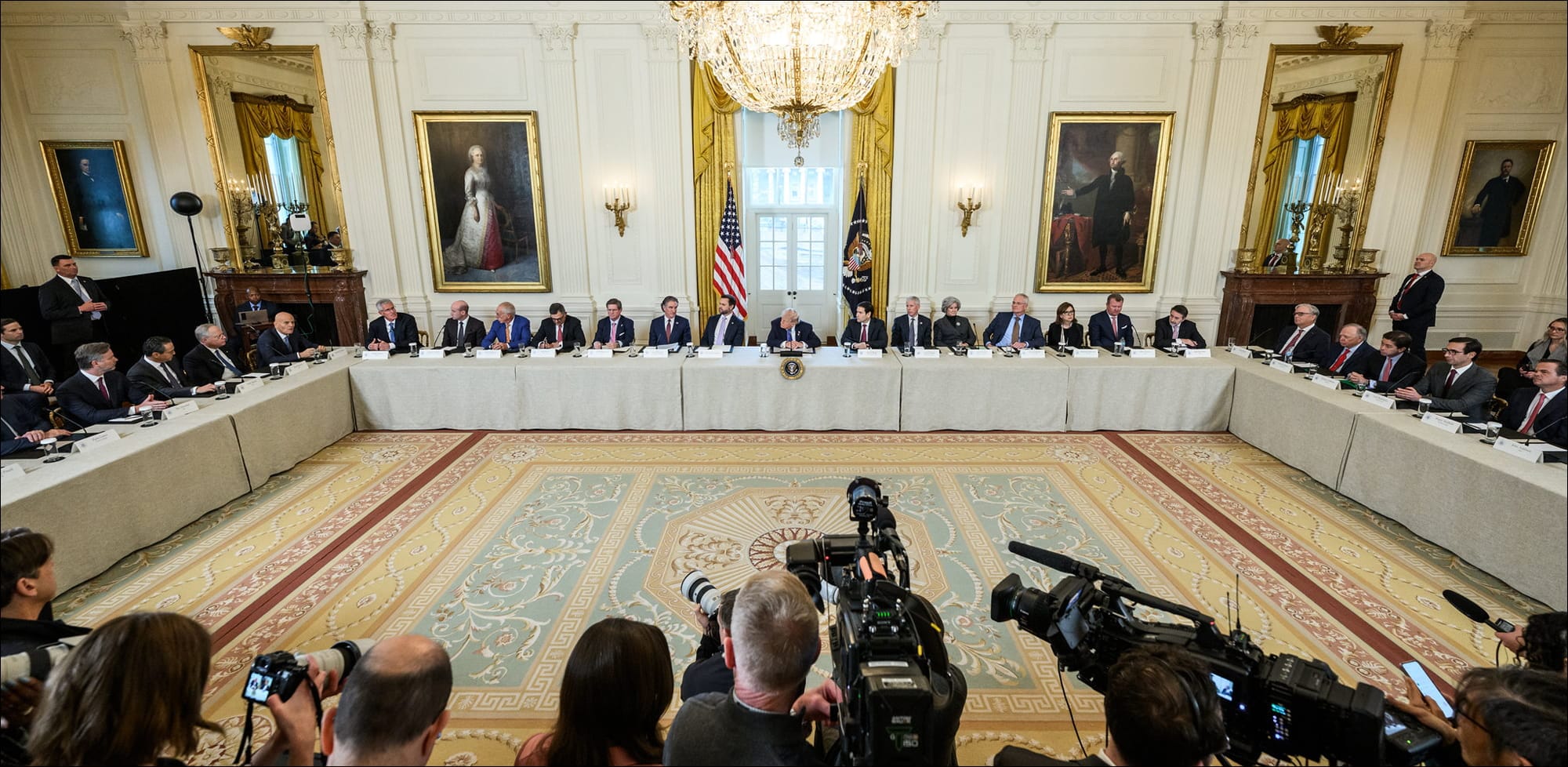
Perhaps the most cynical element of this “whirlwind week” is the strong-arming of American capital. The oil majors — ExxonMobil, Chevron, ConocoPhillips — know better than anyone that Venezuela is a money pit. Decades of underinvestment and corruption have left the infrastructure in ruins. Executives have privately demanded “serious guarantees” before risking billions in a war zone.
Trump’s response has been a classic pressure tactic. By publicly stating he has “25 people that aren’t here today” ready to take their place, he is forcing their hand. He needs their signatures on the dotted line now, locking them into the project before the initial “victory” euphoria fades and the grim reality of guerrilla warfare in the Orinoco Belt sets in. It is a shotgun wedding, presided over by the 82nd Airborne.
Europe’s stark warning
For Europe, this spectacle is a grim clarion call. The “Donroe Doctrine” — a clumsy but dangerous revival of 19th-century imperialism — treats the Western Hemisphere as a closed shop, explicitly designed to cut out Chinese and Russian influence. But in doing so, it treats sovereign nations as vassal states and international law as a nuisance.
We are witnessing the weaponisation of energy policy on a scale not seen since the 1970s. If the US succeeds in driving oil to $50, it may provide a short-term balm for European industry. However, the geopolitical price tag will be ruinous. A destabilised South America, a refugee crisis in the Caribbean, and an America that views the world solely through the lens of extraction are threats we cannot ignore.
The “Caracas Rush” is not a strategy; it is a gamble. And as any seasoned punter knows, the house eventually wins — but rarely the player who bets it all on a single spin of the wheel. Europe must prepare for the moment the ball lands on zero.

GOING FURTHER
Trump promises oil executives ‘total safety’ if they invest in Venezuela after Maduro ouster | AP NEWS
Trump Announces U.S. Military's Capture of Maduro | US DEPARTMENT OF WAR
‘Uninvestable’: Trump pitch to oil execs yields no promises | POLITICO
Trump declares himself ‘Acting President of Venezuela’ in ultimate rage bait | METRO
Trump plans to use Venezuela’s huge crude reserves ‘to cut US oil price to $50 a barrel’ | THE GUARDIAN
Dense, sticky and heavy: why Venezuelan crude oil appeals to US refineries | THE GUARDIAN
Trump to West Point grads: 'We are ending the era of endless wars' | REUTERS
Trump ran as the ‘Peace President’ — now MAGA shrugs at White House’s new foreign military action | THE INDEPENDENT
President Donald J. Trump Safeguards Venezuelan Oil Revenue for the Good of the American and Venezuelan People | THE WHITE HOUSE
Trump says Venezuela will purchase American products with revenue from oil deal | CNBC
US oil companies say they need guarantees to invest in Venezuela, FT reports | REUTERS
Trump promises oil companies ‘total safety’ in Venezuela as he urges them to invest billions | THE GUARDIAN
‘Chaos is coming’: Venezuela primed for violent insurgency following US intervention, experts warn | THE INDEPENDENT
Trump’s new doctrine confirms it. Ready or not, Europe is on its own | THE GUARDIAN
‘I don’t need international law’: Trump says power constrained only by ‘my own morality’ | THE GUARDIAN
Sources:
▪ This piece was first published in Europeans TODAY on 15 January 2026.
▪ Cover: Flickr/The White House. (Licensed under a Creative Commons Attribution-ShareAlike 4.0 International License.)