Burnham’s gamble could rescue Labour, or deepen Britain’s crisis
Andy Burnham may be Labour’s strongest answer to Reform UK, but replacing Keir Starmer without a general election could also expose the party to a faster and harsher judgement.

🔍 WHY THIS STORY MATTERS
Labour’s leadership crisis could reshape Britain’s government, economic direction and resistance to Reform UK, while testing whether another unelected prime minister can restore public trust.
KEY TAKEAWAYS...
● Andy Burnham’s Makerfield victory has intensified pressure on Keir Starmer.
● Burnham offers Labour a stronger regional and anti-Reform appeal, but not yet a tested national programme.
● A change of prime minister without a general election could deepen public distrust in Westminster.
● If Burnham fails quickly, Reform UK could be the main political beneficiary.
A ndy Burnham has given Labour a reason to believe it can still beat Reform UK. He has not yet proved he can govern Britain.
That is now the central question in British politics. Is Burnham the remedy for Labour’s crisis, or another symptom of it?
The arguments for and against Burnham
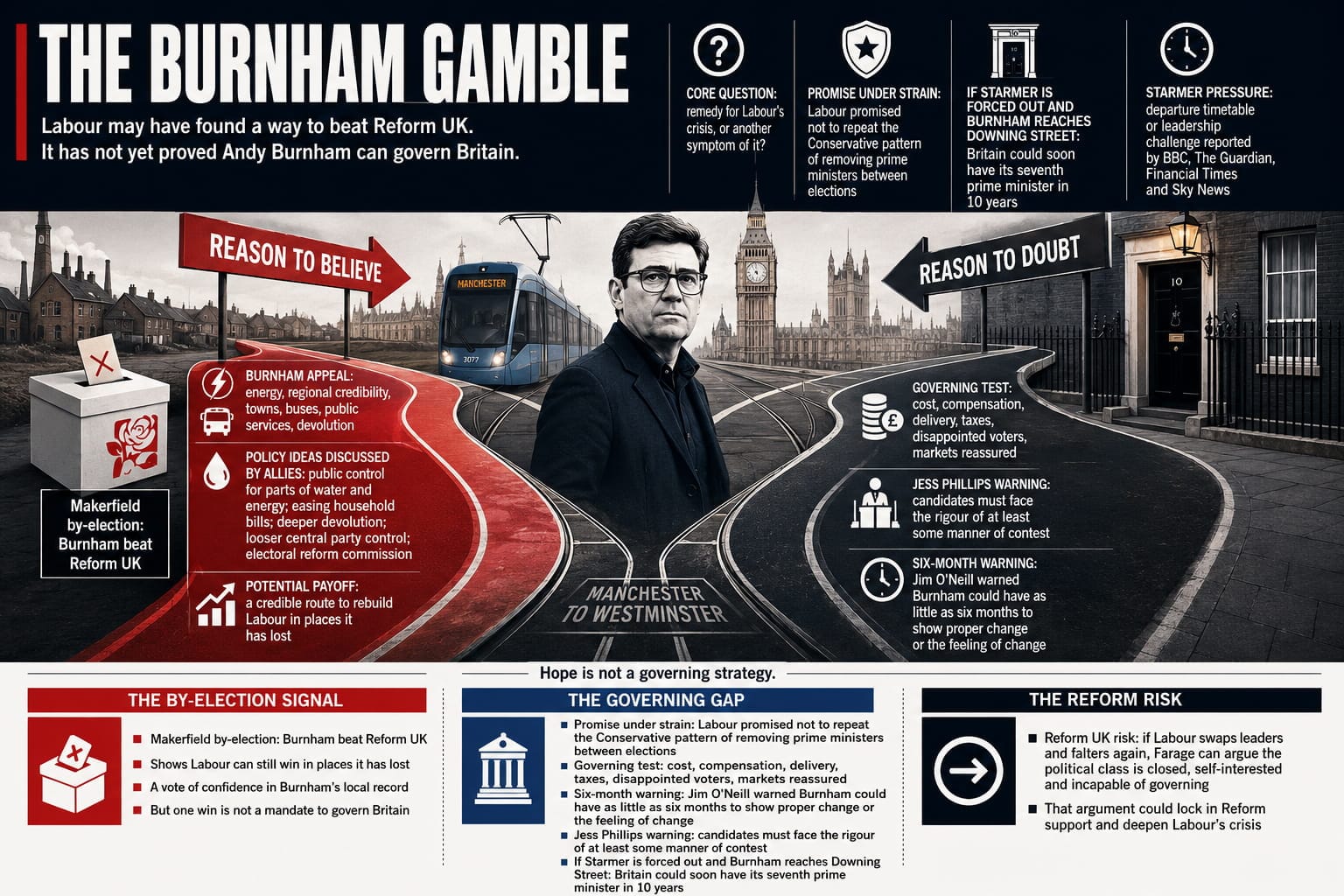
After Burnham’s decisive victory in the Makerfield by-election, pressure on Sir Keir Starmer has moved from serious to existential. BBC reporting described talk of Starmer staying on to fight as fading fast. The Guardian, the FT and Sky News have reported growing pressure from Labour MPs and ministers for the prime minister to set out a departure timetable or face a leadership challenge.
The argument for Burnham is simple. Starmer looks exhausted, weakened and politically diminished less than two years after Labour’s 2024 landslide. Burnham looks like a politician with energy, regional credibility and an ability to speak to voters in places where Labour fears Nigel Farage’s Reform UK. In Makerfield, he beat Reform in a contest treated by all sides as a test of whether Labour still had a route back to its own voters.
The argument against him is just as serious. A mayoral record in Greater Manchester is not a national governing programme. A by-election win is not a mandate to run the country. Replacing another British prime minister without a general election could confirm, rather than repair, the public sense that Westminster parties treat leadership as an internal possession.
Labour promised not to repeat the Conservative pattern of removing prime ministers between elections. That promise is now under severe strain. If Starmer is forced out and Burnham reaches Downing Street, Britain could soon have its seventh prime minister in 10 years. For voters who have lived through Brexit, austerity, pandemic government, inflation and repeated leadership collapses, another change at the top may look less like renewal than another act of political self-preservation.
Burnham’s populism
Burnham’s supporters believe he offers a way out. His politics are more emotional and more place-based than Starmer’s. He speaks the language of towns, buses, public services and regional neglect. He has spent years arguing that power is too centralised in London. His Greater Manchester record has made him visible, recognisable and trusted by many voters beyond Westminster.
The policy difference is emerging, but remains incomplete. The Guardian has reported that Burnham allies are discussing a more interventionist programme, including bringing parts of the water and energy sectors into public control, easing household bills, deepening devolution, loosening central party control over MPs and considering electoral reform through a national commission.
That may be politically potent. It may also be financially and administratively difficult. Public ownership of utilities would raise questions about cost, compensation and delivery. Rent freezes and moving levies off energy bills could help some households, but would require hard fiscal choices. Giving mayors more control over public services may fit Burnham’s instincts, but schools, hospitals and national funding rules cannot be remade by rhetoric alone.
The danger is that Burnham’s appeal is partly built on being outside the machine. As mayor, he could criticise Whitehall, speak for his region and demand more from central government. As prime minister, he would become the centre. He would own the trade-offs. He would have to decide which promises wait, which taxes rise, which voters are disappointed and which markets must be reassured.
That is why Labour MPs calling for a swift transition should be careful. If Burnham is installed through momentum rather than scrutiny, he may inherit power before his programme has been properly tested. Former minister Jess Phillips has already argued that candidates must face “the rigour of at least some manner of contest”. That warning goes to the democratic weakness at the heart of the moment.
Labour’s countdown to disaster?
There is also a brutal question of time. Starmer’s authority has collapsed quickly because politics now punishes disappointment at high speed. Burnham would not be granted a long honeymoon simply because he is new. Sky News reported a warning from Jim O’Neill, one of Burnham’s advisers, that he could have as little as six months to show “proper change” or at least the feeling of change before he too was in serious trouble.
That is the risk for Labour. If Burnham becomes prime minister and cannot quickly improve living standards, restore party discipline and show that Labour can still deliver, the party may find itself trapped. It could not easily remove yet another leader without looking absurd. It could struggle on under a damaged prime minister. Or it could be pushed towards an early general election it may not be ready to fight.
That path would benefit Reform UK. Farage’s central claim is that Britain’s political class is closed, self-interested and incapable of governing. Labour removing a prime minister it elected less than two years earlier, then replacing him with another leader who also falters, would hand Reform a powerful argument. It would let Farage say that both Starmer’s caution and Burnham’s promise had failed.
None of this means Burnham should not challenge. Starmer’s position may already be too weak to recover. Labour’s 2025 and 2026 electoral setbacks, policy reversals and internal unrest have left many MPs fearing that inaction is more dangerous than change. Burnham has shown something Starmer has struggled to show: an ability to make Labour voters feel that politics might still speak to them.
But hope is not a governing strategy. If Burnham is to be Labour’s answer to Reform, he must prove that his politics can survive contact with national office. He must show how his promises are paid for, how fast change can realistically happen and why voters should accept a new prime minister chosen first by Labour, not by the country.
Burnham may be Labour’s best (last?) chance to stop Farage. He may also be the gamble that exposes Labour’s crisis more fully. If he enters Downing Street on the claim that Manchester can show Britain the way, the judgement will come quickly. If he fails, the next beneficiary may not be Labour at all.
🔮 WHAT MATTERS NEXT...
🎯 WHAT TO WATCH NEXT:
● Whether Starmer sets out a departure timetable or insists on fighting a leadership contest.
● Whether Burnham gives clearer answers on tax, public ownership, devolution, and fiscal rules.
● Whether Labour MPs demand a contested process or move towards a rapid transition.
● Whether Reform UK can turn Labour’s internal crisis into a wider anti-Westminster argument.
🎯 MOST LIKELY OUTCOME:
● Labour’s leadership crisis is likely to intensify unless Starmer can quickly show he still has cabinet and parliamentary support.
🎯 WHAT COULD CHANGE THE PICTURE:
● A strong contest, a credible economic plan or a sudden shift in MP support could alter whether Burnham looks like renewal or risk.
🎯 WHY THIS MATTERS:
● Britain’s next leadership decision may determine whether Labour contains Reform UK or strengthens the case against the political establishment.

GOING FURTHER
What will 'change' look like if Andy Burnham becomes prime minister? | The Guardian
Corbyn criticises 'strange' lack of policy in leadership debate and says Burnham must offer real change | The Guardian
'Astonishing' win for Andy Burnham puts pressure on Starmer to step aside | The Guardian
Starmer under growing pressure to quit after Burnham’s by-election victory | Financial Times
Politics latest: 100 Labour MPs now calling for Starmer to resign | Sky News
Sources:
▪ This piece was first published in Europeans TODAY on 20 June 2026.
▪ Cover: Dreamstime/KORWEN.