UK Political-Impact Tracker: The week’s gains and setbacks
From a teachers’ pay funding concession and a £500m McLaren investment to Reform UK’s £72m donations controversy, our inaugural tracker measures the political impact of the week’s most consequential developments.

.
Week 1: 14–20 September 2026
🔍 WHY THIS STORY MATTERS
Our UK Political-Impact Tracker, released every Sunday, tracks key developments involving politicians and influential figures like business leaders, trade-union leaders, campaigners, journalists, and academics shaping UK political debate. Events are ranked by significance: positive points for favourable developments, negative for adverse ones. These scores contribute to a Political-Impact Table. The scores don’t judge politicians’ quality or policies but reflect the balance of notable favourable and adverse events related to them.
KEY TAKEAWAYS...
● A government concession on funding teachers’ pay produces the strongest favourable development of our UK Political-Impact Tracker inaugural week.
● McLaren’s £500m UK investment and the transfer of Chiltern Railways into public ownership also rank highly because they involve substantial, measurable outcomes rather than rhetoric alone.
● Reform UK’s £72m donation controversy generates the strongest adverse development after combining exceptional media visibility with measurable public opposition to donations of that scale.
● The resignation of Reform UK’s Welsh leader following his arrest, and a separate defection from Reform to Plaid Cymru, make Wales particularly significant this week.
P olitical weeks are often judged through headlines, polling snapshots or partisan claims about who is supposedly “winning”. The Europeans TODAY UK Political-Impact Tracker takes a different approach. Every week, we review key developments involving politicians and influential figures in the UK, including business leaders, campaigners, journalists, and academics. We rank these events by their political significance: favourable ones earn +10 to +1 points, adverse ones -10 to −1. These scores are added to a Political-Impact Table, reflecting the balance of positive and negative developments, not judgement of individuals or policies.
Week #1 — Political Gains
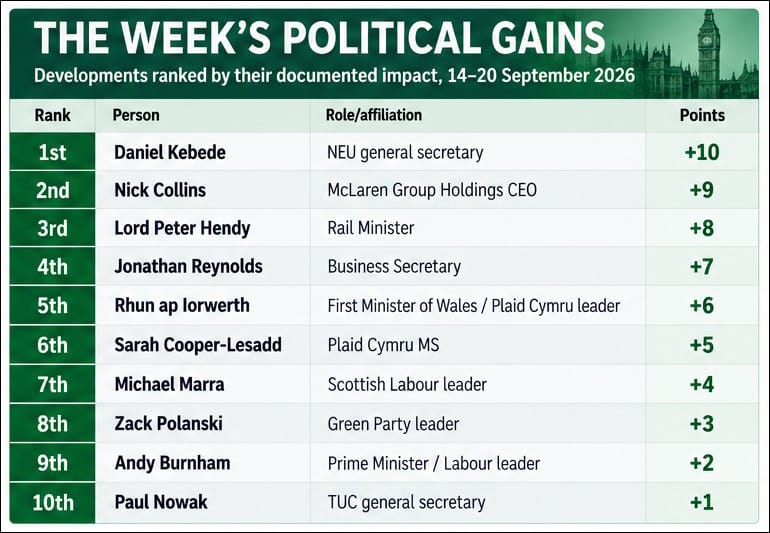
10pts — A funding concession puts Daniel Kebede’s development first
The strongest favourable development of the inaugural week is associated with Daniel Kebede, general secretary of the National Education Union. Ministers agreed to fully fund the teachers’ pay settlement in England after schools had previously been expected to absorb part of the cost from existing budgets. Earlier in the summer, the NEU had calculated that schools would have been required to find around £460m themselves and had warned that industrial action remained possible.
The government’s change means approximately £500m in additional funding this year, according to reporting by The Guardian. The significance for the tracker is the combination of a concrete national policy change, substantial funding and the union having directly campaigned for the shortfall to be eliminated.
9pts — McLaren investment provides the week’s second major gain
Nick Collins, chief executive of McLaren Group Holdings, receives +9 points after McLaren announced around £500m of UK investment. The government said the programme would create 1,000 additional UK jobs by 2032, expand research, development and manufacturing, and potentially support up to another 3,000 jobs across the wider automotive sector.
8pts — Rail nationalisation moves from promise to implementation
Lord Peter Hendy, the Rail Minister, receives +8 points following the transfer of Chiltern Railways into public ownership on 20 September. The Department for Transport said 25 additional daily services were planned from December alongside roughly 10,000 additional weekday seats and other service improvements.
7pts — Government steps towards acquiring Speciality Steel UK
Jonathan Reynolds, the Business Secretary, receives +7 points after announcing that the government would work towards the public acquisition of Speciality Steel UK. The company’s sites in Rotherham, Stocksbridge, Brinsworth and Wednesbury support more than 1,300 jobs. The government said it had concluded that it could not support the proposed sale to the preferred private bidder.
6pts — Wales and Scotland establish a new cooperation framework
Rhun ap Iorwerth receives +6 points for signing the Cardiff Agreement with Scottish First Minister John Swinney. The agreement establishes a formal framework for cooperation between the Welsh and Scottish governments across child poverty, living standards, economic growth, fiscal arrangements, climate policy, international engagement including relations with the EU, and cultural issues.
5pts — A Reform defection changes the Senedd arithmetic
Sarah Cooper-Lesadd receives +5 points following her defection from Reform UK to Plaid Cymru. Cooper-Lesadd was elected as a Reform MS only months earlier. Her move made her Plaid Cymru’s 44th Member of the Senedd while simultaneously reducing Reform’s representation to 33 seats. She told ITV Cymru Wales on 15 September 2026 that she had become increasingly uncomfortable with Reform’s political approach and believed Plaid was more closely aligned with what she wanted to achieve.
4pts — Michael Marra takes control of Scottish Labour
Michael Marra receives +4 points after winning the Scottish Labour leadership. Marra secured 63.2% of the vote against Joe Fagan and inherited a party attempting to recover from a difficult Scottish Parliament election.
Polanski, Burnham and Nowak complete the gains board
Green Party leader Zack Polanski receives +3 points after polling in urban constituencies suggested substantial Green advances against Labour.
Andy Burnham receives +2 points after two national polls showed Labour ahead of Reform and Burnham maintaining stronger personal ratings than the other major leaders tested. Opinium placed Labour on 27% and Reform on 24%, with Burnham at +5 net approval.
Paul Nowak receives +1 point after the TUC general secretary was appointed for a four-year term as a non-executive director of the Bank of England’s Court.
Week #1 — Political Setbacks
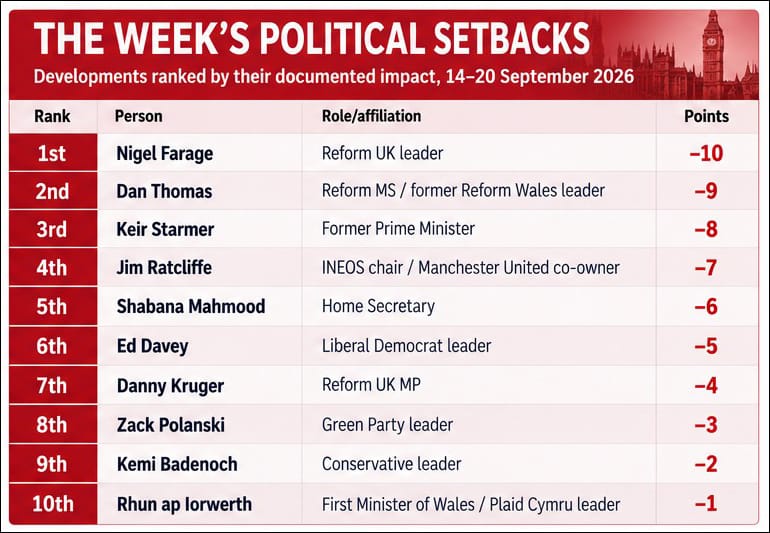
-10pts — Reform’s £72m donations controversy dominates the adverse board
The strongest adverse development is associated with Nigel Farage after Reform UK’s receipt of two extraordinary £36m donations, from Ben Delo and Christopher Harborne, became one of the most prominent political stories of the week. Farage defended the donations as an investment in political competition.
What makes the story particularly significant for this tracker is the combination of unprecedented financial scale, sustained national coverage, proposed changes to political-finance rules and measurable public reaction. Opinium found that 57% regarded a £36m individual political donation as unacceptable, against 20% who considered it acceptable. Asked specifically about Reform’s £72m, 47% supported imposing a donation cap retrospectively, while another 22% supported a cap without retrospective application.
-9pts — Dan Thomas resigns as Reform’s Welsh leader
Dan Thomas receives −9 points after resigning as Reform UK’s Welsh leader following his arrest on suspicion of assault and controlling or coercive behaviour. Thomas was released without charge at that stage and bailed while police inquiries continued. He denied wrongdoing. The timing made the political impact greater because Cooper-Lesadd’s defection occurred on the same day. A senior Reform Wales figure subsequently rejected suggestions that the party was in crisis, while acknowledging that it had been a difficult period.
-8pts — Starmer faces scrutiny over Wormald’s record severance package
Former PM Keir Starmer receives −8 points after publication of details surrounding former cabinet secretary Sir Chris Wormald’s £859,496 exit package. The FT reported that the payment included £526,598 beyond standard contractual compensation and that Starmer personally approved the arrangement. A ministerial direction was required because of value-for-money concerns. The Guardian separately reported that the payment was the largest severance package of its type for a senior UK civil servant.
-7pts — Ratcliffe’s comments provoke sustained political and supporter backlash
Sir Jim Ratcliffe receives −7 points following extensive coverage and criticism of comments about immigration, taxation and Britain’s direction. The Manchester United Muslim Supporters’ Club called for the club’s ownership, including Ratcliffe, to leave after his latest remarks. Government figures also challenged Ratcliffe’s criticism of Britain.
-6pts — Mahmood faces scrutiny over the cost of UK-France migrant returns
Home Secretary Shabana Mahmood receives −6 points after telling MPs of the Home Affairs Committee that returning a person to France under the UK-France “one in, one out” arrangement costs approximately £56,000 per return. Mahmood defended the figure by comparing it with the potential cost of prolonged hotel accommodation for asylum seekers.
-5pts — Davey’s polling weaknesses
Ed Davey receives −5 points after several pieces of evidence pointed in the same direction. Opinium recorded his net approval at −8. The same poll found only 16% agreed that the Liberal Democrats were ready for government, compared with 47% who disagreed.
Kruger, Polanski, Badenoch and ap Iorwerth complete the adverse board
Reform UK MP Danny Kruger receives −4 points after comments characterising people crossing the Channel in small boats as comparatively wealthy generated significant criticism and rebuttal from refugee organisations.
Zack Polanski receives −3 points after the Greens’ executive rejected a proposal to postpone the party conference so that resources could be concentrated on the Holborn and St Pancras by-election.
Conservative leader Kemi Badenoch receives −2 points after her Opinium net approval moved from 0 to −6 in one week, while Conservative voting intention in the same poll fell one point to 18%.
Rhun ap Iorwerth receives −1 point as a separate adverse development. ITV Cymru Wales polling found the proportion saying he was doing a good job had fallen from 44% to 36%, while support for Welsh independence stood at 20%.
Week #1 — Political Impact Table
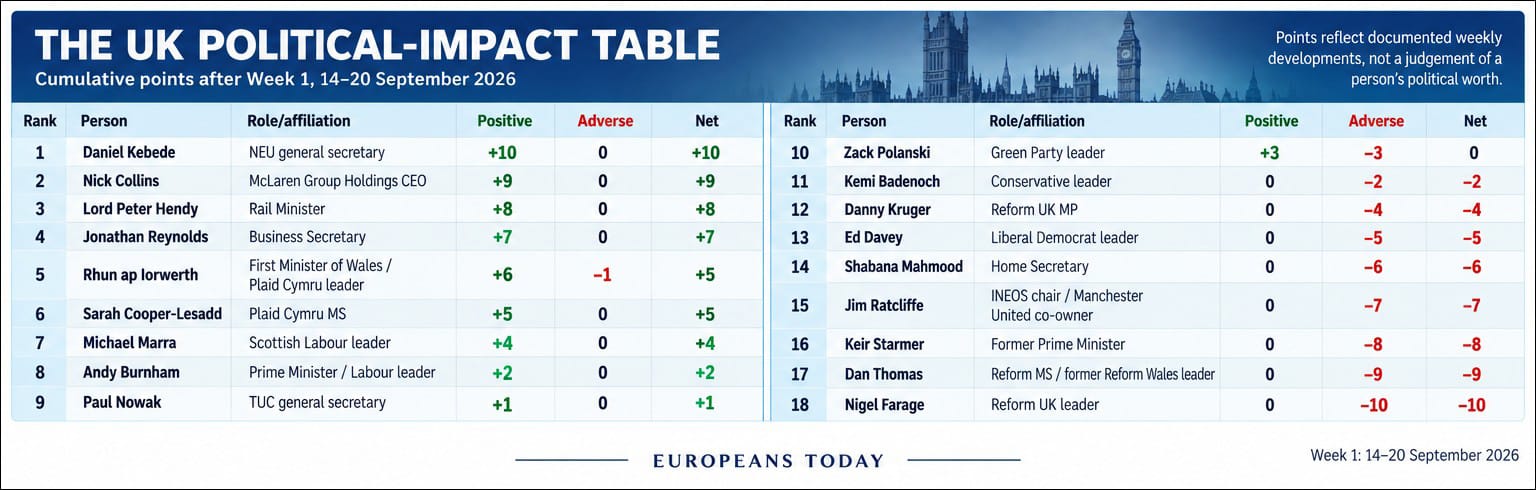
XTRA | How the Political-Impact Table works
The two weekly boards generate the points used in the cumulative table.
A first-place favourable development is worth +10, second place +9 and so on until tenth place receives +1.
A first-place adverse development is worth −10, second place −9 and so on until tenth place receives −1.
If someone appears on both boards, both scores count.
For example, Rhun ap Iorwerth receives +6 from the favourable board and −1 from the adverse board this week, producing a net Week 1 score of +5.
Zack Polanski receives +3 and −3, producing a net score of 0.
The calculation in future editions will be:
New total points = previous cumulative total + this week’s net change.
The tracker is open-ended. Scores will continue accumulating for as long as the series runs rather than automatically expiring after 26 or 52 weeks.
This makes it possible to see whether a person repeatedly accumulates significant favourable developments, adverse developments, or a mixture of both over a prolonged period.
METHODOLOGY
Before assigning the weekly scores, Europeans TODAY searches broadly across official government and parliamentary material, regulators, courts, polling organisations, political parties, trade unions, businesses and major independent news organisations.
Potential entrants are then reviewed individually. That review can include policy delivery, elections, appointments, resignations, defections, court or regulatory action, polling, interviews, speeches, press conferences, business decisions, scandals, investigations, favourable and adverse coverage, public interventions and expert analysis.
Visibility also matters. A highly prominent story can have substantial political impact even without an immediate institutional decision. We therefore consider the breadth, duration and intensity of coverage, together with measurable public reaction where evidence is available.
However, repeated articles about the same event do not generate separate points. They are consolidated into a single underlying development.
Polling is treated cautiously. Small movements rarely justify large scores, and multiple polls showing essentially the same change are considered collectively rather than being stacked as separate developments.
Allegations, investigations, charges and convictions are treated as different categories. An investigation is never presented as proof of guilt. Party-level consequences are also distinguished from evidence of personal responsibility.
The weekly positions therefore represent an editorial assessment of the documented political significance of developments, using a consistent points framework. They are not ratings of personal competence, character or political desirability.
Follow our UK Political-Impact Tracker every week for the latest favourable developments, adverse developments and cumulative political-impact scores.
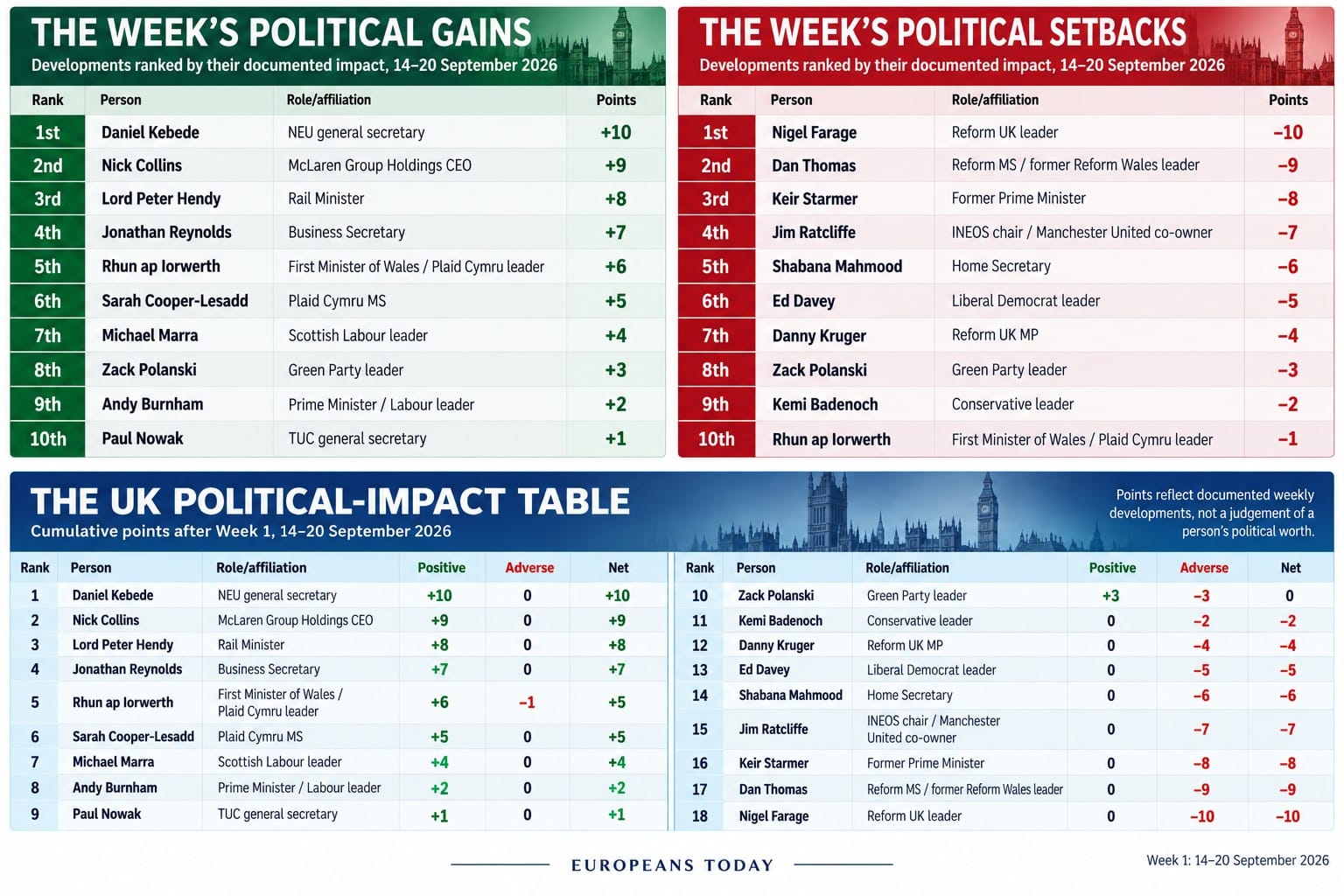

GOING FURTHER
- Opinium, Voting intention and political attitudes, published 19 September 2026
- Ipsos, Labour four points ahead approaching conference season, 20 September 2026
- UK Government, McLaren £500m UK investment announcement, 16 September 2026
- Department for Transport, Chiltern Railways brought into public ownership, 17 September 2026
- Department for Business, Government moves to acquire Speciality Steel UK, 14 September 2026
- Welsh Government, Cardiff Agreement, 14 September 2026
- ITV Cymru Wales, Sarah Cooper-Lesadd defects to Plaid Cymru, 15 September 2026
- Bank of England, Court appointments including Paul Nowak, 16 September 2026
Sources:
▪ This piece was first published in Europeans TODAY on 21 September 2026.
▪ Cover: Dreamstime/KORWEN.