Brazil’s presidential election and the attempted return of the far-right to power
Brazil’s election on Sunday could return the far-right Bolsonaro movement to power despite its founder and senior allies being convicted over an attempt to overturn the country’s democratic order.

.
🔍 WHY THIS STORY MATTERS
Brazil’s election could return the Bolsonaro movement to the presidency after Jair Bolsonaro and senior allies were convicted over a coup plot, raising questions about judicial accountability and democratic institutions.
KEY TAKEAWAYS...
● Flávio Bolsonaro, the son of former far-right president Jair Bolsonaro, is challenging President Luiz Inácio Lula da Silva for the presidency.
● The election comes less than four years after Bolsonaro supporters attacked Brazil’s Congress, Supreme Court and presidential palace.
● Jair Bolsonaro and senior allies, including military officers, were subsequently convicted over a broader coup plot.
● Flávio Bolsonaro has promised to pardon his father if elected and announced plans to appoint five firmly conservative Supreme Court judges.
B razilian voters head to the polls on Sunday with the Bolsonaro movement seeking a return to the presidency less than four years after supporters of Jair Bolsonaro stormed the institutions at the heart of the country’s democracy.
The events of 8 January 2023 are central to understanding the stakes surrounding this election.
Thousands of Bolsonaro supporters invaded and vandalised Brazil’s Congress, Supreme Court and presidential palace in Brasília, one week after Luiz Inácio Lula da Silva took office. Many rejected Bolsonaro’s 2022 electoral defeat and demanded military intervention against Lula’s government.
The violence did not emerge in isolation. Investigations uncovered a broader attempt to prevent the democratic transfer of power.
Brazil’s Supreme Court subsequently convicted Jair Bolsonaro of participating in a coup plot intended to keep him in office. He was sentenced to more than 27 years in prison. Seven close allies were also convicted, including senior military officers.
The military dimension requires an important distinction. Bolsonaro discussed measures to remain in power with military commanders, but the armed forces did not collectively support the plan. Senior military figures were implicated in the conspiracy, while the army and air force commanders refused to participate.
The January assault nevertheless exposed serious failures within the security apparatus. Supreme Court justice Alexandre de Moraes said shortly afterwards that the attacks could only have occurred with the acquiescence or involvement of public security and intelligence authorities.
Those events now form the backdrop to an extraordinary political comeback attempt.
Flávio Bolsonaro, Jair Bolsonaro’s son, is challenging Lula for the presidency. He has promised to pardon his father if elected and announced plans to appoint five firmly conservative Supreme Court judges.
For Bolsonaro supporters, the election offers an opportunity to return conservative government to power. For opponents, it raises a different question: what would happen to the accountability established after Brazil resisted an attempt to overturn its previous presidential election?
Lula has described the choice in stark terms, telling supporters that Brazil must consolidate its democracy or risk losing it.
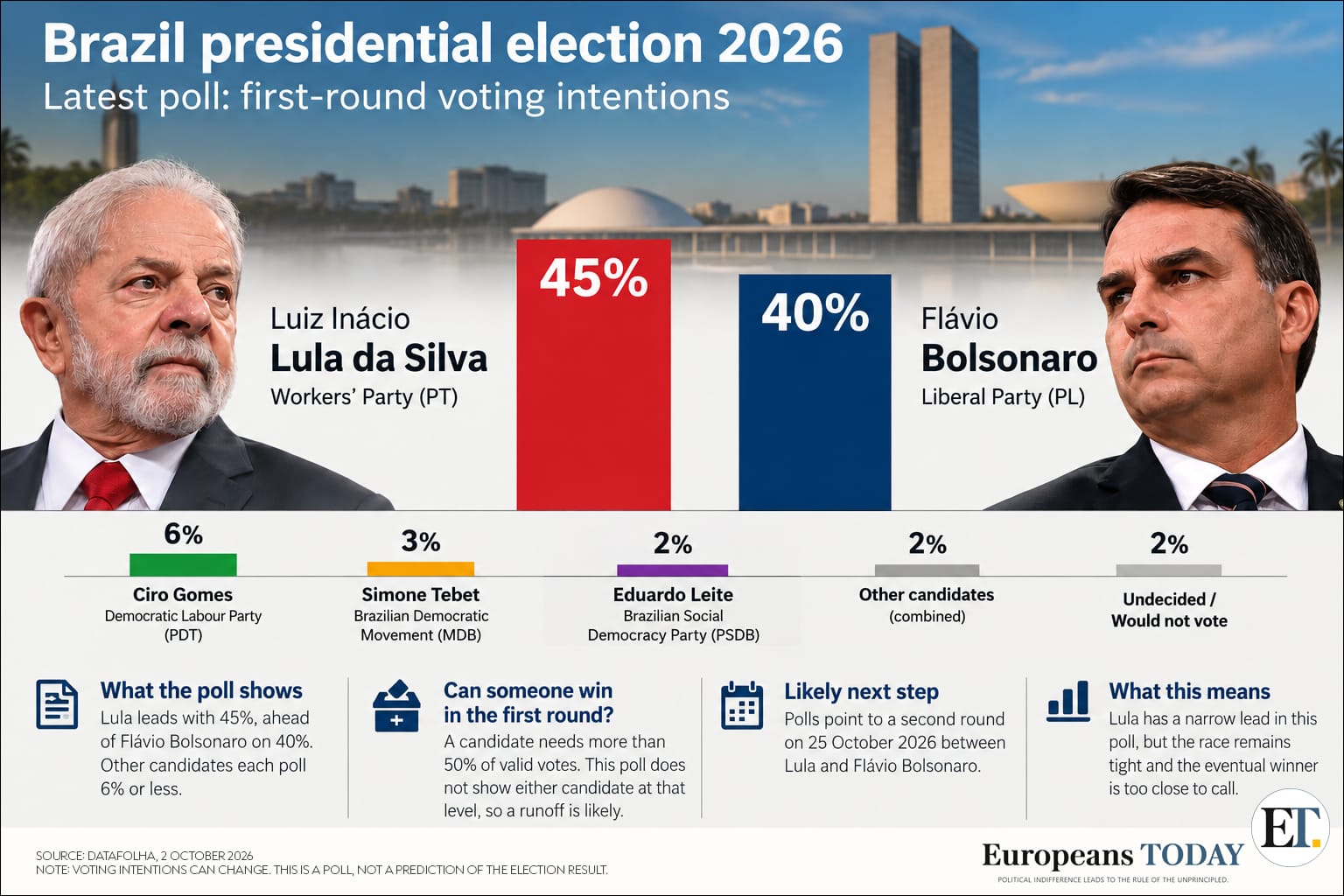
The president enters Sunday’s first round with a narrow lead in the latest Datafolha polling, at about 45% against Flávio Bolsonaro’s 40%. Neither is currently polling at the level required for an outright first-round victory, making a 25 October runoff the expected next stage. The wider contest remains too close to call.
The events following the previous election are well documented. Bolsonaro supporters attacked the physical seats of Brazil’s three branches of government, while Bolsonaro and senior allies were later convicted over a broader attempt to overthrow the democratic order.
That record makes the institutional consequences of Sunday’s vote an unavoidable part of Brazil’s election.
🔮 WHAT MATTERS NEXT...
🎯 WHAT TO WATCH NEXT:
● Brazilians vote in the first round on 4 October, with attention focused on whether the presidential contest proceeds to the scheduled runoff.
● The performance of congressional candidates will also matter because any future president’s ability to implement institutional changes will depend partly on support in Congress.
● Flávio Bolsonaro’s pledge to pardon his father will remain under scrutiny, particularly over its legal and institutional implications.
● The composition and future appointments of Brazil’s Supreme Court will remain important because the court played a central role in proceedings arising from the attempted overturning of the 2022 election.
🎯 WHAT COULD CHANGE THE PICTURE:
● Turnout, late movement among undecided voters and the eventual distribution of congressional seats could materially affect both the presidential contest and the governing environment after the election.
🎯 WHY THIS MATTERS:
● Whoever wins will inherit a democracy still dealing with the institutional consequences of the attempt to overturn the result of Brazil’s previous presidential election.

GOING FURTHER
Lula says only he can stop rise of fascism under Bolsonaro’s son | THE GUARDIAN
Jair Bolsonaro convicted over coup plot | THE GUARDIAN
Jair Bolsonaro’s coup conviction explained | THE GUARDIAN
Bolsonaro supporters storm Brazil’s presidential palace, Congress and Supreme Court | THE GUARDIAN
Brazil confronts the aftermath of the 8 January attacks | ASSOCIATED PRESS
Brazil’s election and the Bolsonaro political comeback | ASSOCIATED PRESS
Sources:
▪ This piece was first published in Europeans TODAY on 3 October 2026.
▪ Cover: Dreamstime/KORWEN.