As Bolsonaro leads him into Brazil runoff and abstention hits record, where can Lula find the votes to recover?
Flávio Bolsonaro leads Lula by 2.22 million votes after Brazil’s first round, but a record 33.47 million voters stayed home. The runoff will test whether President Lula can expand his electorate as Brazilians choose between sharply different programmes and competing visions of the Bolsonaro legacy.

.
🔍 WHY THIS STORY MATTERS
Brazil’s runoff pits sharply different political programmes against each other, while record abstention means mobilisation could matter almost as much as persuasion in deciding the presidency.
KEY TAKEAWAYS...
● Far-right Flávio Bolsonaro leads left-wing President Lula by 2,224,965 votes after the first round.
● A record 33.47 million registered Brazilians did not vote, almost 15 times the gap between the finalists.
● Lula can seek additional support among abstainers, voters for eliminated candidates and nearly six million people who cast blank or null ballots, but Bolsonaro can compete for the same groups.
● The runoff also presents contrasting choices on welfare, public spending, crime, climate policy, religion, and the future of Jair Bolsonaro.
B razil’s presidential election will be decided on 25 October after the far-right candidate, Senator Flávio Bolsonaro, finished ahead of left-wing President Luiz Inácio Lula da Silva, turning the next three weeks into a contest not only over which candidate can change minds, but over which Brazilians can be persuaded to vote at all.
With 100% of ballot boxes counted, TSE (Brazil’s Superior Electoral Court) figures give Bolsonaro 56,104,503 votes (47.03% of valid votes), against 53,879,538 (45.16%) for Lula. Neither obtained the majority required to win outright, sending them to the 25 October runoff.
The margin is historically narrow. The difference is 2.2 million votes, or 1.87%. Folha de S.Paulo reported that it is the smallest first-round gap between the two leading presidential candidates since Brazil’s redemocratisation.
Yet Bolsonaro begins the new campaign with something Lula does not have: first place. “Brazil wants change,” Bolsonaro said after the count. Lula acknowledged that the result was “unexpected” and declared: “Tomorrow we start a new campaign.” The question is what that new campaign can change.
What does Lula stand for?
The choice is ideological as well as personal.
Lula’s programme places a larger role on the state in economic development. He proposes maintaining Brazil’s fiscal framework while using public investment, infrastructure programmes, industrial policy and housing programmes to support growth. His political identity remains closely associated with Bolsa Família, minimum-wage increases, labour rights, and redistribution.
He has also backed ending the six-day working week without reducing salaries, an attempt to reconnect the Workers’ Party (PT) with everyday questions of work and quality of life.
On public security, Lula proposes greater federal coordination rather than Bolsonaro’s emphasis on punishment: a Ministry of Public Security, integration of intelligence and police data, financial pressure on organised crime, tighter control of weapons and greater cooperation between federal and state authorities.
On the environment, Lula promises zero net Amazon deforestation by 2030. His government has presided over a substantial fall in deforestation since returning to office, although environmentalists have also criticised its continued willingness to expand fossil-fuel production.
His political difficulty is that improved employment and income figures have not eliminated dissatisfaction over everyday living costs. Folha de S.Paulo reports that expensive food, indebtedness and pressure on household budgets have weakened the electoral benefits Lula might otherwise have expected from favourable economic indicators.
What does Flávio Bolsonaro stand for?
Bolsonaro offers a smaller-state economic programme and a considerably tougher criminal-justice agenda.
His programme proposes a new spending ceiling, cutting at least ten ministries, reducing administrative expenditure and accelerating privatisations and concessions. Folha de S.Paulo describes his economic proposal as a deep spending-cutting programme, while Lula argues for continued public investment.
On crime, Bolsonaro proposes classifying major factions such as the PCC and Comando Vermelho as narcoterrorist organisations, reducing the age of criminal responsibility, restricting sentence progression, building new high-security prisons and sharply expanding surveillance. His programme also proposes chemical castration for people convicted of some sexual offences.
Both candidates say they want to attack organised crime financially. Their disagreement is principally over the extent to which the answer lies in institutional coordination and prevention, as Lula argues, or harsher punishment, imprisonment and policing, as Bolsonaro proposes.
Environmentally, their programmes also diverge. Bolsonaro promises to end illegal deforestation by 2029 but has questioned human-caused climate change, supports weaker environmental restrictions and favours greater possibilities for mining and agricultural development. Lula promises zero net deforestation by 2030.
Internationally, Bolsonaro favours a closer relationship with Donald Trump’s United States. Lula has made Brazilian sovereignty a campaign theme and favours maintaining Brazil’s more independent position between Washington, Beijing and the wider BRICS grouping. Associated Press
There is, however, another defining element of a Flávio Bolsonaro presidency: his father.
— Flávio Bolsonaro (@FlavioBolsonaro) May 26, 2026
Flávio Bolsonaro shared a photo showing him meeting with US President Donald Trump at the White House to bolster his image in Brazil.
Bolsonaro says he would pardon his father
Former president Jair Bolsonaro is currently serving a 27-year prison sentence after his conviction for attempting to overthrow Brazil’s democratic order following his 2022 election defeat.
Flávio Bolsonaro rejects the conclusion that his father attempted a coup and has explicitly said that, if elected, he would pardon him.
“I can’t distance myself from him,” he told The Washington Post. “I will defend him and his administration.”
Associated Press reports that releasing his father and bringing him back into political life has been part of Bolsonaro’s campaign. That matters because Flávio has simultaneously tried to present himself as a more restrained version of Jair Bolsonaro.
He told The Washington Post: “I’m the Bolsonaro you always wanted,” arguing that the moderation would principally be in how he communicates his ideas. His substantive programme nevertheless retains much of the family’s conservative political project.
Past associations, religion and allegations under scrutiny
Flávio Bolsonaro has faced scrutiny over his relationship with Adriano da Nóbrega, a former police officer later linked by prosecutors to Rio militia activity. Bolsonaro formally praised Nóbrega in 2003. After Nóbrega was arrested on a murder charge, Bolsonaro nominated him in 2005 for the Tiradentes Medal, the Rio state legislature’s highest honour. Nóbrega was convicted later that year, but the conviction was overturned, and he was acquitted at a retrial in 2007. Nóbrega’s wife and mother also worked in Bolsonaro’s legislative office. Bolsonaro denies involvement with militias and has said he believed Nóbrega was innocent in the murder case.
Flávio Bolsonaro’s evangelical rhetoric has also stirred concern among some Brazilian Catholics. He said that, if elected, he would “declare that Brazil belongs to the Lord Jesus Christ”. A viral claim that he intended to remove Our Lady of Aparecida as Brazil’s patron saint was unsubstantiated, and Bolsonaro denied any such plan. The episode nevertheless highlighted political sensitivities surrounding Brazil’s Catholic majority and its rapidly growing evangelical population.
Brazilian outlet PlatôBR alleged that Flávio Bolsonaro had attended parties with sex workers, citing purported material involving former business partner Alexandre Santini. The Workers’ Party amplified allegations of supposed “orgies” during the campaign. However, Folha de S.Paulo said it had been unable to independently verify PlatôBR’s reporting. Bolsonaro declined to answer journalists’ questions about the allegations at the time.
Separately, Bolsonaro is formally under investigation over his role in seeking financing from former Banco Master owner Daniel Vorcaro for Dark Horse, a film about Jair Bolsonaro. Police documents reported by Folha de S.Paulo say Flávio acted as a direct interlocutor in funding negotiations. He has acknowledged seeking money for the film but denies receiving improper advantages or wrongdoing. Allegations concerning parties organised by Vorcaro are separate and do not establish that Flávio Bolsonaro attended them.
Why did Bolsonaro finish ahead?
Whatever weight voters placed on these controversies, they did not prevent Bolsonaro from finishing first. Part of the first-round story appears to be dissatisfaction with the incumbent government and Bolsonaro’s successful effort to present himself as the candidate of change.
Folha de S.Paulo’s post-election analysis argues that Lula’s focus on democracy, sovereignty and positive economic indicators failed to neutralise anti-Workers’ Party sentiment or dissatisfaction over household finances.
The result also raises a deeper question for the Brazilian left. Lula’s renewed focus on ending the six-day working week speaks directly to formally employed workers. But Brazil’s workforce also contains millions of self-employed people, informal workers, small entrepreneurs, and people earning through digital platforms.
Whether Lula can make a traditional labour and social-protection agenda resonate with those voters will be one of the questions of the second round.
Then there are 33.4 million people who did not vote
The largest potential source of additional votes did not choose Bolsonaro, Lula or anyone else.
They stayed home.
The 33,469,244 absentees represent a record number for a presidential first round. The 21.08% abstention rate is the highest since 1998, when 21.49% of voters stayed home. Folha de S.Paulo reported that the previous presidential first round, in 2022, recorded 20.9% abstention, with about 32.7 million voters absent.
Compare those 33.47 million absentees with Bolsonaro’s lead over Lula: 2,224,965 votes. Just over 15 times as many Brazilians stayed home as separate the two finalists. That is why turnout matters.
The record abstention gives Lula a potentially important electorate to mobilise, but the 33.47 million people cannot be treated as latent Lula voters. Some may prefer Lula. Some may prefer Bolsonaro. Others may dislike both. Some did not vote for practical rather than political reasons.
Detailed demographic information for this year’s first-round absentees is not yet sufficient to determine how they would divide politically. There is nevertheless evidence that the question is particularly relevant to Lula.
Before the vote, Brazilian political scientist Antônio Lavareda pointed out that lower-income and less-educated voters, constituencies in which Lula has traditionally performed strongly, have historically shown higher abstention.
And after the result, Mayra Goulart, a political scientist at the Federal University of Rio de Janeiro, explicitly identified turnout as part of Lula’s second-round challenge, telling Associated Press that his campaign should examine voters for eliminated candidates and “try to reduce abstention”.
So the idea that Lula needs to persuade some non-voters to turn up is not simply an exercise in electoral arithmetic. Brazilian specialists are discussing it.
Almost six million more voters rejected every candidate
There is another significant group.
The final TSE count records 2,300,798 blank ballots and 3,674,249 null ballots. Together, that is 5,975,047 votes, from people who went to vote but did not register a valid presidential choice.
Add them to the 33,469,244 abstentions, and 39,444,291 registered voters either stayed home or cast no valid presidential vote. That figure is about 17.7 times Bolsonaro’s final advantage of 2,224,965 votes.
Again, it would be wrong to treat them as Lula votes waiting to be collected. But it illustrates how much larger the potentially movable electorate is than the distance separating the candidates.
A third pool: voters whose candidates have been eliminated
Lula also has to compete for people who cast valid ballots for somebody else.
Augusto Cury finished third with about 3.45 million votes. Renan Santos and Ronaldo Caiado, together with the remaining minor candidates, take the total number of votes cast for eliminated candidates to roughly 9.3 million.
Associated Press reports that Cury does not intend to endorse either finalist and that Caiado and Santos had also previously said they would not do so.
Those voters cannot simply be transferred to the candidate their former choice endorses or refuses to endorse.
Pre-election Datafolha polling actually suggested that supporters of Cury, Caiado and Renan Santos who expressed a runoff preference leaned more towards Bolsonaro than Lula, although these were relatively small subgroups and must be interpreted cautiously.
That makes abstention potentially even more important to Lula’s arithmetic.
Bolsonaro can expand too
There is a temptation to reason that Bolsonaro’s supporters are highly motivated and therefore almost all of his potential electorate must already have voted. Brazil’s recent history warns against that assumption. In 2022, Jair Bolsonaro increased his total by roughly seven million votes between the first and second rounds, while Lula added roughly three million.
Those additional Bolsonaro votes cannot all be identified as first-round abstainers. They included voters who had backed eliminated candidates and potentially people who had cast invalid ballots. But the comparison demonstrates that a strongly mobilised Bolsonaro movement can still find millions of additional votes between rounds.
Flávio Bolsonaro is therefore competing for exactly the same broad pools as Lula: abstainers, supporters of eliminated candidates, and blank or null voters.
Lula does not simply need another 2.22 million people
This is the essential arithmetic. Lula trails by 2,224,965 votes. But if Lula gains one million new voters and Bolsonaro gains one million too, nothing changes. Lula needs a net shift of more than 2,224,965 votes in his favour.
That can happen through several combinations: more Lula-inclined abstainers turning out, more supporters of eliminated candidates choosing him, previous blank or null voters casting a valid Lula vote, Bolsonaro voters staying home, or a smaller number actually switching between the finalists.
The second-round electorate does not have to be identical to the first-round electorate.
Brazil saw abstention fall slightly between the first and second rounds in 2022. That does not prove the same thing will happen in 2026, nor that any increase in participation would benefit Lula. But it establishes that first-round non-voters can return once the contest narrows to two candidates.
That makes the next three weeks two campaigns at once. One is a campaign of persuasion, fought over people who already voted but can change their choice. The other is a campaign of mobilisation, fought over who turns up in the first place.
Flávio Bolsonaro begins with 56.10 million votes. Lula begins with 53.88 million.
But 33.47 million registered Brazilians stayed home, 5.98 million voted blank or null, and 9.32 million backed candidates who are no longer in the race.
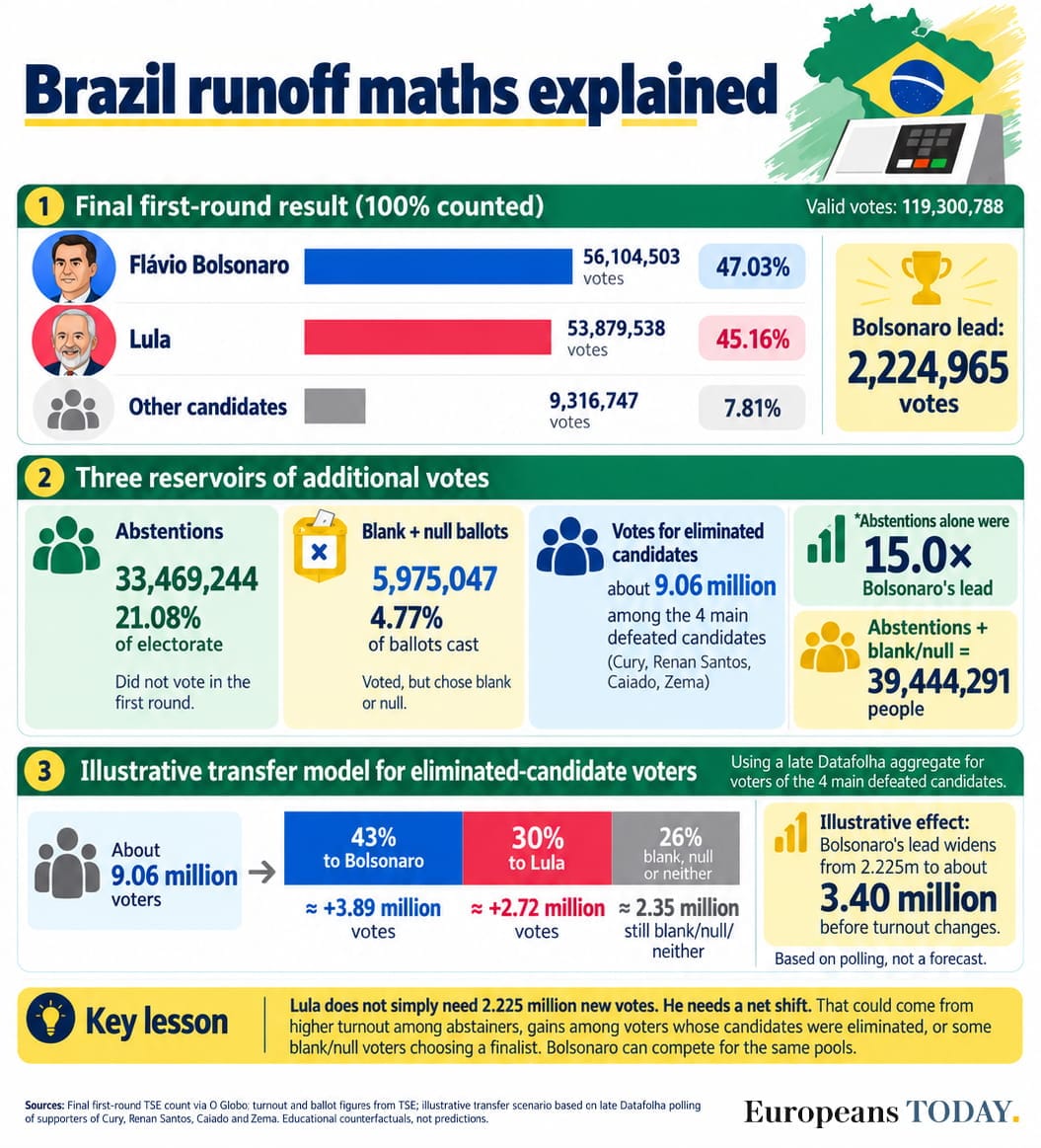
Bolsonaro enters the runoff ahead, and pre-election polling suggested potentially favourable arithmetic for him among some voters whose candidates were eliminated. Lula nevertheless faces a deficit small enough to be overcome through a combination of higher turnout, support from voters who backed eliminated candidates, blank or null voters choosing a finalist, and any switching between the two candidates. The central unknown is whether the electorate on 25 October looks materially different from the one that voted in the first round.
The first round established who leads.
It did not establish who will constitute the electorate that decides Brazil’s presidency on 25 October.
🔮 WHAT MATTERS NEXT...
🎯 WHAT TO WATCH NEXT:
● Both campaigns are likely to intensify turnout operations, particularly in regions and social groups where abstention was high.
● Watch whether Augusto Cury, Ronaldo Caiado, Renan Santos or other eliminated candidates remain neutral, and whether their supporters follow any later endorsements.
● Watch for new polling measuring whether first-round abstainers and blank or null voters intend to participate on 25 October.
● Lula’s campaign is likely to test whether labour protections, Bolsa Família and cost-of-living messages can expand his support beyond his first-round coalition.
● Bolsonaro’s campaign will seek to preserve its first-round mobilisation while defending his record, his relationship with Jair Bolsonaro, and his tougher security platform.
🎯 MOST LIKELY OUTCOME:
● The second round is likely to remain highly competitive and focused on mobilisation as well as persuasion. Current evidence does not support a responsible prediction of the winner.
🎯 WHAT COULD CHANGE THE PICTURE:
● A significant shift in turnout, unexpectedly strong movement among supporters of eliminated candidates, or a major political, economic or legal development during the campaign could alter the balance.
🎯 WHY THIS MATTERS:
● Brazil’s next president will shape policy on democratic institutions, crime, inequality, climate and international alignment, while the turnout battle will test who is actually represented in the final result.

GOING FURTHER
Bolsonaro and Lula head to runoff: 5 takeaways from Brazil’s election | The Washington Post
Brazil’s Bolsonaro dynasty closes in on stunning comeback | Financial Times
Brazilians will vote in a highly polarized presidential race on Sunday. Here’s what to know | Associated Press
Future of Amazon rainforest policies at stake in Brazilian presidential election | Associated Press
Bolsonaro’s son runs for president with a mission: Get dad out of prison | The Washington Post
What to know about the viral claim about Brazil’s patron saint jolting a tight presidential race | Associated Press
Abstenção bate recorde e vai a 21%, com mais de 33 milhões de ausentes | Folha de S.Paulo
PT explora reportagem que liga Flávio Bolsonaro a garotas de programa e Rolex, e candidato evita responder | Folha de S.Paulo
Diferença entre Flávio e Lula é a menor da história no 1º turno em eleição presidencial | Folha de S.Paulo
Abstenção bate recorde e vai a 21% com mais de 33 milhões de ausentes | Folha de S.Paulo
Crescente no 1º turno desde 2006, abstenção pode definir eleição com cenário apertado | Folha de S.Paulo
Veja pontos em que os planos de governo de Lula e Flávio Bolsonaro divergem | Folha de S.Paulo
Lula e Flávio Bolsonaro propõem caminhos diferentes para derrotar facções | Folha de S.Paulo
Ex-PM estava preso por homicídio quando Flávio Bolsonaro o homenageou | Folha de S.Paulo
PT explora reportagem que liga Flávio Bolsonaro a garotas de programa e Rolex e candidato evita responder | Folha de S.Paulo
Flávio Bolsonaro negociava recursos para Dark Horse com Vorcaro e Eduardo era gestor do dinheiro, diz PF | Folha de S.Paulo
Sources:
▪ This piece was first published in Europeans TODAY on 5 October 2026.
▪ Cover: Dreamstime/KORWEN.