What the battle between Nigel Farage and Count Binface really tells us about Britain’s mood
Nigel Farage’s Clacton by-election win masks an unusual protest signal, with Count Binface taking more than a quarter of votes as the standards inquiry resumes.

🔍 WHY THIS STORY MATTERS
Clacton delivered Farage a decisive victory but also an extraordinary protest vote, testing how much can legitimately be inferred about wider British politics from an atypical contest without mainstream-party challengers.
KEY TAKEAWAYS...
● Nigel Farage retained Clacton with more than 63% of votes cast, while turnout remained below 45%.
● Count Binface finished second with 9,455 votes, taking more than a quarter of the ballots cast.
● The contest featured a record 34 candidates after the other major political parties declined to stand.
● Farage’s return to Parliament means the parliamentary standards investigation into his financial declarations resumes.
T he people of Clacton have spoken. Well, 44% of them have, with the majority of eligible voters staying at home rather than cast their ballot in the byelection. Reform UK leader Nigel Farage, the winning candidate, also stayed away – snubbing the count at Clacton leisure centre after claiming police had warned him of an organised campaign to disrupt proceedings.
In the end, Farage received 63% of the vote, amounting to an endorsement from only 28% of the eligible electorate. That his second-place rival was a joke candidate standing as an “independent space warrior” wearing a bin-shaped helmet would seem to bear out the Daily Mail’s observation that “when voters are shouting at you, it’s bad. When they’re laughing at you, it’s over”. Count Binface received 9,455 votes – one in four of those cast.
Byelections are supposed to take place because a member is no longer able to serve. In Farage’s petulant speech of July 7, when he stood down as MP for the Essex constituency, he objected to being held accountable for undeclared payments from a foreign national. He stated that he could make some “real big money” in the US, where he said he had “plenty of offers”.
Farage went on to say he wanted the people of Clacton to judge him and now – after the votes have been counted – says the result “speaks for itself”.
But this byelection was not an opportunity for the voters of Clacton to scrutinise the sources of Farage’s finances. No hard evidence was presented to them. And they have other things to do with their time than pursue the kind of forensic investigation that a parliamentary standards commissioner will be able to carry out. Now that Farage is once again an MP, the previously opened probe resumes.
It is not as if the voters of Clacton don’t have other pressing issues to think about. According to government findings, one part of the constituency (Jaywick) is the most deprived area in England. The number of people in Clacton leaving school with no formal qualifications is reckoned to be the second highest of any town in England. Parts of the district has one of the lowest life expectancies and highest under-75 mortality rates nationwide. Nearly half of the working-age population is economically inactive, heavily exceeding the national average.
This is a population that may well want to be pick a fight with “the establishment”. But promoting the career of a multimillionaire politician is probably not the best way to go about it
An expression of mood, not politics
So what does this byelection say about contemporary British politics? The Farage narrative suggests that it is about the heroic representation of the real people by a leader who is uniquely capable of speaking their language.
But what was most striking in the Clacton panto-plebiscite, where a record 34 candidates faced off against each other, was the cynical disconnect between Westminster politics and the experiences of people who feel ground down and institutionally neglected. (Not to mention so far from political decision-making that one in four of them chose to vote for a bloke with his tongue in his cheek and a bin over his head.)
This byelection was less about political choices than the expression of a public mood – democracy as a register of feelings rather than the “who gets what, when and how” summed up by American political scientist Harold Laswell.
Farage does not offer his followers a way out of their deprived status. After all, the one cluster of policies that really motivates him – ending mass immigration – is hardly going to invigorate Clacton. It is one of the least ethnically diverse constituencies in England, with 96% of residents classed as white.
The story that Farage tells – and he does so masterfully – is of a last-ditch attempt to save Britain from contamination by globalism, as if any contemporary nation state could possibly stand alone against the might of transnational corporations and the all-powerful bond markets.
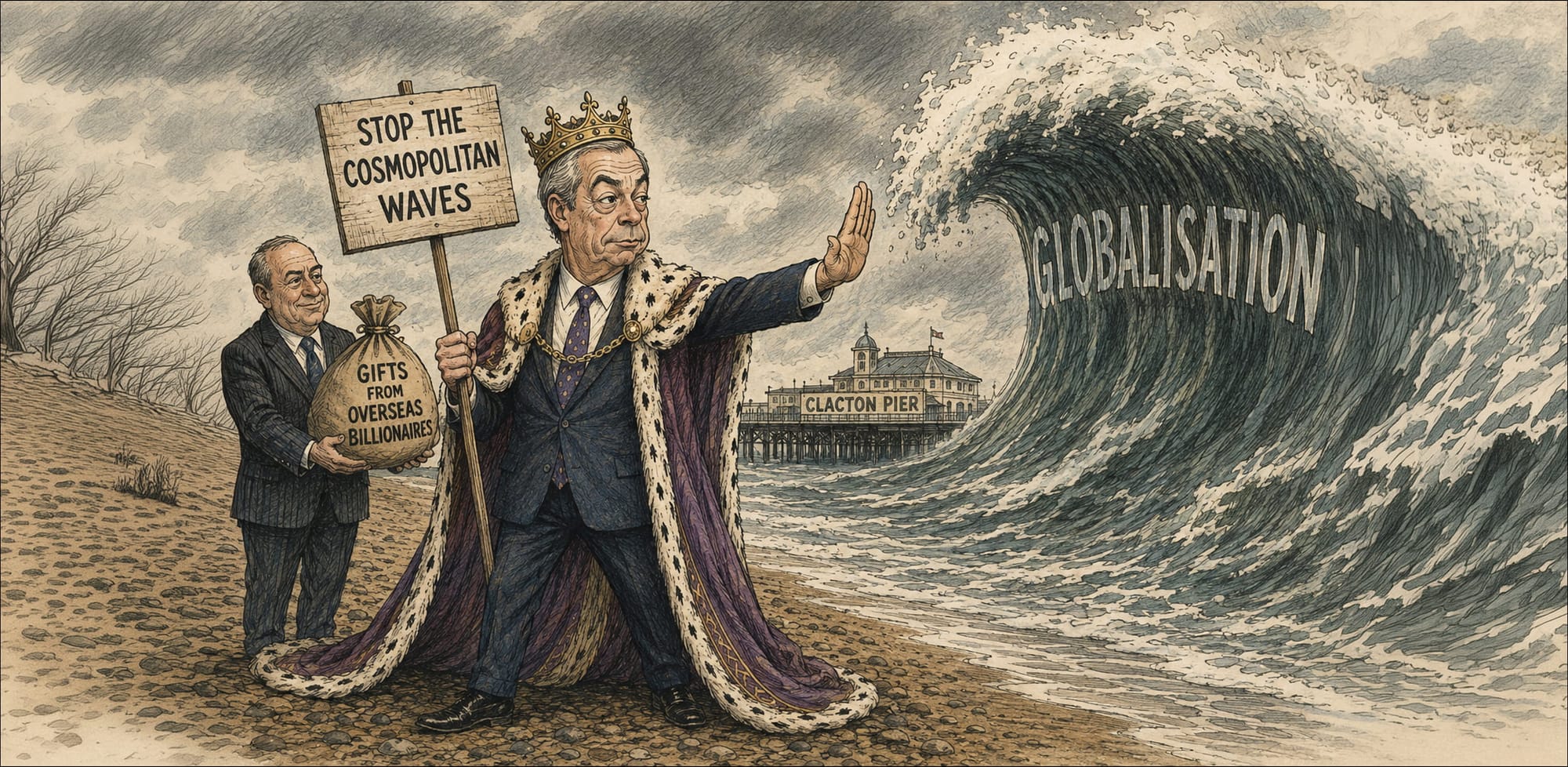
Fittingly for a coastal town MP, Farage is a King Canute, publicly promising to hold back the cosmopolitan waves while privately accepting gifts from overseas billionaires.
The problem with Farage’s narrative is that it requires ongoing supplies of rhetorical fury to stir the passions of its believers. Reform UK faces competition from Rupert Lowe’s far-right Restore Britain party, with its support from Elon Musk, who fell out with Farage apparently over the Reform leader’s unwillingness to back far-right agitator Tommy Robinson.
The narrative of deep resentment has a self-inflating quality. For every outrage identified or manufactured, there is always greater public fury that can be ignited. The competition between rival groups to arouse ever-greater degrees of what Farage has called “pure cold rage” can have dangerous consequences.
It is unclear whether the electoral absurdity at Clacton will be seen by historians as a precursor to Farage’s reputational rehabilitation and onward march to Downing Street, or a further step on the slippery slope towards greater political ugliness. Either way, Count Binface’s footnote status in the chronicles is assured – along with the nearly 10,000 voters who believed that their future would be best represented by a dustbin.
🔮 WHAT MATTERS NEXT...
🎯 WHAT TO WATCH NEXT:
● Whether the parliamentary standards commissioner’s resumed investigation concludes that Farage should have declared the financial support under examination.
● Whether any adverse finding progresses to a Commons sanction severe enough to open the possibility of a recall process in Clacton.
● How Farage and Reform UK respond as scrutiny of political donations and financial support returns to the centre of the story.
● Whether future elections with mainstream-party competition produce anything resembling Clacton’s unusually large protest vote for a satirical candidate.
🎯 MOST LIKELY OUTCOME:
● Farage remains MP while the standards process runs its course, with the Clacton result cited by supporters as vindication but its wider electoral significance remaining disputed.
🎯 WHAT COULD CHANGE THE PICTURE:
● A serious adverse standards finding — particularly one capable of triggering parliamentary sanctions and a recall process — would shift attention from the electoral spectacle back to accountability.
🎯 WHY THIS MATTERS:
● Clacton tests whether electoral popularity can be separated from parliamentary accountability and whether an extraordinary local contest offers any reliable guide to Britain’s wider political direction.

GOING FURTHER
Five questions over Nigel Farage’s £5 million donation | EUROPEANS TODAY
Nigel Farage wins Clacton byelection in contest boycotted by other main parties | The Guardian
Standards watchdog resumes Farage probe as rivals slam needless byelection | The Guardian
Farage £5m ‘gift’ inquiry reopened after Clacton by-election win | Sky News
‘He goes a bit funny if you use his real name’: the unstoppable rise of Count Binface | The Guardian
Sources:
▪ This piece was originally published in The Conversation and re-published in Europeans TODAY on 14 August 2026. | The author writes in a personal capacity.
▪ Cover: Dreamstime/KORWEN.