Violence escalates at French school blockades as government links far-left party to mobilisation
Hundreds of police officers have been injured, school staff assaulted, and public buildings and emergency vehicles attacked in France’s lycées unrest, as French authorities say intelligence services attribute the mobilisation to far-left and ultra-left.

.
🔍 WHY THIS STORY MATTERS
France’s lycées unrest now combines genuine education grievances, serious violence and an intelligence-based government accusation against the far-left, raising questions about political responsibility, public order and the limits of mobilisation.
KEY TAKEAWAYS...
● French authorities reported 1,949 arrests and 305 injured police officers and gendarmes on Thursday.
● School staff, headteachers, firefighters, and public property have also been targeted during serious incidents.
● Prime minister’s office says French intelligence services assess that far-left and ultra-left networks helped organise the lycée mobilisation.
V iolence surrounding France’s lycées blockades escalated sharply on Thursday, with hundreds of police officers injured, school staff assaulted, schools damaged by fire and emergency vehicles attacked, as the government said intelligence services link La France insoumise (LFI) and ultra-left networks to the organisation of the mobilisation.
The Interior Ministry said 1,949 people were arrested across France on Thursday, principally over violence, attacks on people exercising public authority and unlawful gatherings. It reported 305 police officers and gendarmes injured during the day. The Justice Ministry said 1,793 people had been placed in police custody since Monday.
The toll within the education system was also substantial. Education Minister Édouard Geffray said 65 school staff and 170 pupils had been injured since the movement began. According to education authorities and union representatives, several headteachers had been assaulted or manhandled during blockades.
More than 400 establishments are expected to remain closed on Friday, with lessons moved online where necessary.
Unfortunately, some incidents went far beyond blocking school entrances.
In Nantes, a fire destroyed the entrance hall of Lycée Nelson-Mandela and damaged its facade. Euronews reported that the deputy head described the fire as apparently deliberate, although its precise origin was still being established. The building was not expected to reopen physically before the November holidays.
In Nantes, a fire destroyed the entrance hall of Lycée Nelson-Mandela and damaged its facade. | FRANCE 24
In Marseille, firefighters responding to a fire outside Lycée Saint-Exupéry were attacked, and one of their vehicles was burned. A firefighter was struck by a projectile and suffered a facial fracture. A bus was also set alight near Lycée La Floride. At Lycée Victor-Hugo, members of staff were splashed with petrol while protesters poured fuel onto containers.
🔴 Marseille : des marins-pompiers ont été pris à partie en marge des manifestations lycéennes.
— TF1Info (@TF1Info) October 1, 2026
👉 Leur véhicule a été pillé puis incendié devant le lycée Saint-Exupéry alors qu’ils intervenaient sur un feu de détritus. Un marin-pompier a été légèrement blessé. pic.twitter.com/c5e95x9Fp3
National Assembly President Yaël Braun-Pivet also described an assault on a policewoman who, she said, heard people shouting “kill her” before being beaten. She cited attacks on firefighters and burning schools while urging MPs to call for calm.
policière passer à tabac sur paris 😱#blocage #blocus #Lycéens #lycee #pauvrefrance pic.twitter.com/Jxid8uf8yE
— sf_2080 (@BallaDiawara15) October 1, 2026
Obviously, the violence we see in the streets of France does not characterise every blockade or every student taking part. Students have repeatedly raised concerns about absent teachers, overcrowding, deteriorating buildings, demanding timetables, and a lack of educational resources. Le Monde has reported peaceful mobilisation alongside the serious disorder.
But the scale of the violent incidents has fundamentally altered the political stakes.
🔴 À Nantes, le hall du lycée Nelson-Mandela a été ravagé par les flammes, sans faire de blessé. Un incendie volontaire, selon la direction. Des lycéens mobilisés disent leur colère de voir leur mouvement associé à ces destructions. #JT20h pic.twitter.com/TwIFMLwgaC
— Le20h-France Télévisions (@le20hfrancetele) October 1, 2026
Prime Minister Sébastien Lecornu convened an interministerial crisis meeting on Thursday. His office subsequently said French intelligence services assess the lycée blockades as a “manoeuvre organised by LFI and its ultra-left proxies”. The government is attributing an organised role to Jean-Luc Mélenchon’s far-left party, but no evidence currently establishes that LFI ordered individual acts of arson, assaults on headteachers, attacks on police officers or the burning of emergency vehicles.
Education Minister Geffray has also distinguished between the original student grievances and the subsequent violence. He said the initial demands deserved to be heard. However, he argued that the movement had been taken over in places by “ultraviolent” groups. He accused LFI of having encouraged and politically appropriated the blockades while separately identifying ultra-left groups as responsible for violent behaviour.
Statements by LFI politicians have nevertheless intensified scrutiny of the party’s approach. Bally Bagayoko, the LFI mayor of Saint-Denis, said earlier in the week that violence “can be legitimate”, while also saying it was preferable to avoid it. The Paris police prefect referred his remarks to prosecutors over suspected incitement to commit an offence. Bagayoko later clarified that violence was not LFI’s method of action.
Jean-Luc Mélenchon has similarly combined confrontational rhetoric with an explicit call for non-violence. Le Monde reported that he had urged LFI supporters to “interpose” themselves against what he called police brutality before subsequently saying that LFI advocated non-violent methods of struggle.
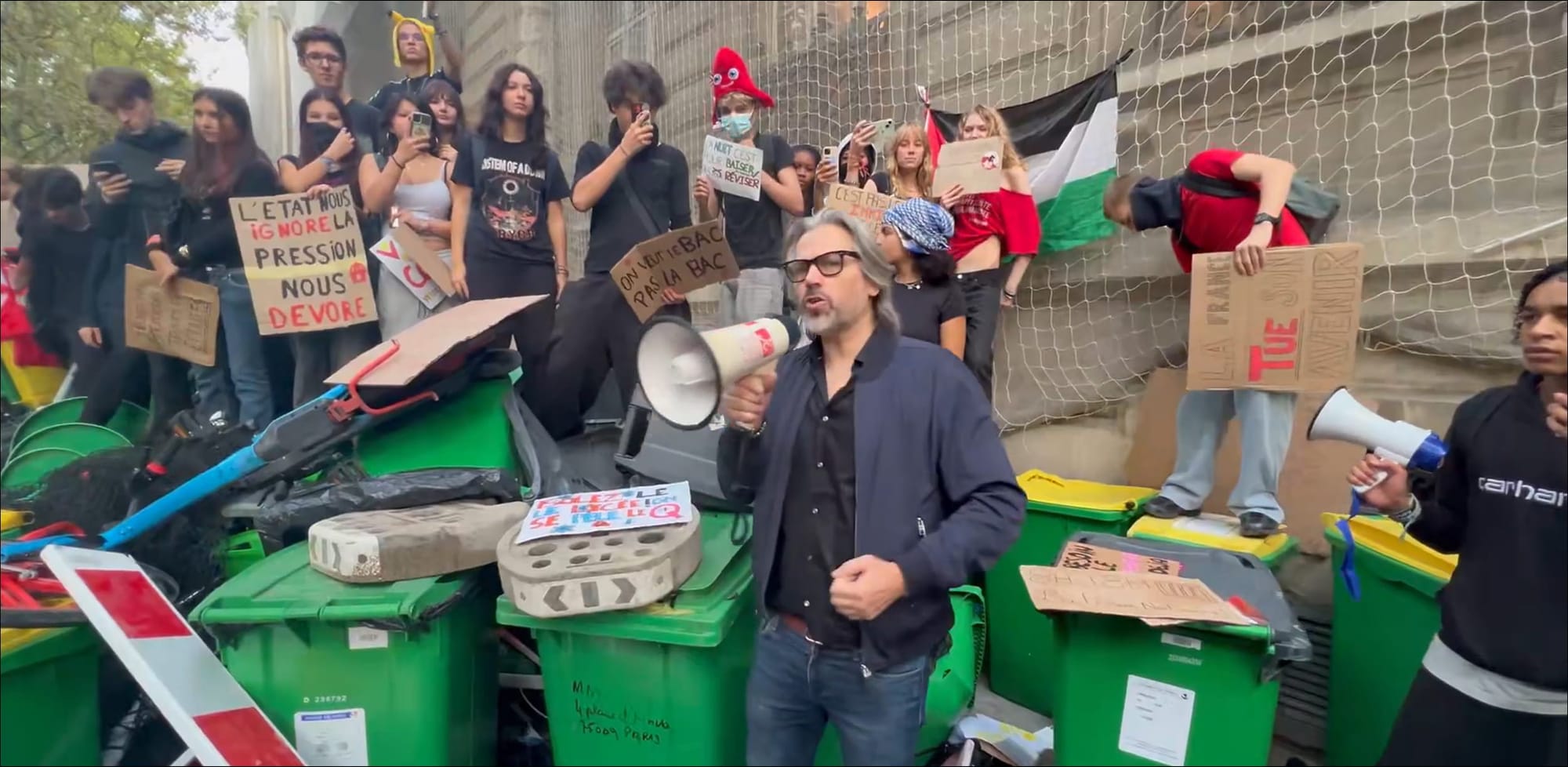
LFI rejects the government’s wider account of the mobilisation and maintains that the party did not launch the lycées movement. The dispute therefore involves three separate questions that should not be conflated: who helped organise and expand the mobilisation, who committed the violent acts accompanying some blockades, and how LFI intends to use the political energy surrounding the movement.
Police conduct is also under investigation. Three inquiries by the police inspectorate, the IGPN, concern injuries sustained by pupils during interventions at Saint-Ouen-l’Aumône, Sevran, and Tours. In the latter case, prosecutors said a pupil’s head injury was compatible with an LBD projectile.
The unrest inevitably carries significance for the 2027 presidential contest because Mélenchon, a far-left candidate, is seeking to mobilise younger voters, and LFI has placed itself visibly alongside the lycées movement. Le Monde has described the tension between LFI’s strategy of political confrontation and Mélenchon’s need to broaden his appeal.
There is currently no verified evidence that Mélenchon and his party planned the current unrest as a rehearsal for violence between the two presidential rounds or following a possible Marine Le Pen victory in 2027. Whether the political mobilisation is causally linked to the violence is a separate, unresolved question, though it remains a working theory.
🔮 WHAT MATTERS NEXT...
🎯 WHAT TO WATCH NEXT:
● Whether the government publishes further detail supporting the intelligence assessment that it has attributed to French services.
● Arrests, prosecutions, and investigations that may establish who organised particular assaults, fires, and attacks on schools or emergency services.
● Decisions on school closures, reopening, and security as authorities assess damage and the risk of further blockades.
● The outcome of IGPN investigations into injuries suffered by pupils during police interventions.
● Whether LFI continues encouraging the mobilisation while maintaining its stated commitment to non-violent methods.
🎯 MOST LIKELY OUTCOME:
● Political and legal scrutiny of both the violence and LFI’s role in the mobilisation is likely to intensify as investigations develop.
🎯 WHAT COULD CHANGE THE PICTURE:
● Publication of intelligence material or judicial evidence directly linking, or failing to link, political organisers to specific acts of violence would materially alter the assessment.
🎯 WHY THIS MATTERS:
● Establishing the difference between political mobilisation, inflammatory rhetoric and responsibility for criminal violence is essential to democratic accountability.

GOING FURTHER
Blocages des lycées : violences, incendies et affrontements, Lecornu accuse LFI et l’ultra gauche | Euronews
Blocage des lycées : « Le mouvement doit être entendu » ; des étudiants manifestent aux côtés des plus jeunes | Le Monde
Présidentielle 2027 : les injonctions contradictoires de Jean-Luc Mélenchon et LFI vis-à-vis du mouvement lycéen | Le Monde
Le blocus des lycées prend de l’ampleur et oppose La France insoumise et le gouvernement | Le Monde
Blocage des lycées : en banlieue parisienne, les élèves veulent se faire entendre sur leur quotidien et « contre l’injustice » | Le Monde
Blocage des lycées : 625 interpellations et 119 blessés depuis le début de la contestation | Euronews
Présidentielle 2027 : Jean-Luc Mélenchon, entre radicalité et besoin de rassembler, rêve d’un duel avec l’extrême droite | Le Monde
Sources:
▪ This piece was first published in Europeans TODAY on 1 October 2026.
▪ Cover: Dreamstime/KORWEN.