From Paris to Lisbon and Milan, cost-of-living protests spread as Britain stands apart
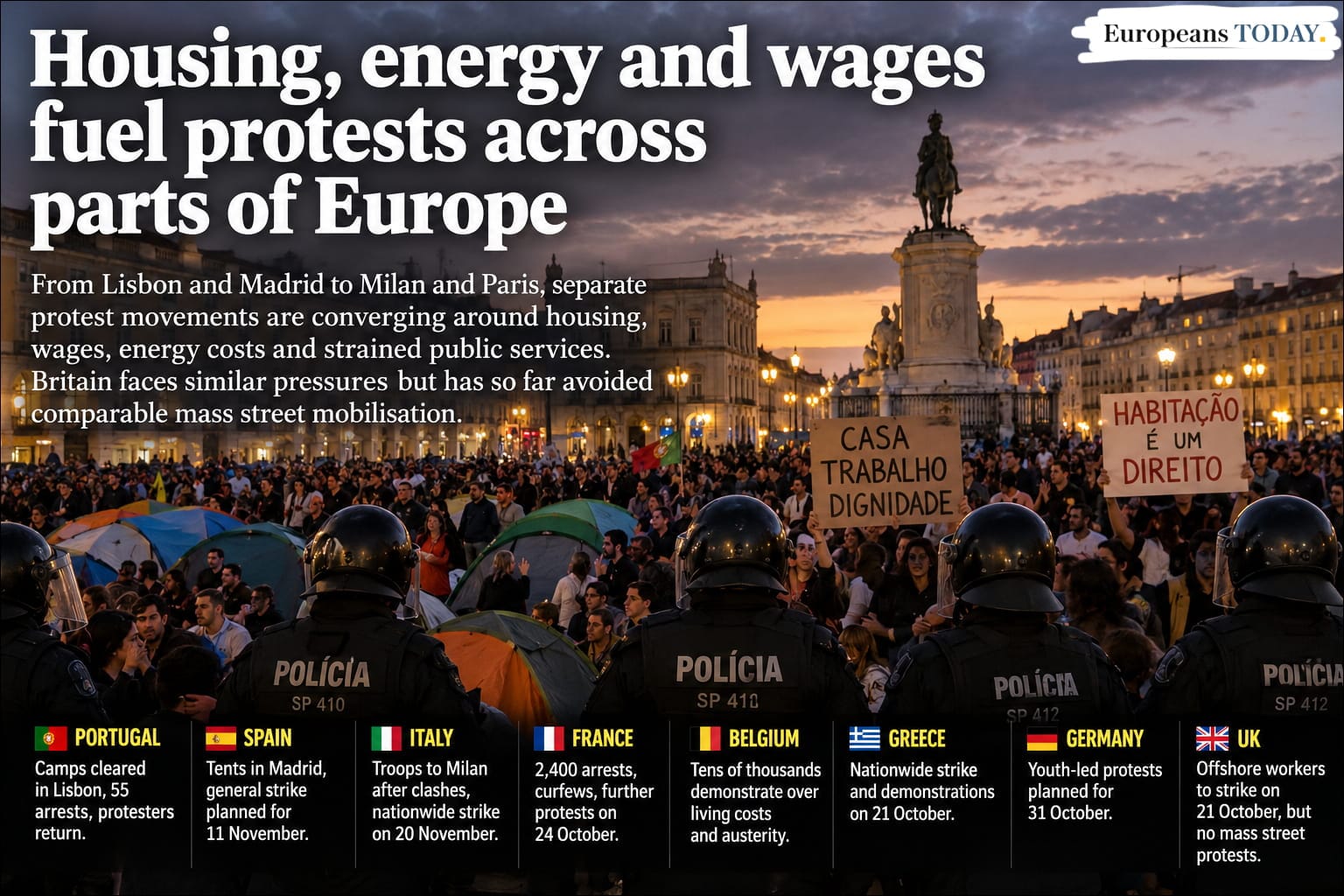
From Lisbon and Madrid to Milan and Paris, separate protest movements are converging around housing, wages, energy costs and strained public services. Britain faces similar pressures but has so far avoided comparable mass street mobilisation.

🔍 WHY THIS STORY MATTERS
Across Europe, separate national disputes over housing, energy, wages and public services are testing governments’ ability to protect living standards, maintain public order and preserve trust without conflating peaceful protest with criminal violence.
KEY TAKEAWAYS...
● Housing affordability has become a central grievance in Portugal and Spain.
● Italy and France face both peaceful mobilisation and serious public disorder.
● Belgium, Greece and potentially Germany broaden the picture beyond the main southern European protests.
● Britain faces similar economic pressures and industrial disputes but has so far avoided comparable mass street mobilisation.
A widening series of demonstrations, occupations and strikes is putting governments across parts of Europe under pressure as households contend with expensive housing, higher energy costs, pressure on wages and strained public services.
The protests do not seem to be one coordinated European movement, and their origins differ substantially. But developments in Portugal, Spain, Italy, France, Belgium and Greece increasingly share an economic backdrop of weakening purchasing power and dissatisfaction with the cost or quality of essential services.
Euro-area inflation rose to 3.8% in September from 3.2% in August, according to Eurostat’s flash estimate cited by Euronews. Energy prices were 18.8% higher than a year earlier, adding to pressures from housing and food costs already weighing on household budgets.
Portugal
Portugal has become one of the clearest examples of housing grievances developing into sustained mobilisation.
Police moved before dawn on Tuesday to dismantle protest camps in Lisbon’s Rossio Square and Porto after demonstrators occupied central public spaces to demand action on housing. Police arrested 55 people in Lisbon during the operation.
The clearance did not end the mobilisation. Thousands returned to Lisbon and other Portuguese cities on Tuesday evening. In Rossio, protesters voted to re-establish their tent camp from Wednesday, only hours after police had removed it.
The housing protests follow broader demonstrations over wages, pensions and public services. Le Monde reported that tens of thousands marched in Lisbon on 17 October, while campaigners in Portugal and Spain are preparing coordinated action on 11 November.
Spain
Spain’s mobilisation also combines the housing crisis with separate disputes over wages and public services.
Hundreds of tents have occupied Madrid’s Puerta del Sol since 26 September as protesters demand measures against rising rents and difficulties accessing housing. The issue has become increasingly important ahead of Spain’s early general election on 29 November.
Trade unions have formally registered a general strike for 11 November centred on the housing crisis and purchasing power. The mobilisation is backed by several national and regional unions, although some organisations have declined to participate and the main employers’ federation, CEOE, has said it intends to challenge the strike in court.
Madrid is simultaneously facing an indefinite teachers’ strike that began on 14 October. Teachers are demanding fewer classroom hours, smaller classes, improved salaries, better infrastructure and reduced bureaucracy. Spain’s government delegation in Madrid has opened an investigation into police intervention during one of the demonstrations after protesters reported injuries.
Italy
Italy is confronting a different combination of economic protest, labour action and serious public disorder.
Demonstrations over rising prices and economic conditions have been accompanied by clashes, vandalism and looting in Milan and several other northern cities. The Italian government has announced the deployment of 500 soldiers to Milan and tougher security measures, including stronger penalties linked to violence during demonstrations. Further protests are expected on Saturday.
The economic grievances extend beyond city centres. Lorry drivers in southern Italy have protested against fuel costs, while farmers and fishers have also joined road and motorway blockades in Calabria and Campania. Italy’s largest trade union confederation, CGIL, has called a general strike for 20 November.
France
France remains central to the wider European picture.
Student-led protests over teacher shortages, school conditions and public services developed into broader demonstrations involving anger about living costs. Most protesters demonstrated peacefully, but the movement was followed by extensive rioting, looting and arson involving smaller groups.
Nearly 2,400 people were arrested after the most serious disturbances. Authorities imposed partial curfews in Paris and other cities, while the French government said military personnel would be used during further demonstrations to free police and gendarmes for public-order duties. Another major security deployment is planned for Saturday.
Belgium, Greece, Germany next?
Belgium has experienced its own series of demonstrations over living costs, austerity and education. Tens of thousands joined an earlier mobilisation in Brussels against federal government measures, while subsequent protests in Brussels and Liège were accompanied by clashes with police and arrests.
Greece represents another strand of the unrest. Students from several Athens universities established a tent camp outside parliament on 13 October, with organisers saying they had been influenced by demonstrations elsewhere in Europe. Teachers’ unions, student organisations, administrative workers and parents subsequently called a nationwide strike and demonstrations for 21 October.
Germany is not yet seeing mobilisation on the same scale, but it has become a country to watch. A youth movement organised largely through social media is calling nationwide protests for 31 October. Its demands include better education and healthcare, affordable living conditions, improved prospects for young people and greater political participation.
And what about the UK?
Britain remains a notable contrast.
British households face many of the same pressures involving housing, energy and the wider cost of living, while industrial tensions are increasing. But Britain has so far avoided a nationwide street movement comparable with those in France, Portugal, Spain or Italy.
More than 160 offshore workers employed by Apache are scheduled to begin a 24-hour strike on Wednesday 21 October if last-minute talks through the conciliation service Acas fail. Unite has warned that the action could affect installations connected with the Forties Pipeline System, while Apache says it expects to maintain production. Further offshore industrial action is also planned.
Europe is not experiencing a uniform uprising
Several countries facing high inflation or housing pressures have not seen comparable demonstrations, and the movements already under way involve different participants, political circumstances and immediate grievances.
Nor should peaceful protesters be conflated with the smaller groups responsible for looting or attacks on police. The right to peaceful protest and the prosecution of criminal violence are separate questions, even when both emerge from the same demonstrations.
What is developing instead is a cluster of national movements responding to overlapping pressures. Housing affordability, purchasing power, fuel and energy prices (linked to Donald Trump’s war in the Middle East), education and strained public services repeatedly appear among their grievances. Associated Press and Euronews both describe the unrest as spreading across several European countries while stressing the different national causes behind it.
For governments, the challenge therefore extends beyond restoring public order after violence. It is whether they can address the economic and social concerns sustaining peaceful mobilisation while resisting attempts to exploit disorder politically or misrepresent who is responsible for it.
For now, Britain remains outside the main street-protest wave. But from Lisbon and Madrid to Milan, Brussels, Athens and Paris, the repeated appearance of housing, wages, energy and public services in protesters’ demands suggests that social pressure is no longer confined to one country or one political crisis.
Trump and Russia
The violence has also, obviously, generated political misinformation.
US President Donald Trump and Republican allies blamed Muslim migrants for much of the disorder in France and Italy. An Associated Press fact check found no evidence supporting that claim.
French authorities have not identified one ethnic or religious community as responsible, and analysts cited by AP said opportunistic criminality accounted for much of the violence.
The riots have also raised concerns about Russian interference ahead of the 2027 presidential election. Although investigators found little evidence of foreign involvement in organising protests so far, pro-Kremlin outlets rapidly exploited the violence to portray Western decline. French authorities fear such disinformation campaigns could deepen political divisions and undermine democratic confidence.
🔮 WHAT MATTERS NEXT...
🎯 WHAT TO WATCH NEXT:
● Greece has scheduled nationwide strike action and demonstrations for 21 October involving education unions, students, administrative workers and parents.
● More than 160 Apache offshore workers in the UK are scheduled to begin a 24-hour stoppage on 21 October.
● France and Italy are preparing for further demonstrations on 24 October, with both governments strengthening their security responses.
● Germany’s emerging youth movement is calling nationwide demonstrations for 31 October, providing an early test of whether similar grievances can produce larger mobilisation there.
● Spanish and Portuguese campaigners are preparing action for 11 November, while Italy’s CGIL has called a general strike for 20 November.
🎯 MOST LIKELY OUTCOME:
● The protests are likely to remain nationally distinct rather than becoming one coordinated European movement, while shared pressures over housing, energy, wages and public services continue to generate parallel mobilisation.
🎯 WHAT COULD CHANGE THE PICTURE:
● Rapid concessions on housing, wages or energy costs could reduce mobilisation, while serious further violence or disproportionate policing could shift attention towards security, civil liberties and government accountability.
🎯 WHY THIS MATTERS:
● With upcoming elections in many European countries in 2027, governments are being tested on whether they can address economic grievances while protecting peaceful protest and separating legitimate mobilisation from criminal disorder.

GOING FURTHER
Inflation squeeze pushes Europeans onto the streets. Can the EU help? | EURONEWS
Italie, Espagne, Belgique, Portugal : en Europe, la colère sociale gagne du terrain, sur fond de flambée des prix de l’énergie et de crise du logement | LE MONDE
Italy to deploy 500 troops to Milan after days of protests and looting | THE GUARDIAN
Garamendi confirma que CEOE impugnará la huelga general por la vivienda y la cataloga como “electoral” | EL PAÍS
La Delegación del Gobierno en Madrid anuncia otra investigación sobre las cargas policiales contra los profesores | EL PAÍS
FACT FOCUS: Trump and Republicans blame France’s immigrants for riots without evidence | ASSOCIATED PRESS
Proteste, Gewalt, Ausgangssperren: Warum Europas Jugend rebelliert | DW
North Sea strikes could severely disrupt UK fuel supplies, union warns | THE GUARDIAN
[ Europeans TODAY ]