American liberators of Nazi camps got ‘a lifelong vaccine against extremism’ − their wartime experiences are a warning for today
80 years after Mauthausen’s liberation, Spanish antifascists and American soldiers remain united by a stark warning: the horrors of fascism are not history but a resurging threat to democracy today.

What you need to know
🔹 Mauthausen’s liberation revealed Nazi horrors, shocking the young American liberators deeply.
🔹 Survivors documented crimes using Nazi tools, aiding justice at postwar trials.
🔹 Veterans’ lifelong memories became warnings against authoritarianism and modern extremism.
W hen American soldiers liberated the Mauthausen Nazi concentration camp in Austria 80 years ago this May, Spanish prisoners welcomed them with a message of antifascist solidarity.
The Spaniards hung a banner made from stolen bed sheets over one of Mauthausen’s gates. In English, Spanish, and Russian, it read: “The Spanish Antifascists Greet the Liberating Forces.”
Both American servicemen and Spanish survivors remember the camp’s liberation as a win in their shared fight against extremism, my research on the Spanish prisoners in Mauthausen finds. They all understood the authoritarian governments of Nazi Germany, Italy and Spain as fascist regimes that used extremist views rooted in intolerance and nationalism to persecute millions of people and imperil democracy across Europe.
World War II, the Holocaust and the horrors of Nazi violence have no modern equivalent. Nevertheless, extremism is now threatening democracy in the United States in recognizable ways.
As the Trump administration executes summary deportations, works to suppress dissent, fundamentally restructures the federal government and defies judges, experts warn that the country is turning toward authoritarianism.
As a scholar of the Mauthausen camp, I believe that understanding how American soldiers and Spanish prisoners experienced its liberation offers a valuable lesson on the real and present dangers of extremism.
We knew then why we had to stop Hitler.
In 1938, the Nazis established Mauthausen, a forced labor camp in Austria, with an international prisoner population. My research shows that the Nazis murdered 16,000 Jews and 66,000 non-Jewish prisoners at Mauthausen between 1938 and 1945, including 60% of the roughly 7,200 Spaniards imprisoned there.
The Spanish prisoners were committed antifascist resistors sent there in 1940 and 1941. Known as Republicans or Loyalists, they had fought against Francisco Franco in the Spanish Civil War and Adolf Hitler in World War II.
The young men with the 11th Armored Division of the U.S. Army who liberated Mauthausen would never forget the moment they discovered the camp. It was May 5, 1945, just days before the war ended in Europe. A platoon led by Staff Sgt. Albert J. Kosiek was repairing bridges in this tucked-away corner of Austria when a Swiss Red Cross delegate alerted them to a large Nazi concentration camp nearby.
Mauthausen’s international survivors were among the Nazis’ last prisoners to be freed.
George Sherman was a 19-year-old tank gunner from Brooklyn when his patrol found Mauthausen. He was Jewish and had read about the Nazi camps in Europe in the Army’s newspaper.
Still, seeing a concentration camp with his own eyes was alarming.
“The piles of bodies” struck him, he remembered in an oral history recorded for the University of South Florida in 2008. So did “these people walking around like God knows – skeletons and whatnot.”
Sgt. Harry Saunders, a 23-year-old radio operator from Chicago, also remembered the moment he saw the Mauthausen survivors. They were men and women of all nationalities.
“The live skeletons, the people that were in the camp, it was indescribable, it was such a shock,” he said in a 2002 interview for the Mauthausen Memorial’s Oral History Collection in Vienna.
One of the Spanish prisoners at Mauthausen, Francesc Boix, had stolen a camera from the SS in the chaotic moments before the camp’s liberation. Boix photographed Sgt. Saunders rumbling into the concentration camp on an armored car.
Saunders kept that photograph for the rest of his life. It captured a moment of clarity for him.
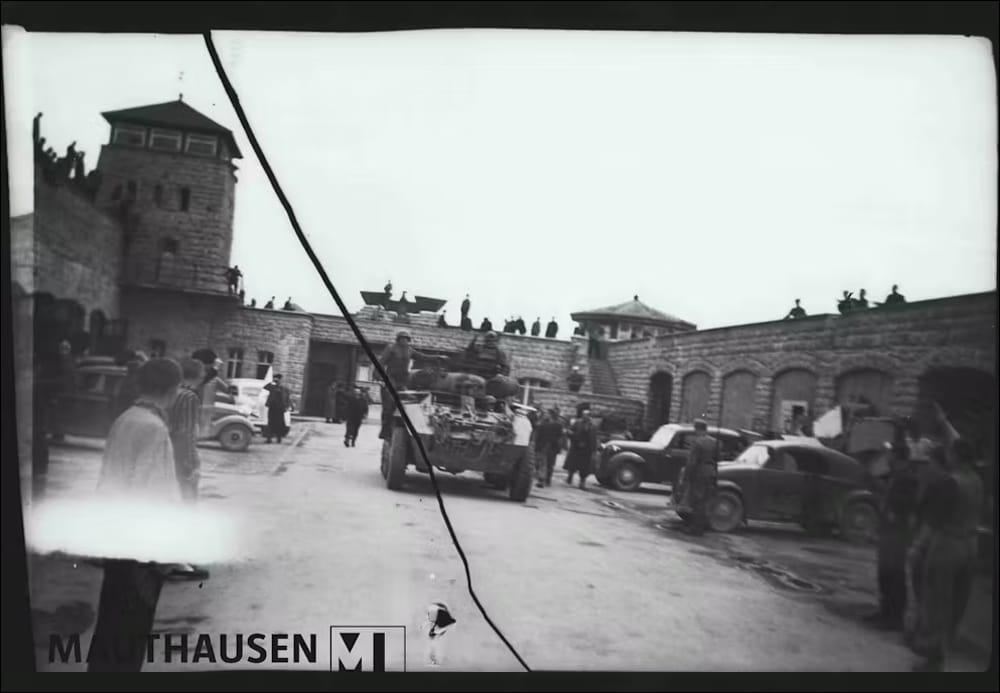
— American liberators rolling into the Mauthausen concentration camp on May 5, 1945, as photographed by prisoner Francesc Boix. Sgt. Harry Saunders is standing on the left fender.
“When we liberated Mauthausen, we really knew then why we had to stop Hitler and why we really went to war,” he said in the interview.
Frank Hartzell, a technical sergeant with the 11th Armored Division, was 20 when he helped to liberate Mauthausen. He turned 100 this year. We met in mid-March 2025 and discussed his wartime experience.
“What I saw and experienced appalled me,” Hartzell told me.
The outrage has stayed with him for 80 years.
Starved and crippled but alive.
The American liberators toured the gas chambers and the crematory ovens in Mauthausen.
Maj. Franklin Lee Clark saw the dead stacked up in “piles like cord wood to the point that they had to bring in bulldozers and make mass graves,” and took photos to document it.
Soldiers from the 11th Armored Division directed locals to bury the men and women murdered by the Nazis. The local Austrians claimed they had not known about their town’s concentration camp. But a farmer who lived nearby had been upset about all the dead bodies visible from her property. She filed a complaint asking the Nazis either to stop “these inhuman deeds” or do them “where one does not see it.”
The American liberators made sure that the townspeople could no longer look away from the murderous rampage carried out in their backyards.
While Boix was taking photos of American soldiers during liberation, the soldiers were taking photos of the welcome banner the Spaniards had painted.
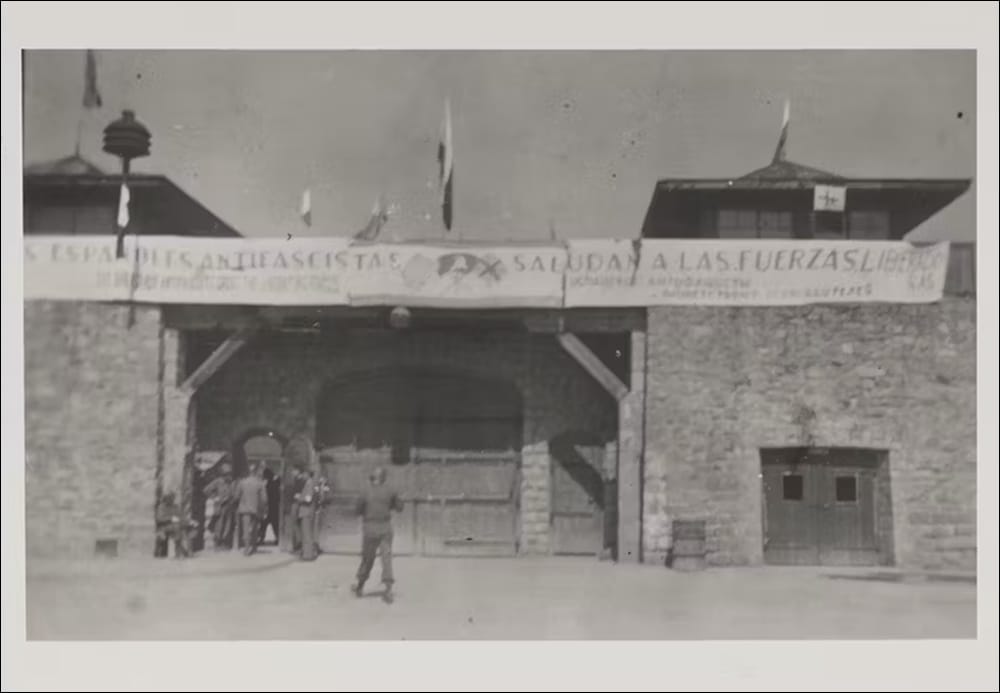
— The Spanish banner hanging on the Mauthausen prison gate, May 1945.
On the back of one snapshot, a Signal Corps soldier typed out his impressions of their message: “I really know what that word (antifascist) means. We liberated these prisoners in the Mauthausen concentration camp near Linz, Austria. They were Poles, Hungarians and Spanish Loyalists (remember the Loyalists?). They had men and women in this camp. Starved and crippled but alive.”
After Mauthausen was liberated, the freed Loyalists set to work documenting the Nazis’ crimes. Along with his countrymen Joan de Diego, Casimir Climent and others, Spanish survivor Joaquín López Raimundo compiled lists of Mauthausen victims and their Nazi captors. Using the Nazis’ own typewriters, they spent two weeks listing the names and personal details of Spanish victims of Mauthausen and of the SS who had killed them.
The result was page after page of evidence they handed over to American war crimes investigators and the International Red Cross.
Boix, meanwhile, gave the Americans hundreds of photo negatives he had rescued from the camp’s photography lab.
Boix later testified about these images in the war crime trials at Nuremberg and Dachau. He described seeing the Nazis beat, torture and murder their victims in Mauthausen and then photograph the bodies. For 2½ years, Boix stole the photographic evidence of their crimes.
He “could not keep those negatives because it was so dangerous,” he testified at Dachau, so he “hid them in various places until the liberation.”
— Testimony in the Nuremberg war crime trials. Francesc Boix’s testimony begins at 7:44.
A lifelong vaccine against extremism
For the American liberators, their up-close view of the horrors of Mauthausen and their interactions with the Spanish antifascist survivors were a lifelong vaccine against extremism.
They witnessed how a fascist leader tore the world apart. They saw with their own eyes the death and destruction of political extremism.
When I interviewed Hartzell, he expressed concern that the United States is going down a dangerous path.
“The USA today is not the USA I fought and came close to dying for,” Hartzell told me.
As American Mauthausen liberator Maj. George E. King warned an interviewer in 1980: “This is the lesson we have to learn: It could happen here.”

Sources:
▪ This piece was originally published in The Conversation and re-published in Europeans TODAY on 5 May 2025. | The author writes in a personal capacity.
▪ Cover: National Archives and Records. - Cpl. Donald R. Ornitz, US Signal Corps/Administration, III-SC-206395. (Licensed under a Creative Commons Attribution-ShareAlike 4.0 International License.)