Small boat crossings are down. Why do so many Britons think they are up?
Small-boat crossings are falling, yet millions believe the opposite. From Brexit to Trump, Farage, Musk and algorithmic social media, emotionally powerful political messages can reinforce perceptions that diverge sharply from measurable reality.

🔍 WHY THIS STORY MATTERS
Voters are entitled to disagree over immigration policy. But democratic choices become more vulnerable when emotionally powerful narratives persuade large numbers of people that measurable events are moving in the opposite direction.
KEY TAKEAWAYS...
● Small-boat crossings are down 43%, yet 40% of Britons believe they have increased.
● Brexit showed how slogans, migration imagery and disputed claims can make complex political questions emotionally immediate.
● Farage, Trump and Musk demonstrate different ways politicians and influential figures can amplify migration as threat, disorder or “invasion”.
● Research on repetition and algorithmic feeds shows that the information people repeatedly encounter can affect what feels credible and politically important.
B ritain’s small-boat debate presents a striking problem for democracy.
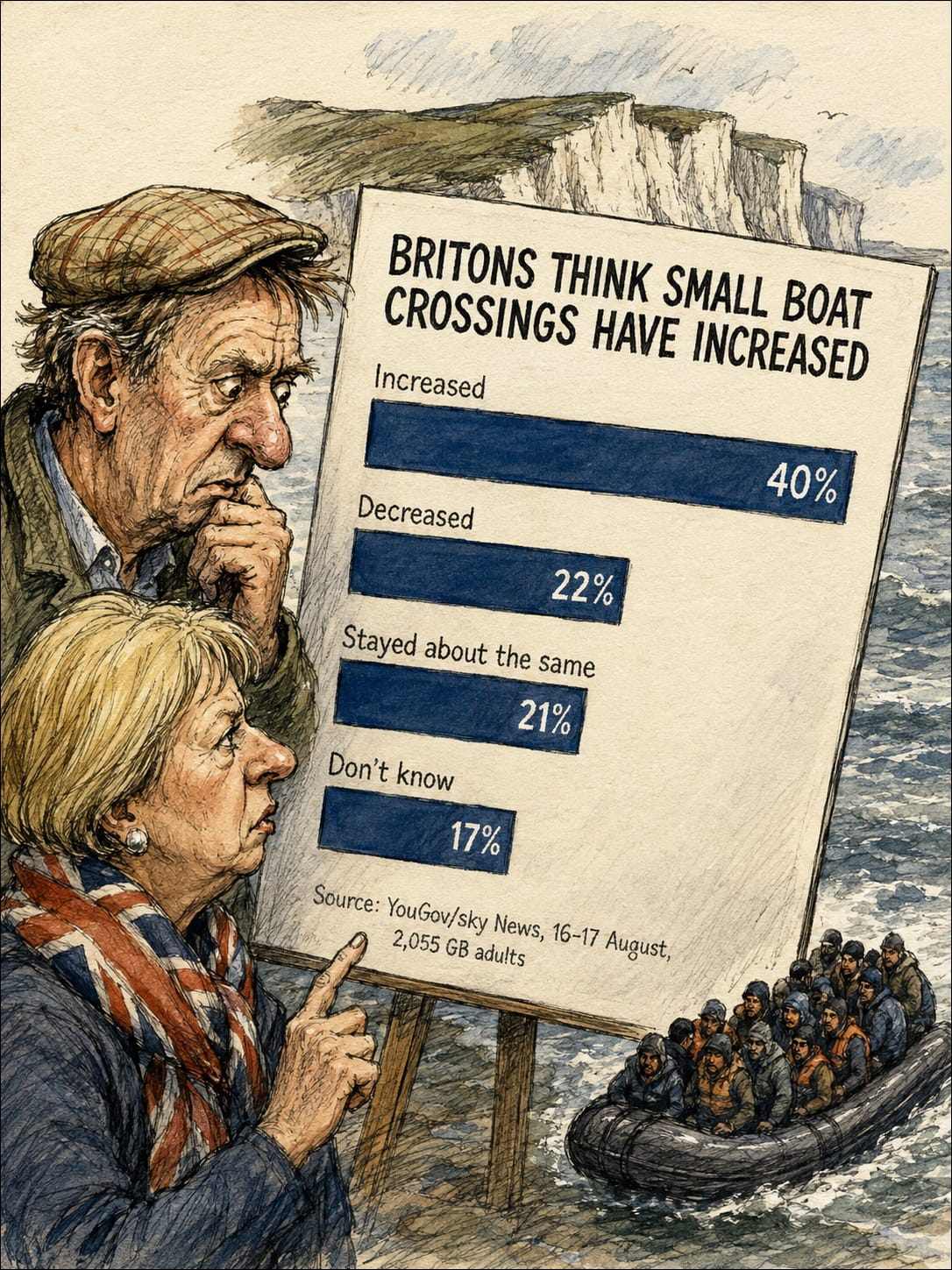
A YouGov poll for Sky News found that 40% of Britons believe small-boat crossings have increased this year. Among Reform UK supporters, the figure was 70%; among Conservative supporters, 56%.
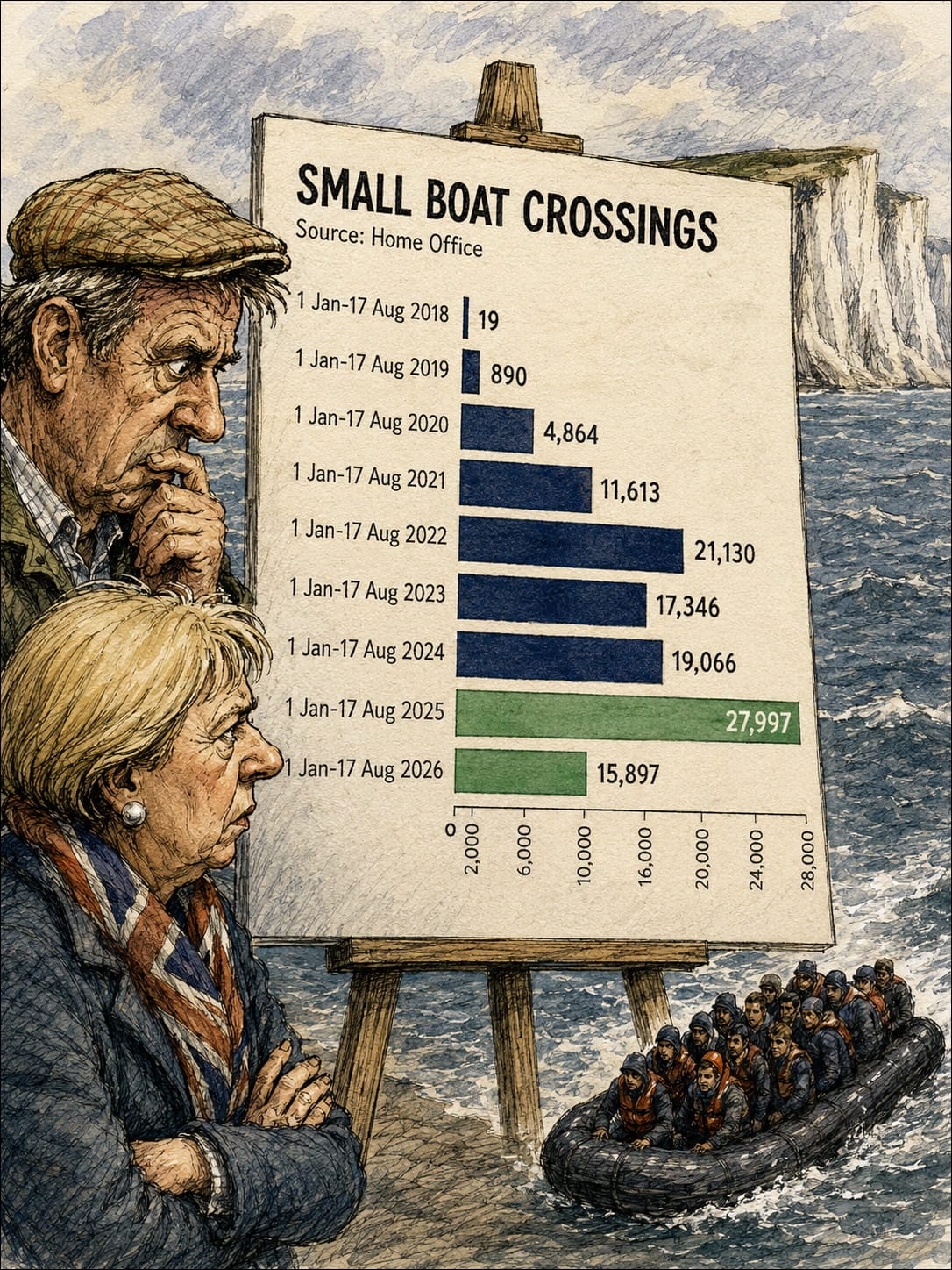
Yet Home Office figures show crossings at their lowest comparable level since 2021. By 17 August, 15,897 people had crossed the Channel in small boats this year, 43% fewer than at the same point last year.
That does not settle the political argument. A voter can look at 15,897 crossings and conclude the number is still too high. But saying crossings have increased is different. That is a factual claim, and the figures show the opposite.
People do not experience politics through spreadsheets. They experience it through headlines, television pictures, politicians, repeated phrases and videos on their phones. A boat arriving on a beach is visible. A 43% annual decline is an abstraction.
Britain has seen this before. During the 2016 EU referendum, immigration dominated many front pages, especially in pro-Brexit newspapers. Vote Leave’s red bus carried the disputed claim that Britain sent the EU £350 million a week and suggested the money could instead fund the NHS. Nigel Farage, campaigning separately, unveiled the “Breaking Point” poster showing refugees at the Croatia-Slovenia border.
Arron Banks, the principal funder of Leave.EU, later described the campaign philosophy starkly: “Facts don’t work... You have got to connect with people emotionally. It’s the Trump success.”
Emotion itself is not the problem. Every campaign appeals to fear, hope, identity or belonging. The democratic problem begins when emotion depends on a false, misleading or disproportionate picture of reality.
Populist politicians exploiting fears
Farage has continued to make migration visually immediate. During the rise in Channel crossings in 2020, he repeatedly travelled to Dover and the Kent coast, watched for migrant boats, and produced social media material. He later recalled going out specifically “to film the migrant boats crossing”. The images were real. But visual immediacy is not statistical prevalence.
The same applies to language. Farage has described irregular migration as an “invasion”. Donald Trump has repeatedly used the same word for migration into the United States, while building campaigns around “Build the Wall” and claims involving migrant criminals and people supposedly released from prisons or mental institutions.
In 2026, Trump seized on dramatic images from Ceuta, in Spain, described the crossings as an invasion and said the episode would become a midterm “talking point”. He warned that something similar would happen in the US if Republicans lost power. His estimate of “hundreds of thousands” entering Ceuta was far above contemporary reports of about 60,000.
The technique is familiar: select alarming images, attach the vocabulary of war and criminality, warn that the same danger is coming, then present the election as the means of preventing it.
Social media intensifies the effect
Elon Musk is not only a political participant, but also the owner of X. A Sky News investigation created nine British test accounts and found that politically neutral users were shown about twice as much right-wing political material as left-wing material on X.
Another experiment, reported by The Guardian, altered the X feeds of more than 1,000 Americans during the 2024 presidential election. After one week, users shown more divisive material reported greater hostility towards opposing-party supporters. Those shown less became less hostile. It did not prove algorithms changed votes, but it showed that changing the information environment could change political feelings.
Repetition matters too. Psychologists describe an “illusory truth effect”, in which repeated claims can become more believable because they have become familiar. A message can begin with a politician, become a headline, be discussed on television and return through social media. Familiarity can start to resemble confirmation.
Falsehood is only part of the problem. Distortion can be created from facts. A genuine crime can be repeated until it seems typical. A real border crossing can be described as an invasion. A true image can dominate coverage while the wider trend receives little attention.
Artificial intelligence adds another layer. During the 2024 US campaign, the false claim that Haitian migrants in Springfield, Ohio, were eating pets was accompanied online by AI-generated imagery documented by the Associated Press. Trump repeated the allegation during a televised debate, even after the claim was debunked.
Musk has also shared fabricated journalism, including a fake Daily Telegraph article claiming rioters could be sent to detention camps in the Falklands. The Telegraph confirmed that no such article existed.
None of this means media or algorithms mechanically control votes. People often choose media that reflects beliefs they already hold. But voters cast ballots according to the world they think they inhabit.
That is why the small-boats statistic matters. Crossings were down 43%, yet 40% believed they were up.
Democracy can survive fierce disagreement about what the facts mean. It is in greater difficulty when large numbers of citizens no longer agree on what the facts are.
🔮 WHAT MATTERS NEXT...
🎯 WHAT TO WATCH NEXT:
● Whether the sharp year-on-year fall in Channel crossings continues, and whether public perceptions begin to move with the figures.
● How Reform UK and other British parties frame migration as they compete for voters concerned about borders and asylum.
● How Donald Trump uses immigration, Ceuta and “invasion” rhetoric as the US approaches the 2026 midterm elections.
● Whether scrutiny of X and other recommendation systems produces greater transparency over the political material algorithms amplify.
🎯 MOST LIKELY OUTCOME:
● Immigration will remain politically powerful even if crossings continue below last year’s level, because public salience and perception can lag behind changing statistics.
🎯 WHAT COULD CHANGE THE PICTURE:
● A renewed rise in crossings, a major policy change or stronger evidence about how media exposure affects political behaviour could materially alter the argument.
🎯 WHY THIS MATTERS:
● Democratic disagreement is healthy, but it becomes more dangerous when voters are making choices from fundamentally different understandings of measurable reality.

GOING FURTHER
Nearly half of Brits are wrong about number of small boats, poll shows | SKY NEWS
How technology disrupted the truth | THE GUARDIAN
In Kent, the ‘silent Reform voter’ may give Nigel Farage his greatest victory | THE GUARDIAN
How misinformation and hardened immigration policy turned Ceuta into Europe’s latest flashpoint | THE GUARDIAN
How the world’s richest man is boosting the British right | SKY NEWS
Small changes to X feeds can rapidly increase political polarisation | THE GUARDIAN
AI is helping shape the 2024 presidential race | ASSOCIATED PRESS
Elon Musk shares fake news about England rioters being sent to Falklands | THE GUARDIAN
[ Europeans TODAY ]