Tesco sets stricter conditions for food additive use amid consumer concerns
Britain’s largest supermarket is joining a wider retailer-led move towards simpler ingredient lists, while France shows that supermarket additive policies can go considerably further in transparency and duration.

🔍 WHY THIS STORY MATTERS
Major European supermarkets are increasingly setting their own ingredient standards ahead of regulation, giving retailers growing influence over what goes into food and how consumers understand ultra-processed products.
KEY TAKEAWAYS...
● In the UK, Tesco says 114 additives are now banned or restricted across its own-brand ranges, up from 65.
● France’s Coopérative U separately says it had excluded 114 additives from about 5,000 own-brand food products by the end of 2025.
● M&S and Ocado are also responding to UK demand for shorter, more recognisable ingredient lists.
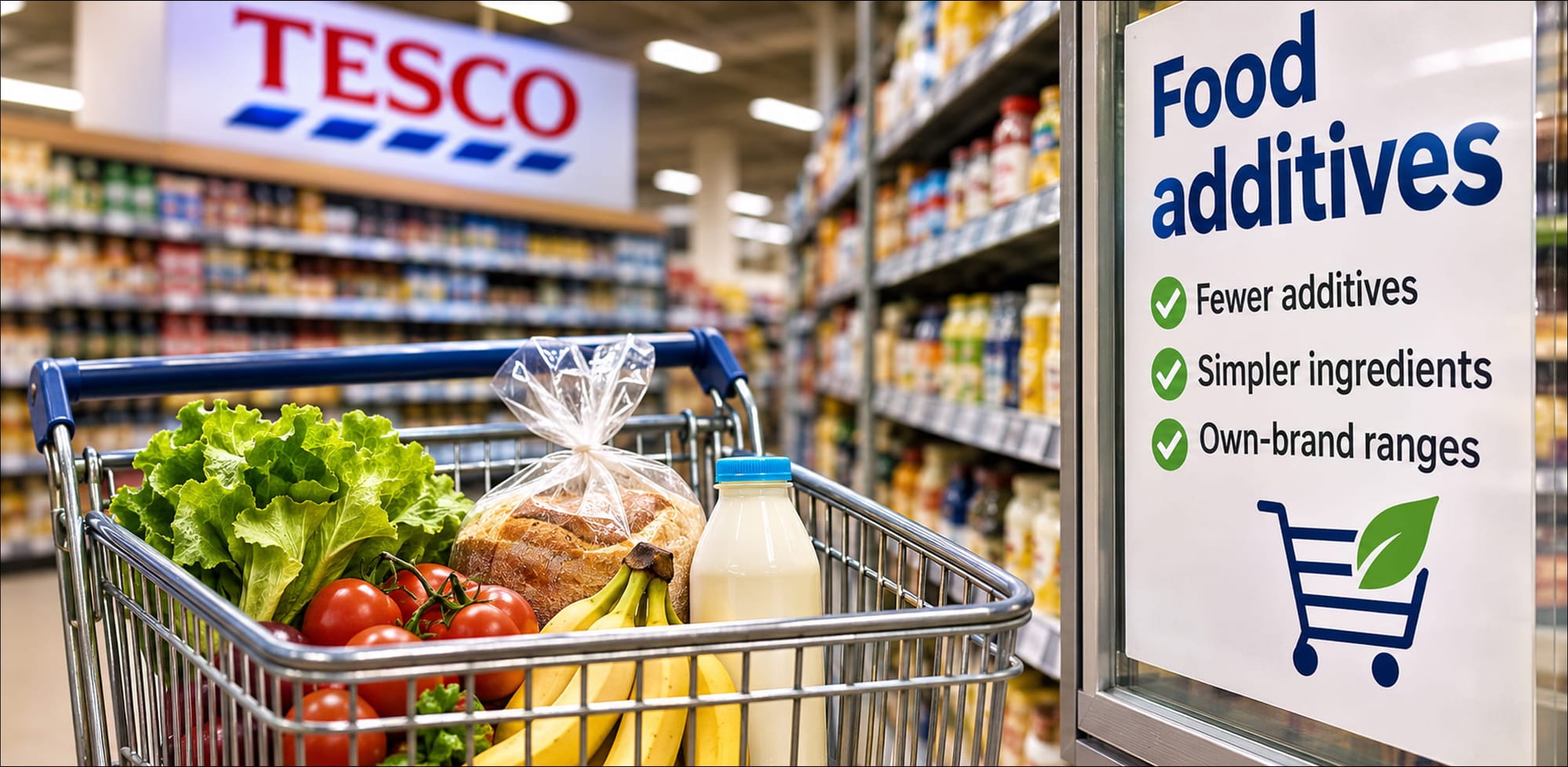
T esco has expanded restrictions on additives in its own-brand food as Britain’s largest supermarket responds to growing customer concern about ultra-processed products and demand for simpler ingredient lists.
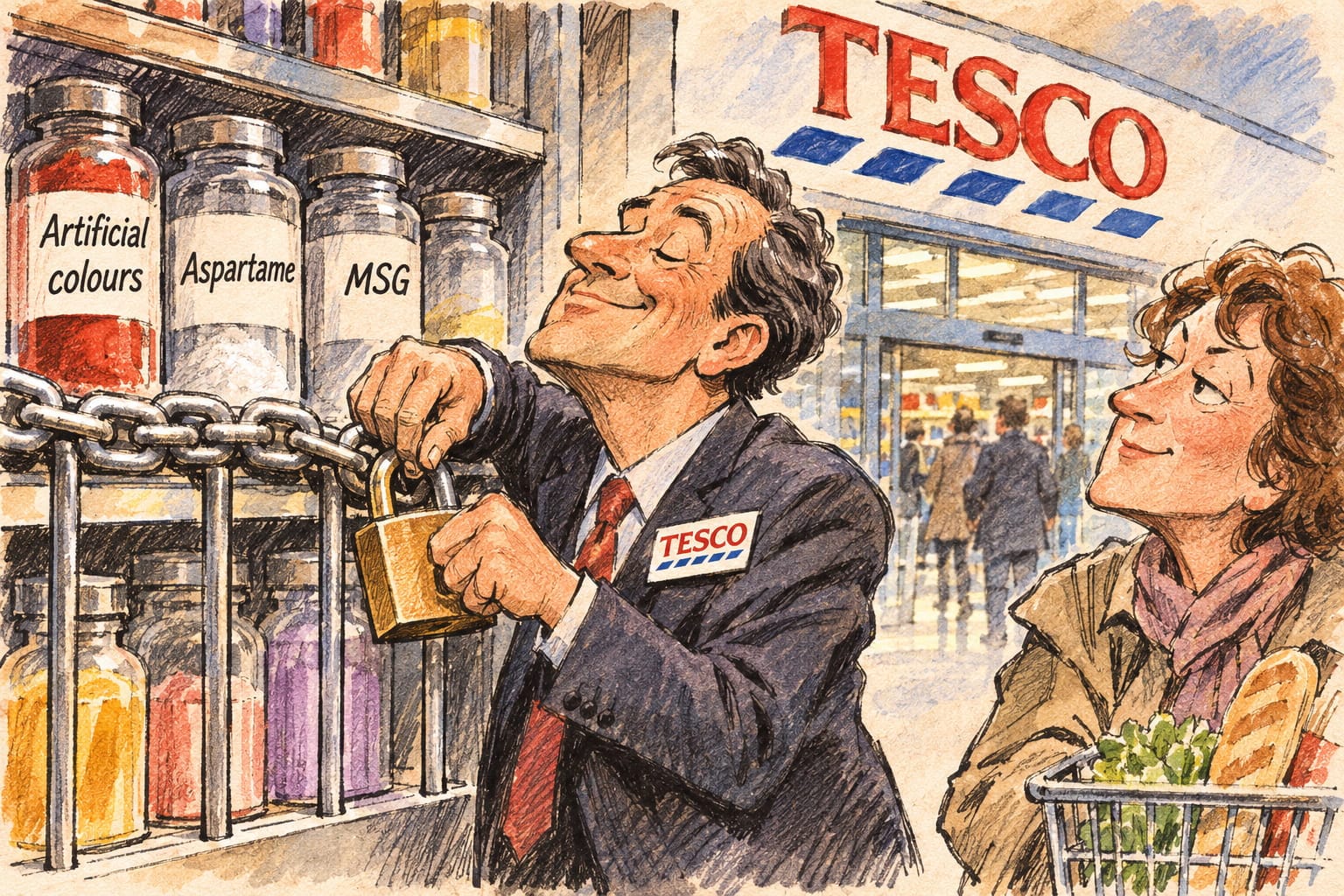
The company says 114 additives are now either banned or restricted across its own-brand ranges, up from 65 a year earlier. Artificial colours, aspartame and monosodium glutamate are among those banned, while other additives are subject to restrictions.
Tesco says additives should be used only where necessary for food safety, shelf life or product quality, and in the minimum quantity required. It has also introduced an online shopping filter intended to help customers find products without additives.
But Tesco is part of a wider shift among European retailers rather than an isolated case.
In France, Coopérative U, whose network includes Super U and Hyper U, says it has been removing substances it classifies as controversial from its own-brand products since 2012. By the end of 2025, U said it had excluded 114 additives from around 5,000 own-brand food products.
There is an important difference in transparency, though. Coopérative U publicly describes a methodology that considers scientific and regulatory alerts alongside wider consumer and societal concerns, and says substances identified as controversial can be removed, substituted or limited where viable alternatives exist. Tesco has not published its complete list of 114 additives, specified how many are banned rather than restricted, or provided a public timetable for completing reformulation.
France has seen similar initiatives before. In 2019, Intermarché announced plans to remove 140 additives and reformulate hundreds of own-brand products, illustrating how French retailers have used additive reduction as a competitive issue for several years.
The trend is increasingly visible in Britain too. M&S has expanded its Only Ingredients range, built around short ingredient lists. In October, Ocado launched a Simple Ingredients online aisle containing more than 350 products screened to exclude artificial additives including colours, emulsifiers, stabilisers and flavours.
However, supermarket restrictions should not be confused with regulatory findings that the ingredients concerned are unsafe.
In October, The Grocer reported analysis by food-rating app Yuka which found that 1,282 of 4,196 Tesco own-label products examined contained at least one additive Yuka categorises as “high-risk”. That description is Yuka’s assessment, not a UK regulatory classification.
Tesco also told The Grocer that reformulating products can take several years rather than months.
Scientific debate over ultra-processed food remains unsettled. Research has associated diets high in UPFs with poorer health outcomes, but the UK’s Scientific Advisory Committee on Nutrition has highlighted limitations in the evidence and has not recommended UPF-specific regulation.
The emerging picture is therefore less a coordinated European crackdown than a retailer-led experiment. Tesco, U, M&S, Ocado and others are taking different approaches to growing consumer demand for simpler food while regulators continue to assess what processing itself means for health.
For Tesco, the test is now transparency. France shows that retailers can explain more about how their exclusion policies work. British shoppers still do not have Tesco’s complete list or a timetable showing how quickly its promises will change what they find on shelves.
🔮 WHAT MATTERS NEXT...
🎯 WHAT TO WATCH NEXT:
● Whether Tesco publishes its complete list and clearly distinguishes additives that are banned from those merely restricted.
● Whether Sainsbury’s, Asda, Morrisons or other large UK grocers adopt comparable range-wide policies.
● Whether European retailers increasingly publish exclusion lists or ingredient standards for their private-label ranges.
● Whether stronger scientific evidence leads UK or European authorities to change official guidance on ultra-processed food.
🎯 MOST LIKELY OUTCOME:
● Retailer-led reformulation is likely to continue incrementally, but different supermarket definitions and exclusion criteria will make direct comparisons difficult without greater disclosure.
🎯 WHAT COULD CHANGE THE PICTURE:
● New scientific evidence establishing whether health risks associated with UPF consumption result from processing itself, particular additives, nutritional composition or a combination of factors could substantially change both regulation and supermarket policies.
🎯 WHY THIS MATTERS:
● When supermarkets set standards beyond legal requirements, transparency becomes essential so consumers can distinguish measurable reformulation from marketing claims.

GOING FURTHER
Tesco Sustainability Report 2026 | TESCO PLC
Tesco bans 114 ingredients in ultra processed food clampdown | THE GROCER
Lutter contre les substances controversées | COOPÉRATIVE U
French supermarket chain to remove additives using phone app that rates products | EURONEWS
Ocado claims UK first with ‘Simple Ingredients’ aisle launch | THE GROCER
How M&S ‘Only’ ingredients range blazed a trail for non-UPF brands | THE GROCER
Three in 10 Tesco own-label products contain ‘high-risk’ additives despite crackdown | THE GROCER
Processed foods and health: SACN’s rapid evidence update summary | UK GOVERNMENT
Sources:
▪ This piece was first published in Europeans TODAY on 2 November 2026.
▪ Cover: Dreamstime/KORWEN.