Why the probe into Nigel Farage’s finances didn’t hurt him at the ballot box
Research on political scandals helps explain why Nigel Farage’s financial scrutiny may have had little electoral effect in his Clacton stronghold.

🔍 WHY THIS STORY MATTERS
Nigel Farage’s re-election has not ended scrutiny of his finances. The case tests whether partisan loyalty can insulate a prominent politician from electoral damage while a parliamentary standards investigation remains unresolved.
KEY TAKEAWAYS...
● Nigel Farage retained Clacton despite ongoing financial scrutiny and a standards investigation over a £5 million gift he says did not require declaration.
● Political science research suggests supporters often rationalise misconduct allegations rather than switch allegiance.
● Research on the 2009 expenses scandal found that greater apparent wrongdoing increased voter awareness, while electoral effects were generally small.
N igel Farage is the latest in a long line of politicians to face questions about his financial affairs. Despite this, the Reform UK leader comfortably avoided a binning by his constituents in the Clacton by-election – albeit in the absence of the main parties.
This is perhaps unsurprising. The allegations against Farage include the claim (currently subject to a parliamentary standards investigation), that he should have declared a £5 million gift he received ahead of the 2024 general election. Farage has insisted that he has “done no wrongdoing” and that he “followed the rules”.
But a series of academic studies suggest that people tend to justify the behaviour of politicians they support rather than changing their vote to back someone else.
Only when scandals become too blatant and heavily covered for supporters to rationalise away do politicians tend to lose support. With this in mind, it’s perhaps not surprising that Farage won comfortably on home turf.
The effects of scandals on our political attitudes are difficult to study, in part because scandals are rare events. The fallout from any individual scandal could be specific to the politician involved, the time period in which it occurred, or the detail of the scandal itself. Measuring the “scandalousness” of any one event is quite difficult.
These are some of the problems that my colleague James Tilley and I tackled in a study of the 2009 parliamentary expenses scandal in the UK. Back then, hundreds of MPs were accused of claiming expenses to which they were not entitled. Many were required to repay money, and a small number were convicted of fraud and even jailed.
The advantage of studying this particular scandal is that a large number of MPs were implicated in similar misconduct at the same time. In addition, the extent to which each MP was implicated could be quantified, both in terms of the value of expenses they were asked to repay, and by measuring the press coverage focusing on each MP.
Importantly, the extent to which each MP was implicated was essentially random across constituencies. This meant that we could measure how a broad swathe of people responded to allegations affecting their local MP.
We found that voters were remarkably aware of the extent to which their MP was implicated in the scandal. The greater an MP’s apparent wrongdoing, either in terms of the money involved or the press coverage, the more their constituents noticed. However, while some constituents reduced their support for their MP, these effects were generally quite small and would probably have mattered only in marginal constituencies. This reaffirmed some previous work about the same scandal.
Wider trust issues
Another point we considered is whether scandals not only affect people’s attitudes towards the politician implicated, but whether they also affect people’s wider attitudes towards politics as a whole. As such, a judgement about a particular politician becomes generalised into a wider assessment of the performance of politicians in general.
This could be a cause for concern. Trust in politics is associated with whether people turn out to vote, whether they comply with the law and whether they support democratic forms of government. As such, allegations of financial misconduct by politicians could have implications beyond election results.
However, we found no evidence that the constituents of heavily implicated MPs changed their attitudes toward the wider system, in comparison to those whose MP was less implicated. It doesn’t appear that people tend to generalise the behaviour of their local MP into a wider judgment about the system as a whole.
Of course, there are several caveats when comparing the fallout from the expenses scandal with the claims against Farage. The former implicated many MPs at the same time, and the nature of the allegations was different. Farage is also a much more prominent figure than the typical MP we studied. And at the time of writing, the investigation into the claims against him is yet to conclude.
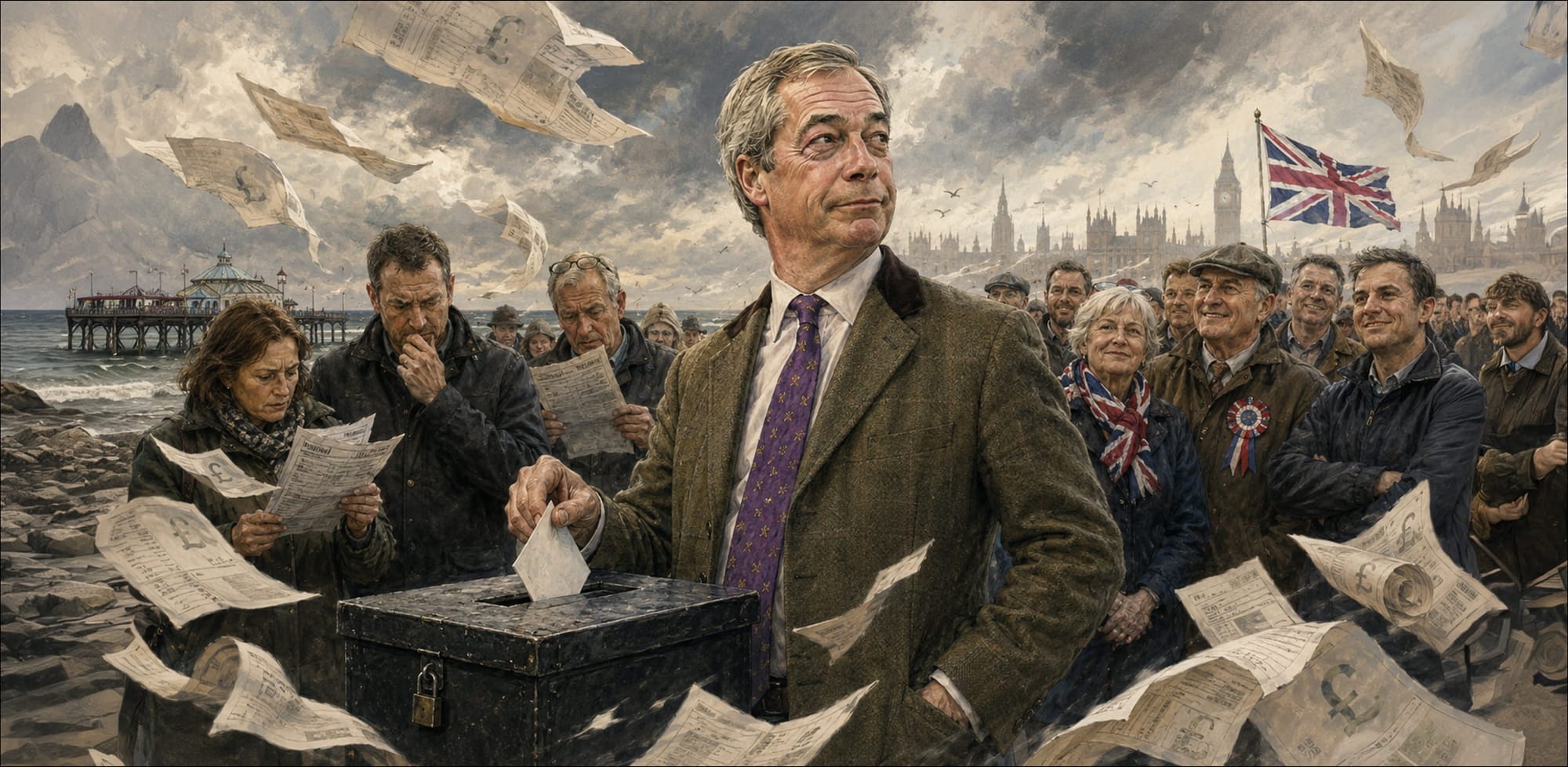
But there are good reasons to expect any change in attitudes among Farage’s constituents to be even weaker in his case. For example, Reform UK voters already tend to have less trust in the system than the average voter. If the claims against Farage are seen to come from that system, his supporters may be even less likely to believe them. Equally, voters with lower levels of trust in politicians generally may be less likely to view the claims against Farage as unusual or particularly deserving of electoral punishment.
When it comes down to it, so far Farage’s experience in Clacton seems to back up the idea that misconduct claims against MPs do not always have substantial effects. That said, with the investigation into the claims against him now resumed, whether this pattern will continue remains to be seen.
🔮 WHAT MATTERS NEXT...
🎯 WHAT TO WATCH NEXT:
● The parliamentary standards investigation is the decisive next test: whether Farage is found to have breached MPs’ registration rules.
● Watch for any new evidence that clarifies whether the £5 million gift was connected to Farage’s political activity or was, as he maintains, purely personal.
● Subsequent constituency and national polling could show whether the controversy produces measurable movement among Reform UK supporters.
● Further financial disclosures involving Farage or Reform UK could increase the cumulative political impact beyond that visible in the Clacton result.
🎯 MOST LIKELY OUTCOME:
● The standards process, rather than the by-election result, is likely to determine whether the controversy produces a concrete political consequence; the vote itself does not resolve the underlying allegations.
🎯 WHAT COULD CHANGE THE PICTURE:
● A substantiated breach finding, significant new financial evidence or clear polling movement among Reform UK voters would materially alter the assessment.
🎯 WHY THIS MATTERS:
● The key test is whether formal accountability or measurable voter movement emerges after an election result that, on its own, cannot settle the questions surrounding Farage’s finances.

GOING FURTHER
Farage claims victory in Clacton: ‘I beat the establishment candidate’ | EUROPEANS TODAY
Five questions over Nigel Farage’s £5 million donation | EUROPEANS TODAY
Standards watchdog resumes Farage probe as rivals slam needless byelection | The Guardian
Nigel Farage asks ‘What is my sin?’ as he mounts staunch defence amid questions over £5m ‘gift’ and benefits in kind | Sky News
Reform UK leader Nigel Farage faces questions over donations from a convicted fraudster | Associated Press
Sources:
▪ This piece was originally published in The Conversation and re-published in Europeans TODAY on 21 August 2026. | The author writes in a personal capacity.
▪ Cover: Dreamstime/KORWEN.